
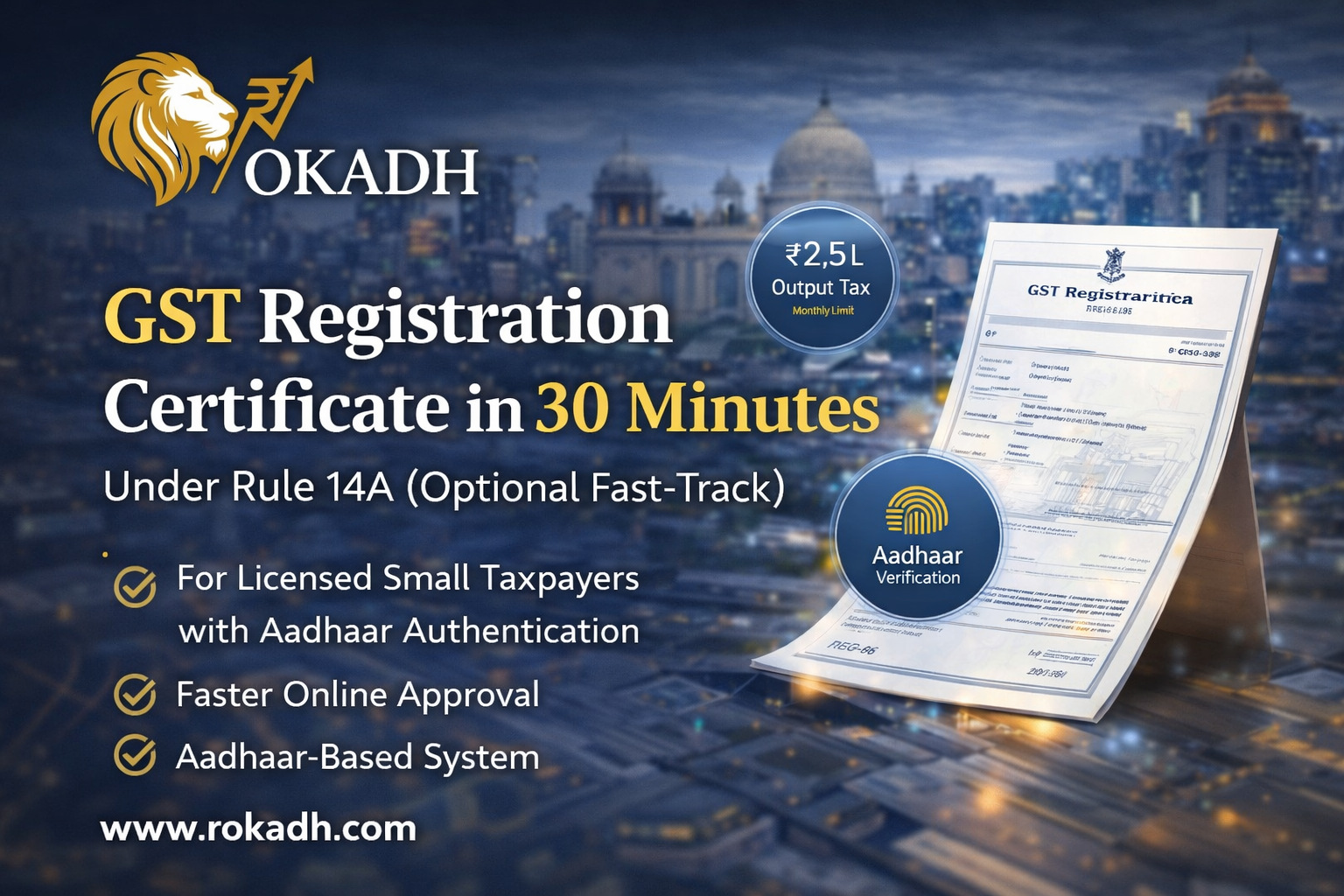
The GST regime in India continues to evolve with a strong focus on ease of doing business, digital governance, and trust-based compliance. One of the most significant recent developments in GST registration is the introduction of Rule 14A, which provides an optional fast-track electronic registration mechanism for eligible taxpayers.
Contrary to popular belief, Rule 14A is not a blanket instant registration provision for everyone. Instead, it is a special option available to a specific category of taxpayers who meet defined conditions—especially those with limited monthly output tax liability and who complete Aadhaar authentication.
This blog explains, in clear and simple language, how GST Registration Certificate issuance under Rule 14A works, who can opt for it, the timelines involved, compliance obligations, and important safeguards built into the law.
1. What Is a GST Registration Certificate?
A GST Registration Certificate (Form GST REG-06) is the legal proof that a person or business is registered under GST law. It authorizes the taxpayer to:
- Collect GST from customers
- Issue GST tax invoices
- Claim input tax credit (ITC)
- File GST returns
- Conduct taxable supplies lawfully
Without a GST Registration Certificate, collecting GST or charging tax is illegal.
2. What Is Rule 14A Under GST?
Rule 14A introduces an optional electronic registration route for certain taxpayers whose monthly output tax liability on supplies made to registered persons does not exceed a specified limit.
Key Objective of Rule 14A:
- Speed up GST registration for small and low-risk taxpayers
- Reduce manual intervention
- Encourage Aadhaar-authenticated registrations
- Promote voluntary compliance
Rule 14A does not replace the normal GST registration process. It provides an additional option for eligible applicants.
3. Who Can Opt for Registration Under Rule 14A?
As per Rule 14A(1), the option is available to:
Any person who has applied for GST registration under Rule 8 and determines that their total monthly output tax liability on supplies made to registered persons (including CGST, SGST/UTGST, IGST, and Compensation Cess) does not exceed ₹2,50,000 per month.
Important Clarifications:
- The limit applies to output tax liability, not turnover
- Supplies considered are supplies made to registered persons
- The limit is monthly, not annual
This provision is designed primarily for small businesses, service providers, and startups operating at a moderate tax liability level.
4. Mandatory Aadhaar Authentication – A Core Requirement
Under Rule 14A(2):
- Any person who does not opt for Aadhaar authentication is not eligible for registration under this rule
- Certain persons notified under Section 25(6D) are excluded
📌 In simple terms:
No Aadhaar authentication = No registration under Rule 14A.
Aadhaar authentication acts as a trust and identity verification mechanism, enabling faster electronic approval.
5. One PAN, One Registration Under Rule 14A
As per Rule 14A(3):
- A person registered under Rule 14A in a State or UT
- Cannot obtain another registration in the same State/UT under this rule against the same PAN
This prevents misuse of the facility by splitting registrations to remain within limits.
6. Timeline for Grant of Registration Under Rule 14A
Under Rule 14A(4):
Upon successful Aadhaar authentication, the applicant shall be granted registration electronically by the common portal within three working days from the date of submission of application.
Key Takeaway:
- Registration is system-driven
- No officer discretion if conditions are fulfilled
- Timeline is clearly defined and legally binding
While many cases may be approved much faster, the statutory timeline is up to three working days, ensuring accuracy and compliance.
7. Why Rule 14A Is Being Referred to as “GST Certificate in 30 Minutes”
In practice, many low-risk applications:
- Complete Aadhaar authentication instantly
- Pass automated validation checks
- Get approved very quickly through the common portal
This has led to the perception of “GST Registration Certificate in 30 minutes”. However, from a legal standpoint:
📌 Rule 14A guarantees electronic registration within three working days, not instant approval for all cases.
The faster approvals are a result of automation and risk-based processing, not an unconditional right.
8. Step-by-Step Process Under Rule 14A
Step 1: File GST Registration Application (REG-01)
Applicant submits registration details electronically under Rule 8.
Step 2: Opt for Registration Under Rule 14A
Applicant confirms eligibility based on monthly output tax liability.
Step 3: Aadhaar Authentication
OTP-based Aadhaar authentication of:
- Proprietor / partners / directors
- Authorized signatory
Step 4: System Validation
Portal validates:
- PAN
- Aadhaar
- Address
- Bank details
- Risk parameters
Step 5: Electronic Grant of Registration
If validations are successful, GST Registration Certificate (REG-06) is issued electronically within prescribed time.
9. What If Aadhaar Authentication or Risk Checks Fail?
In cases flagged by data analysis, the provisions relating to:
- Biometric Aadhaar authentication
- Photograph capture
- Physical verification of documents
may apply, as referenced under Rule 14A(7) read with Rule 8.
This ensures system integrity and fraud prevention.
10. Compliance Responsibility After Registration
Registration under Rule 14A does not reduce GST compliance obligations.
Registered persons must:
- Issue GST-compliant invoices
- File GST returns on time
- Discharge tax liabilities accurately
- Maintain proper records
Exceeding the output tax liability threshold without following due process may attract scrutiny.
11. Option to Withdraw From Rule 14A Registration
A registered person may choose to withdraw from this option by filing FORM GST REG-32, as per Rule 14A(5).
Conditions for Withdrawal:
- Returns must be filed for:
- Minimum 3 months (if application filed before 1 April 2026), or
- Minimum 1 tax period (if filed on or after 1 April 2026)
- All pending returns must be filed
- No cancellation proceedings under Section 29 should be pending
12. Amendment Before Withdrawal Is Mandatory
Under Rule 14A(6):
- Any change in particulars must first be amended under Rule 19
- Only then can the withdrawal application be filed
This ensures data consistency on the GST portal.
13. Verification & Approval of Withdrawal Application
- Withdrawal application is verified under Rule 9
- Officer issues:
- FORM GST REG-33 (approval), or
- FORM GST REG-05 (rejection)
Once approved, the taxpayer can:
- Report output tax liability exceeding ₹2.5 lakh
- From the first day of the succeeding month
14. Restrictions After Withdrawal Approval
As per Rule 14A(12):
- Taxpayer cannot retrospectively amend output tax liability
- Exceeding limits applies only prospectively
This prevents misuse of the option.
15. When Withdrawal Application Can Be Rejected
Under Rule 14A(13):
- If cancellation proceedings are initiated after filing withdrawal
- Withdrawal application will be rejected
- Deemed approval provisions will not apply
16. Key Advantages of Rule 14A for Businesses
✔ Predictable timelines
✔ Reduced manual scrutiny
✔ Faster onboarding
✔ Encourages Aadhaar-based compliance
✔ Suitable for startups & small taxpayers
17. Common Mistakes to Avoid
❌ Miscalculating output tax liability
❌ Not completing Aadhaar authentication
❌ Uploading incorrect documents
❌ Assuming instant approval is guaranteed
❌ Ignoring post-registration compliance
18. How Rokadh Helps Businesses Navigate Rule 14A
At Rokadh, we ensure:
- Correct eligibility assessment under Rule 14A
- Accurate calculation of output tax liability
- Aadhaar-compliant, error-free filings
- Smooth registration or withdrawal process
- Ongoing GST compliance support
Our approach is law-aligned, practical, and risk-aware.
Conclusion: Rule 14A – Faster, But Responsible GST Registration
Rule 14A is a progressive reform that simplifies GST registration for eligible taxpayers while maintaining strong compliance safeguards. It offers speed with accountability, ensuring genuine businesses can start operations quickly without compromising system integrity.
When used correctly, GST Registration Certificate issuance under Rule 14A becomes a powerful facilitation tool for startups, MSMEs, and service providers.
About Rokadh
Rokadh provides end-to-end advisory services in GST, Income Tax, ROC, Trademark, Startup, and NRI compliances, helping businesses stay compliant, confident, and growth-ready.