
Complete Professional Guide on Limited Liability Partnership (LLP) Registration in India by Rokadh Financial Services Private Limited
Modern businesses today require much more than:
- a business idea,
- a shop,
- or a bank account.
Businesses now require:
- legal credibility,
- liability protection,
- compliance structuring,
- taxation planning,
- professional documentation,
- and scalable business identity.
This is exactly why startups, consultants, professionals and growing businesses across:
- Kanpur,
- Lucknow,
- Unnao,
- Ghaziabad,
- Gurgaon,
- Delhi,
- Mumbai,
- and PAN India
- increasingly search:
- Best LLP Registration Consultant,
- LLP Registration Online,
- LLP Incorporation Services,
- Startup Registration Expert,
- LLP vs Private Limited Company,
- Limited Liability Partnership Registration,
- MCA Filing Consultant.
This detailed professional guide by:
Rokadh Financial Services Private Limited
India’s Leading Financial Services Company
explains:
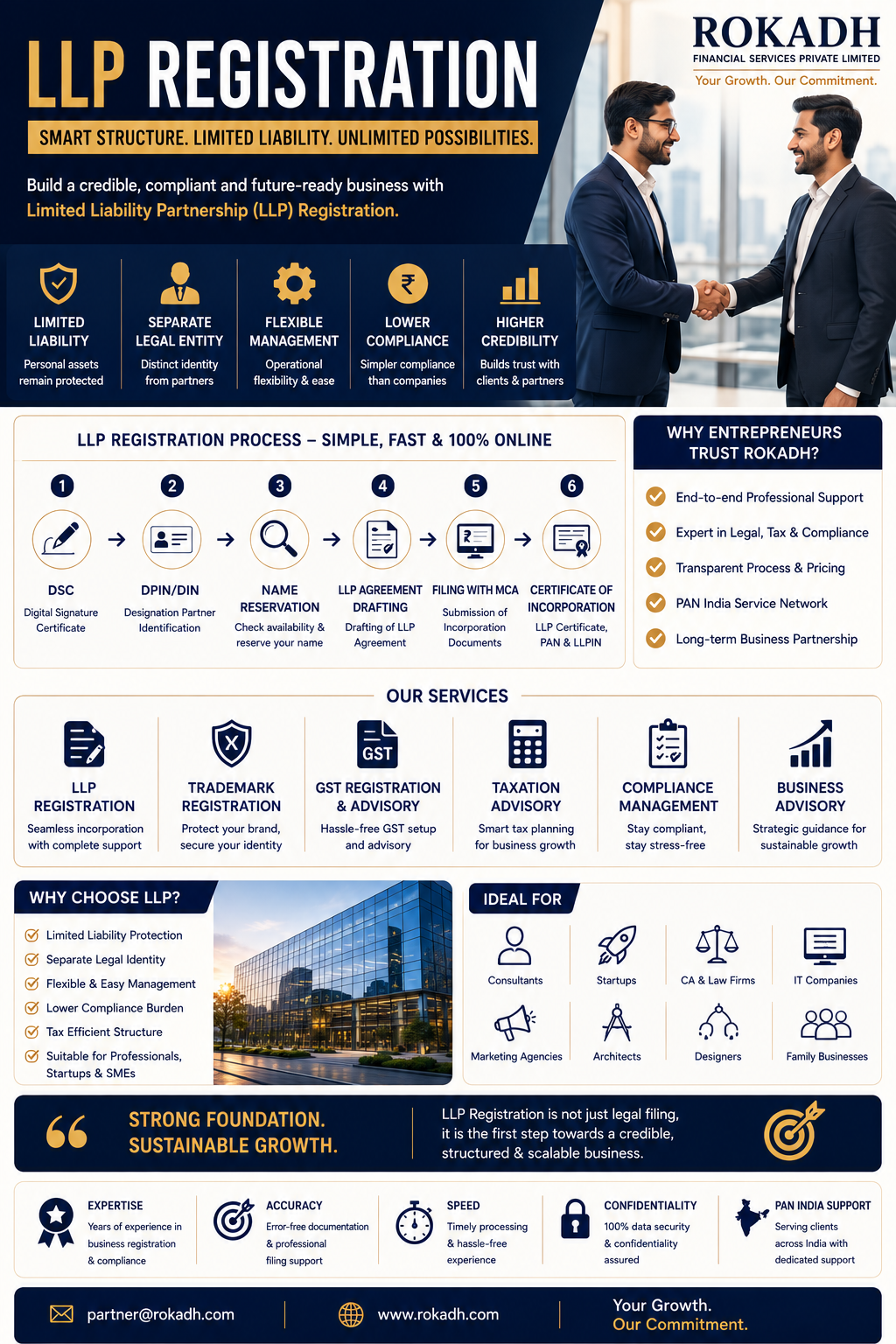
- LLP meaning,
- LLP registration process,
- legal provisions,
- compliance structure,
- taxation implications,
- advantages & disadvantages,
- real case studies,
- common legal mistakes,
- and why professional LLP structuring matters.
What is LLP?
Relevant Provision
Section 2(1)(n) of LLP Act, 2008
“Limited Liability Partnership” means:
- a partnership formed and registered under LLP Act, 2008.
In simple language:
LLP combines:
- flexibility of partnership,
- with:
- benefits of limited liability.
Why LLP Registration Has Become Extremely Popular
Modern entrepreneurs increasingly prefer LLP because:
- compliance is comparatively flexible,
- liability protection exists,
- business credibility improves,
- taxation structure may become efficient,
- and partnership operations become professional.
Major Benefits of LLP Registration
1. Limited Liability Protection
Partners generally enjoy:
- limited liability protection,
- subject to applicable legal conditions.
Personal assets generally remain protected from:
- business liabilities.
2. Separate Legal Entity
LLP has:
- separate legal identity.
This improves:
- professional credibility,
- banking acceptance,
- and operational structuring.
3. Flexible Internal Management
Compared to companies:
- LLP structure often provides operational flexibility.
4. Lower Compliance Burden Compared to Companies
Many startups prefer LLP because:
- compliance management may remain comparatively practical.
5. Better Professional Image
Clients, vendors and institutions often trust:
- registered business structures more than unregistered businesses.
Who Should Consider LLP Registration?
LLP may professionally suit:
- consultants,
- CA firms,
- legal professionals,
- architects,
- agencies,
- startups,
- marketing firms,
- IT companies,
- freelancers,
- family businesses,
- partnership ventures.
Relevant Legal Framework Governing LLP
The primary governing law is:
Limited Liability Partnership Act, 2008
Important provisions include:
- incorporation,
- partner liability,
- compliance,
- financial disclosures,
- and operational governance.
Complete LLP Registration Process in India
Step 1 — Digital Signature Certificate (DSC)
All designated partners generally require:
- Digital Signature Certificate
- for MCA filing.
Step 2 — DPIN / DIN Application
Designated Partner Identification becomes important for:
- authorized LLP operations.
Step 3 — Name Reservation
Relevant Provision
Section 15 of LLP Act, 2008
The proposed LLP name:
- should not resemble existing entities,
- should not violate trademarks,
- and should comply with naming guidelines.
Why Name Search is Extremely Important
Improper name selection may create:
- MCA rejection,
- trademark objection,
- future legal disputes.
This is exactly why professional due diligence by Rokadh Financial Services Private Limited becomes important.
Step 4 — LLP Agreement Drafting
One of the most important legal documents.
The LLP Agreement generally defines:
- rights,
- profit sharing,
- management powers,
- duties,
- operational structure,
- dispute resolution mechanism.
Step 5 — Filing Incorporation Forms with MCA
Registration filing generally includes:
- incorporation forms,
- partner details,
- office proof,
- compliance declarations.
Step 6 — Certificate of Incorporation
Upon approval:
- LLP incorporation certificate,
- PAN,
- and legal registration
- are generally issued.
Why Professional LLP Structuring Matters
Improper structuring may create:
- taxation inefficiency,
- partner disputes,
- legal exposure,
- banking complications,
- compliance penalties.
Real Case Study — Marketing Agency from Gurgaon
Business Profile
- Two co-founders
- Digital marketing agency
- Revenue growing rapidly
Problems Before Consulting Rokadh Financial Services Private Limited
- operating informally,
- weak agreements,
- vendor trust issues,
- taxation confusion.
Strategic Advisory Provided
Professional LLP structure was advised considering:
- operational flexibility,
- partner management,
- scalability,
- compliance practicality.
Result
After LLP registration:
- institutional trust improved,
- client onboarding improved,
- taxation structuring became clearer,
- operational professionalism strengthened significantly.
Real Case Study — IT Consulting Firm from Noida
Business Situation
- three technical founders,
- software consulting operations,
- international clients.
Problems
- no formal legal structure,
- payment processing issues,
- weak contractual credibility.
Professional Resolution
Rokadh Financial Services Private Limited professionally assisted with:
- LLP incorporation,
- GST setup,
- trademark advisory,
- accounting structuring,
- compliance planning.
Comparison: Limited Liability Partnership (LLP) vs. Traditional Partnership
| Basis of Comparison | Limited Liability Partnership (LLP) | Traditional Partnership Firm |
| Legal Status | Separate Legal Entity; registered under the LLP Act, 2008. The firm can hold property and sue or be sued in its own name. | No Separate Legal Entity; established under the Indian Partnership Act, 1932. The firm is merely a collective name for the partners. |
| Liability | Limited Liability; a partner's personal liability is limited to their agreed contribution. One partner is not liable for another's misconduct or negligence. | Unlimited Liability; partners are jointly and severally liable. Personal assets can be attached to recover the firm's debts or legal obligations. |
| Credibility & Trust | Higher Credibility; public records of active status, capital contribution, and annual filings are transparently accessible on the MCA portal. | Moderate Credibility; even if registered with the Registrar of Firms (RoF), data is not centrally accessible, reducing institutional trust. |
| Compliance Load | Structured Compliance; requires mandatory annual filings of Form 8 (Statement of Accounts) and Form 11 (Annual Return), regardless of turnover. | Comparatively Lower; no mandatory annual status filings to the registrar. Compliance is primarily limited to regular tax filings (ITR-5) and GST. |
| Legal Protection | Better Protection; absolute protection of personal wealth from business operational risks and rogue actions of other partners. | Limited Protection; massive personal risk. A mistake or unauthorized debt taken on by a single partner can financially ruin all partners. |
| Scalability | Better Scalability; allows for an unlimited number of partners and structured insertion of new investors or sleeping partners. | Limited Scalability; capped at a maximum of 50 partners. It is legally complex to introduce venture capital or corporate structures. |
Strategic Advisory Note
While a Traditional Partnership is quicker and cheaper to set up (requiring just a notarized or registered partnership deed), the LLP structure is almost always preferred for serious commercial ventures. The unlimited liability clause of a traditional partnership means that commercial litigation can endanger your personal family assets—a risk that an LLP entirely eliminates.
Comparison: Limited Liability Partnership (LLP) vs. Private Limited Company
| Basis of Comparison | Limited Liability Partnership (LLP) | Private Limited Company (Pvt Ltd) |
| Compliance Burden | Comparatively Lower; exempt from statutory audits unless turnover exceeds ₹40 Lakh or contribution exceeds ₹25 Lakh. Fewer routine structural filings. | Higher; statutory audit is mandatory from year one regardless of turnover. Requires strict secretarial filings, board meeting minutes, and explicit compliance tracking. |
| Ownership Flexibility | Partnership-Oriented; ownership and management are integrated. Equity transfers require amending the LLP Agreement with the MCA. | Shareholding-Oriented; ownership is cleanly separated from management. Shares can be smoothly transferred, issued, or split among founders, employees (ESOPs), and investors. |
| Suitable For | Professionals & SMEs; ideal for service providers, consultants, lifestyle businesses, and family-owned firms seeking limited liability with low overheads. | Fundraising Startups; the non-negotiable gold standard for scalable tech ventures, high-growth startups, and anyone targeting venture capital funding. |
| Governance Structure | Flexible; internal governance is customized and driven almost entirely by the clauses drafted inside the mutually signed LLP Agreement. | More Regulated; strictly bound by the rigid framework of the Companies Act, 2013, requiring an formal Board of Directors and shareholder general meetings. |
Strategic Insight for Structuring
- The VC Funding Hardline: Venture Capitalists (VCs) and Institutional Angel Investors will almost never invest in an LLP. They require a Private Limited structure because an LLP cannot cleanly issue shares, create stock option pools (ESOPs) for employees, or separate investor capital from operational partner control.
- Tax Efficiency Nuance: While both entities are taxed at similar base corporate rates, an LLP is often more tax-efficient for profitable, closely-held businesses. This is because LLPs can withdraw profits via partner salary/interest, whereas a Private Limited Company is subject to Dividend Distribution rules when transferring cash back to shareholders.
Important Compliance After LLP Registration
Annual Return Filing
Applicable annual filing compliance generally remains mandatory.
Income Tax Return Filing
LLPs generally require:
- income tax compliance,
- accounting discipline,
- and financial reporting.
GST Compliance
GST applicability depends upon:
- turnover,
- business nature,
- statutory conditions.
Proper Accounting & Documentation
Strong accounting systems help:
- taxation,
- banking,
- compliance,
- scalability.
Why Trademark Registration Should Also Be Considered
Many businesses ignore:
- brand protection.
This later creates:
- trademark disputes,
- branding risks,
- legal notices.
Professional trademark advisory alongside LLP registration becomes strategically important.
Why Businesses Increasingly Trust Rokadh Financial Services Private Limited
1. Strategic Business Understanding
Not merely:
- registration filing.
Professional evaluation includes:
- taxation impact,
- scalability,
- legal exposure,
- future compliance requirements.
2. PAN India Professional Support
Businesses across:
- Kanpur,
- Lucknow,
- Unnao,
- Ghaziabad,
- Gurgaon,
- Delhi,
- Mumbai,
- and PAN India
- increasingly seek professional LLP structuring support.
3. Integrated Professional Advisory
Services professionally integrated include:
- LLP Registration,
- Trademark Registration,
- GST Registration,
- Taxation Planning,
- Startup Structuring,
- Compliance Advisory.
4. Professional Compliance Understanding
Strong legal and practical understanding helps reduce:
- rejection risk,
- procedural defects,
- and future compliance complications.
Why Improper LLP Registration Can Become Dangerous
Improper LLP setup may create:
- partner disputes,
- taxation confusion,
- banking problems,
- compliance penalties,
- operational instability.
35+ Common Mistakes in LLP Registration & Compliance
Improper LLP registration or weak compliance understanding may create:
- partner disputes,
- MCA penalties,
- taxation complications,
- banking problems,
- legal exposure,
- and business instability.
Below are major mistakes frequently identified and strategically resolved by:
Team Rokadh — Rokadh Financial Services Private Limited
India’s Leading Financial Services Company
for businesses across:
- Kanpur,
- Lucknow,
- Unnao,
- Ghaziabad,
- Gurgaon,
- Delhi,
- Mumbai,
- and PAN India.
1. Choosing LLP Without Understanding Future Funding Needs
Some startups later require:
- investors,
- equity funding,
- ESOP structures.
Improper entity selection may later require:
- expensive restructuring.
2. Improper LLP Agreement Drafting
One of the most dangerous mistakes.
Weak LLP Agreement creates:
- partner disputes,
- profit-sharing confusion,
- management conflicts.
3. Equal Partnership Without Role Clarity
Many founders create:
- 50-50 partnerships
- without operational clarity.
This later creates:
- deadlock situations.
4. Ignoring Trademark Availability Before Name Selection
Business registration does not automatically provide:
- trademark protection.
5. Choosing Generic Business Names
Weak brand identity reduces:
- business differentiation,
- digital recognition,
- long-term brand scalability.
6. Wrong Profit Sharing Structure
Improper drafting may create:
- taxation disputes,
- internal conflicts.
7. Ignoring Compliance Calendar
Many LLPs wrongly assume:
- compliance is minimal.
Delayed filing creates:
- additional fees,
- penalties,
- legal notices.
8. Mixing Personal & LLP Transactions
One of the biggest financial mistakes.
9. Using Residential Address Without Proper Documentation
This often causes:
- MCA objections,
- filing delays.
10. Ignoring GST Applicability
Wrong GST assumptions may create:
- penalties,
- notices,
- operational blockage.
11. Choosing Inexperienced Registration Consultant
Weak professional understanding creates:
- defective structuring,
- future legal exposure.
12. Ignoring Taxation Planning During Registration
Entity structure impacts:
- taxation efficiency,
- compliance obligations.
13. Improper Capital Contribution Structuring
Weak capital planning affects:
- financial credibility,
- operational flexibility.
14. Delayed PAN/TAN Compliance
This creates:
- banking,
- compliance,
- taxation complications.
15. Ignoring Accounting Discipline
Improper bookkeeping weakens:
- compliance,
- taxation management,
- scalability.
16. No Written Operational Understanding Between Partners
Verbal understandings often fail during:
- growth,
- profit pressure,
- disputes.
17. Ignoring Exit Clauses in LLP Agreement
Lack of exit planning creates:
- severe future disputes.
18. Improper Partner Selection
Many LLP disputes begin because:
- founders never professionally evaluated compatibility.
19. Using LLP for Completely Unsuitable Business Model
Not every business structure suits every startup.
20. Ignoring Future Scalability
Business structure should support:
- future growth,
- investor readiness,
- expansion.
21. Delayed ROC Filing
One of the most common LLP compliance defaults.
22. Ignoring Professional Taxation Advisory
Tax inefficiency silently reduces profitability.
23. No Separate Compliance Management System
Compliance confusion increases:
- operational stress.
24. Wrong Object Clause Selection
Improper business object drafting creates:
- operational limitations.
25. Ignoring Trademark Registration After LLP Setup
This later creates:
- brand theft risk,
- legal disputes.
26. No Financial Planning Between Partners
Financial mismatch creates:
- operational instability.
27. Choosing Cheap Registration Services
Low-cost filing often ignores:
- strategic legal structuring.
28. Ignoring Banking Compliance Requirements
Poor documentation delays:
- current account activation.
29. Incorrect Partner Documentation
Mismatch in:
- PAN,
- Aadhaar,
- address proof
- frequently creates rejection.
30. No Long-Term Legal Structuring
Short-term thinking creates:
- future restructuring burden.
31. Ignoring Digital Business Credibility
Modern businesses require:
- professional digital identity.
32. Delayed Response to MCA Notices
Ignoring notices increases:
- legal risk,
- compliance burden.
33. No Internal Financial Controls
Weak controls create:
- accounting confusion,
- fraud risk.
34. No Professional Advisory During Expansion
Scaling businesses require:
- structured compliance planning.
35. Assuming LLP Means “No Compliance”
This misconception creates:
- penalties,
- operational instability,
- legal complications.
50+ Most Searched FAQs on LLP Registration
1. What is LLP?
LLP means:
- Limited Liability Partnership.
It combines:
- flexibility of partnership,
- with:
- limited liability protection.
2. Is LLP a separate legal entity?
Yes.
LLP generally enjoys:
- separate legal identity.
3. What is the main advantage of LLP?
Major advantages generally include:
- limited liability,
- operational flexibility,
- professional credibility.
4. Is LLP better than partnership firm?
In many professional cases yes,
because LLP provides:
- stronger legal structure,
- liability protection.
5. Is LLP better than Private Limited Company?
Depends upon:
- business goals,
- funding plans,
- compliance comfort.
6. Who should register LLP?
LLP may suit:
- professionals,
- agencies,
- startups,
- consultants,
- SMEs.
7. Can LLP have multiple partners?
Yes.
Minimum generally requires:
- two designated partners.
8. Can LLP own property?
Yes subject to applicable legal provisions.
9. Is LLP registration compulsory?
Formal registration becomes necessary for:
- legally recognized LLP structure.
10. Can LLP operate PAN India?
Yes.
11. Why is LLP Agreement important?
It defines:
- partner rights,
- profit sharing,
- operational governance.
12. Can LLP raise investment?
Depends upon:
- investor preference,
- business structure suitability.
13. Is audit compulsory for LLP?
Applicability depends upon:
- turnover,
- contribution thresholds,
- legal provisions.
14. Is GST mandatory for LLP?
Depends upon:
- turnover,
- business nature,
- statutory applicability.
15. Can LLP hire employees?
Yes.
16. Why do businesses increasingly prefer LLP?
Because LLP offers:
- professionalism,
- flexibility,
- legal protection.
17. What happens if LLP annual filing is ignored?
This may create:
- penalties,
- compliance notices,
- operational complications.
18. Why should LLP maintain proper accounting?
Accounting supports:
- taxation,
- compliance,
- financial discipline.
19. Can LLP receive foreign payments?
Yes subject to:
- FEMA,
- taxation,
- banking compliance.
20. Why should LLP secure trademark?
Because company registration does not automatically protect:
- brand identity.
21. What documents are required for LLP registration?
Generally:
- PAN,
- Aadhaar,
- address proof,
- office proof,
- subject to applicable requirements.
22. How long does LLP registration take?
Timeline depends upon:
- documentation,
- MCA approval,
- compliance quality.
23. Can freelancers register LLP?
Yes in many cases.
24. Can family businesses operate through LLP?
Yes subject to business suitability.
25. Why is professional drafting important in LLP Agreement?
Weak drafting creates:
- future legal disputes.
26. Can LLP convert into company later?
Yes subject to applicable legal procedures.
27. Why do MCA applications get rejected?
Common reasons include:
- documentation mismatch,
- improper drafting,
- naming conflicts.
28. Can LLP own trademark?
Yes.
29. Why should startups avoid cheap consultants?
Cheap filing often ignores:
- strategic structuring,
- future compliance planning.
30. What is designated partner?
A designated partner handles:
- legal compliance responsibilities.
31. Can NRIs become partners in LLP?
Subject to applicable FEMA and legal provisions.
32. Why should businesses maintain separate bank account?
To maintain:
- accounting clarity,
- compliance discipline.
33. Can LLP do online business?
Yes.
34. Why should startups professionally structure taxation from beginning?
Because restructuring later becomes:
- expensive,
- stressful,
- complicated.
35. Why should businesses avoid verbal partnership understandings?
Because disputes later become:
- legally complicated.
36. What is LLPIN?
LLPIN means:
- LLP Identification Number.
37. Can LLP apply for startup benefits?
Depends upon:
- eligibility,
- applicable recognition frameworks.
38. Why should startups secure digital credibility?
Professional identity improves:
- client trust,
- banking acceptance,
- scalability.
39. Can LLP own intellectual property?
Yes.
40. Why should founders discuss exit planning before LLP registration?
Because future disagreements are common in growing businesses.
41. Can Team Rokadh help with PAN India LLP Registration?
Yes.
42. Does LLP require annual filing every year?
Yes generally applicable compliances remain important.
43. Why do businesses increasingly trust Team Rokadh?
Because Team Rokadh focuses upon:
- strategic structuring,
- compliance clarity,
- long-term business protection.
44. Why is startup compliance important from day one?
Delayed compliance creates:
- penalties,
- notices,
- financial stress.
45. Can LLP structure improve business credibility?
Yes significantly.
46. Why should startups protect their brand alongside LLP registration?
To avoid:
- trademark disputes,
- branding complications.
47. Why is legal structuring important for scalable businesses?
Weak structuring blocks:
- expansion,
- funding,
- operational growth.
48. Can Team Rokadh assist with complete startup ecosystem support?
Yes.
Professional services include:
- LLP Registration,
- Trademark Registration,
- GST Registration,
- Taxation Planning,
- Startup Structuring,
- Compliance Management.
49. Why should entrepreneurs book professional consultation before business registration?
Because wrong structuring may create:
- taxation inefficiency,
- operational complications,
- legal exposure.
50. Why do businesses across Kanpur, Lucknow, Delhi, Mumbai, Ghaziabad, Gurgaon and PAN India increasingly trust Team Rokadh?
Because Team Rokadh professionally focuses upon:
- business structuring,
- legal protection,
- taxation planning,
- compliance management,
- and long-term strategic growth.
This is exactly why growing businesses increasingly choose:
Team Rokadh — Rokadh Financial Services Private Limited
India’s Leading Financial Services Company
for:
- LLP Registration,
- Startup Structuring,
- Trademark Registration,
- GST Advisory,
- Taxation Compliance,
- and Strategic Business Consulting.
Final Professional Conclusion
LLP registration is not merely:
- business paperwork.
It is often:
- the legal foundation of long-term professional growth.
This is exactly why businesses and professionals across:
- Kanpur,
- Lucknow,
- Unnao,
- Ghaziabad,
- Gurgaon,
- Delhi,
- Mumbai,
- and PAN India
- increasingly trust:
Rokadh Financial Services Private Limited
India’s Leading Financial Services Company
for:
- LLP Registration,
- Startup Structuring,
- Trademark Registration,
- GST Advisory,
- Compliance Planning,
- and Strategic Business Consulting.