
Complete Professional Guide on Trust, Society & Section 8 Company Registration in India by Rokadh Financial Services Private Limited
Modern NGOs today require much more than:
- charitable intentions,
- social work,
- or voluntary support.
A professionally structured NGO today requires:
- legal registration,
- taxation planning,
- donor credibility,
- CSR funding eligibility,
- government recognition,
- compliance structuring,
- transparent accounting,
- and long-term institutional sustainability.
This is exactly why NGOs, social entrepreneurs, welfare organizations, educational institutions, charitable groups and social startups across:
- Kanpur,
- Lucknow,
- Unnao,
- Ghaziabad,
- Gurgaon,
- Delhi,
- Mumbai,
- and PAN India
- increasingly search:
- Best NGO Registration Consultant,
- Trust Registration Expert,
- Society Registration Consultant,
- Section 8 Company Registration,
- 12A & 80G Registration,
- CSR Funding Advisory,
- NGO Taxation Consultant,
- NGO Compliance Expert.
This detailed professional guide by:
Rokadh Financial Services Private Limited
India’s Leading Financial Services Company
explains in detail:
- all NGO registration options,
- complete registration process,
- taxation analysis,
- merits & demerits,
- donor perspective,
- compliance obligations,
- market credibility,
- funding eligibility,
- real case studies,
- and why strategic NGO structuring matters.
What is NGO?
NGO generally means:
- Non-Governmental Organization.
Such organizations are usually established for:
- charitable,
- educational,
- social,
- religious,
- environmental,
- healthcare,
- welfare,
- or public benefit purposes.
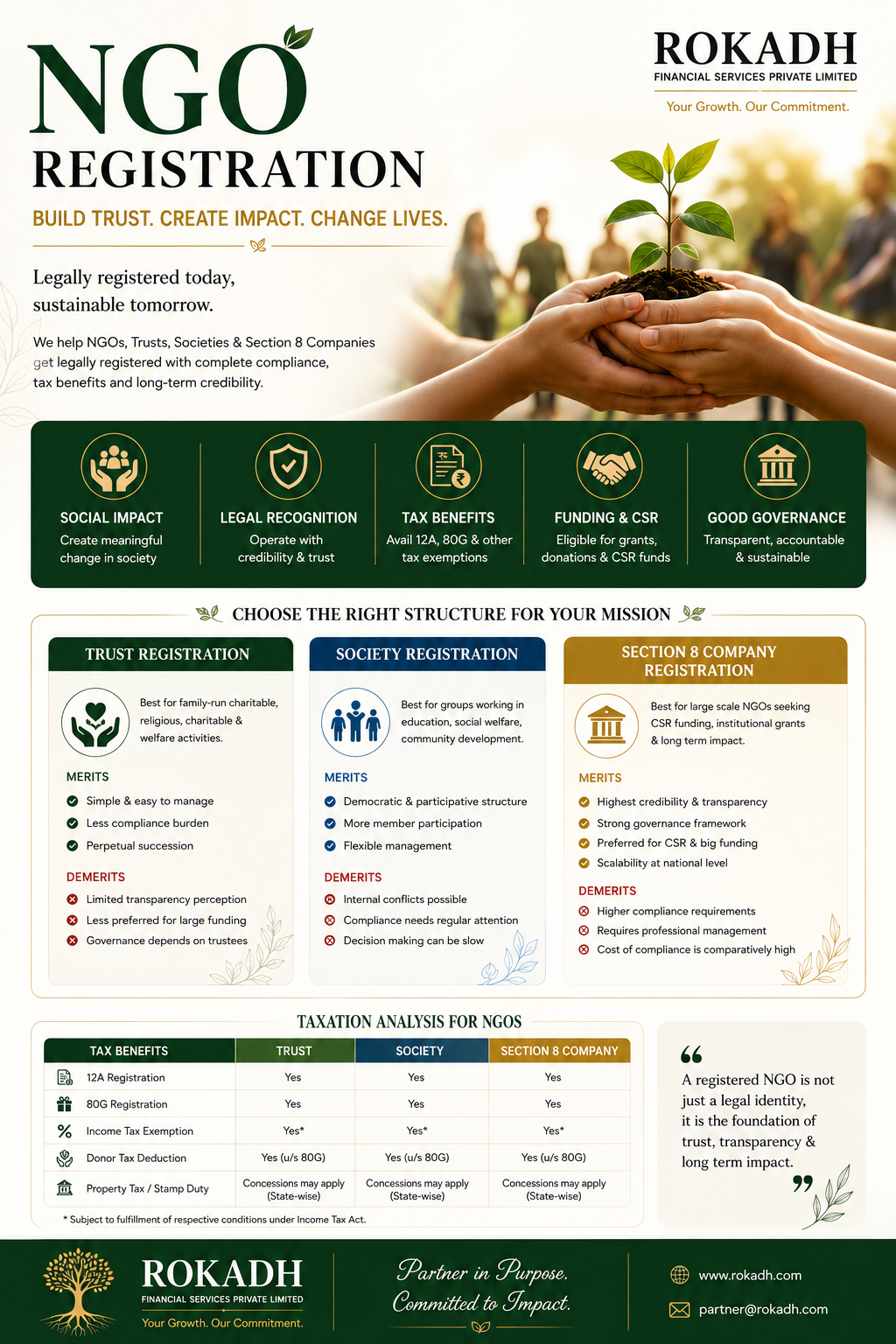
Major NGO Registration Options in India
In India, NGOs are generally structured through:
1. Trust Registration
2. Society Registration
3. Section 8 Company Registration
Each structure has:
- different legal implications,
- taxation impact,
- compliance requirements,
- governance structure,
- and funding perception.
Choosing wrong structure may severely affect:
- donor confidence,
- grant approvals,
- taxation exemptions,
- CSR funding eligibility,
- and long-term sustainability.
1. TRUST REGISTRATION IN INDIA
Governing Law
Generally governed under:
- Indian Trusts Act, 1882
- (subject to applicability and state-specific practices).
Suitable For
Trust structure is often suitable for:
- family charitable activities,
- temples,
- religious activities,
- educational welfare,
- healthcare assistance,
- localized social work.
Complete Trust Registration Procedure
Step 1 — Name Selection
Name should:
- not violate trademark,
- not create public confusion,
- and should reflect charitable objectives.
Step 2 — Drafting Trust Deed
Trust Deed is one of the most important documents.
It generally contains:
- objectives,
- trustee powers,
- governance framework,
- beneficiary details,
- operational clauses.
Step 3 — Appointment of Trustees
Trust generally requires:
- settlor,
- trustees,
- subject to applicable state laws.
Step 4 — Registered Office Proof
Address proof and NOC may be required.
Step 5 — Registration Before Sub-Registrar
Trust Deed is generally executed and registered before:
- relevant registering authority.
Step 6 — PAN Application
After registration:
- PAN becomes important for banking and taxation.
Step 7 — 12A & 80G Registration
Relevant Income Tax Sections
- Section 12A
- Section 80G
These registrations may provide:
- tax exemption,
- donor tax deduction benefits.
Merits of Trust Registration
✔ Comparatively simple structure
✔ Suitable for family-controlled charities
✔ Moderate compliance burden
✔ Useful for local charitable activities
✔ Operational continuity possible
Demerits of Trust Registration
✘ Governance flexibility may become limited
✘ Public transparency may appear weaker compared to Section 8 Company
✘ Institutional funding perception may be comparatively lower
✘ Expansion governance may become difficult in some cases
Market Perspective on Trust Registration
Many local charitable organizations prefer:
- Trust structure
- because:
- operational setup remains practical.
However, large institutional donors increasingly evaluate:
- transparency,
- governance,
- compliance quality.
Taxation Perspective of Trust
Proper 12A registration may help obtain:
- income tax exemption
- subject to legal compliance.
Without proper taxation structuring:
- exemption benefits may be denied.
2. SOCIETY REGISTRATION IN INDIA
Governing Law
Governed under:
- Societies Registration Act, 1860.
Suitable For
Society structure may suit:
- educational groups,
- social welfare associations,
- membership organizations,
- clubs,
- community organizations.
Complete Society Registration Procedure
Step 1 — Selection of Name
Name must comply with:
- legal restrictions,
- trademark norms,
- public policy standards.
Step 2 — Minimum Members
Generally requires:
- minimum governing members,
- subject to applicable provisions.
Step 3 — Drafting MOA & Rules
Documents generally include:
- Memorandum of Association,
- Rules & Regulations.
Step 4 — Address Proof & Identity Documents
Documents of:
- members,
- office,
- authorized persons
- may be required.
Step 5 — Filing Before Registrar of Societies
Application generally submitted before:
- Registrar of Societies.
Step 6 — PAN & Banking Compliance
Post registration:
- PAN,
- bank account,
- accounting setup
- become important.
Step 7 — 12A & 80G Registration
Tax exemption registrations become strategically important.
Merits of Society Registration
✔ Democratic governance structure
✔ Suitable for membership-driven organizations
✔ Better operational flexibility
✔ Useful for educational & social groups
✔ Wider participation possible
Demerits of Society Registration
✘ Internal disputes may increase with large memberships
✘ Compliance discipline becomes important
✘ Governance disputes may arise if documentation weak
Market Perspective on Society Registration
Societies are commonly preferred for:
- educational institutions,
- social development organizations,
- cultural groups.
However, donor preference increasingly focuses upon:
- transparency,
- governance,
- accounting systems.
Taxation Perspective of Society
Societies generally require:
- proper accounting,
- exemption registration,
- income tax compliance,
- to sustain tax-efficient operations.
3. SECTION 8 COMPANY REGISTRATION
Most Professional NGO Structure in India
Relevant Provision
Section 8 of Companies Act, 2013
This structure is increasingly preferred for:
- large NGOs,
- CSR funding,
- national-level organizations,
- institutional donor funding.
Suitable For
✔ Large NGOs
✔ CSR-funded organizations
✔ National social projects
✔ Educational institutions
✔ Scalable charitable structures
✔ International funding-oriented NGOs
Complete Section 8 Company Registration Procedure
Step 1 — DSC & DIN
Digital Signature Certificate and Director Identification become important.
Step 2 — Name Approval
Professional due diligence is critical because:
- rejection risk,
- trademark conflicts,
- MCA objections
- may arise.
Step 3 — Drafting MOA & AOA
Documents define:
- objectives,
- governance,
- operational powers,
- compliance framework.
Step 4 — MCA Filing
Application generally processed through:
- MCA incorporation system.
Step 5 — Certificate of Incorporation
Upon approval:
- incorporation certificate,
- PAN,
- TAN
- may be issued.
Step 6 — 12A & 80G Registration
Critically important for:
- tax exemption,
- donor confidence.
Step 7 — CSR & Funding Structuring
Section 8 Companies often become highly preferred for:
- institutional partnerships,
- corporate funding.
Merits of Section 8 Company
✔ Highest credibility
✔ Strong governance structure
✔ Better donor confidence
✔ Preferred for CSR funding
✔ Strong compliance framework
✔ Better national & institutional image
✔ Excellent long-term scalability
Demerits of Section 8 Company
✘ Higher compliance requirements
✘ Strong governance discipline needed
✘ Professional accounting becomes essential
Market Perspective on Section 8 Company
Large corporates and institutional donors increasingly prefer:
- professionally managed Section 8 entities
- because of:
- transparency,
- governance,
- structured compliance.
Taxation Perspective of Section 8 Company
Proper taxation structuring may provide:
- income exemption benefits,
- donor deduction advantages,
- subject to applicable legal conditions.
Comparative Analysis — Trust vs Society vs Section 8 Company:
| Basis | Trust | Society | Section 8 Company |
| Governing Law | Indian Trusts Act, 1882 (or state-specific Acts) | Societies Registration Act, 1860 (or state-specific Acts) | Companies Act, 2013 |
| Credibility | Moderate | Good | Very High |
| Compliance | Moderate | Moderate | Higher |
| Governance | Trustee-based (Centralized control) | Democratic (Elected Management Committee) | Corporate Governance (Board of Directors & Shareholders) |
| CSR Funding Appeal | Moderate | Good | Excellent |
| Scalability | Moderate | Good | Excellent |
| Institutional Funding | Moderate | Good | Very Strong |
| Transparency Perception | Moderate | Good | Excellent |
Key Takeaway: While a Trust offers the easiest setup and most centralized control, a Section 8 Company is overwhelmingly preferred by modern institutional donors, corporates (for CSR allocation), and international grant-making bodies due to its strict compliance requirements and unparalleled transparency under the Ministry of Corporate Affairs (MCA).
Which NGO Structure is Best?
There is no universal answer.
Correct structure depends upon:
- scale,
- donor goals,
- operational vision,
- governance expectations,
- taxation strategy,
- CSR plans,
- and future expansion.
This is exactly why professional consultation becomes extremely important.
Real Case Study — Educational NGO from Delhi NCR
Situation
An educational welfare organization initially operated informally.
Problems included:
- donor hesitation,
- accounting confusion,
- no legal recognition,
- grant rejection.
Professional Advisory by Rokadh Financial Services Private Limited
After evaluating:
- scale,
- future funding plans,
- governance requirements,
- professional recommendation was:
- Section 8 Company structure.
Result
After structured registration:
✔ institutional trust improved
✔ donor confidence increased
✔ CSR discussions started
✔ compliance became structured
✔ accounting transparency improved
Real Case Study — Family Charitable Trust from Kanpur
Objective
- local charitable activities,
- healthcare support,
- educational aid.
Strategic Advisory
Trust structure was professionally recommended considering:
- operational practicality,
- family governance,
- localized activity model.
Result
The charitable activities became:
- legally recognized,
- taxation structured,
- operationally stable.
Why NGOs Across India Increasingly Trust Rokadh Financial Services Private Limited
1. Strategic NGO Structuring
Not merely:
- registration filing.
Professional evaluation includes:
- taxation,
- compliance,
- governance,
- donor perspective,
- CSR readiness,
- scalability.
2. Strong Understanding of NGO Laws & Taxation
Professional services include:
- Trust Registration,
- Society Registration,
- Section 8 Registration,
- 12A Registration,
- 80G Registration,
- CSR Advisory,
- Taxation Structuring.
3. PAN India NGO Support
Organizations across:
- Kanpur,
- Lucknow,
- Unnao,
- Ghaziabad,
- Gurgaon,
- Delhi,
- Mumbai,
- and PAN India
- increasingly seek professional NGO advisory support.
35+ Common Mistakes in NGO Registration, 12A, 80G & NGO Compliance
Improper NGO registration or weak compliance structuring may create:
- rejection of registration,
- cancellation of exemptions,
- donor distrust,
- CSR funding blockage,
- taxation notices,
- legal penalties,
- and severe operational instability.
Below are major mistakes frequently identified and strategically resolved by:
Team Rokadh — Rokadh Financial Services Private Limited
India’s Leading Financial Services Company
for NGOs, Trusts, Societies and Section 8 Companies across:
- Kanpur,
- Lucknow,
- Unnao,
- Ghaziabad,
- Gurgaon,
- Delhi,
- Mumbai,
- and PAN India.
1. Choosing Wrong NGO Structure
One of the biggest mistakes.
Many organizations blindly register:
- Trust,
- Society,
- or Section 8 Company
- without evaluating:
- future funding goals,
- CSR requirements,
- governance expectations,
- taxation implications.
2. Improper Drafting of Trust Deed / MOA / Rules
Weak drafting creates:
- compliance ambiguity,
- governance disputes,
- operational complications,
- and rejection risk.
3. Ignoring 12A Registration
Without proper Section 12A registration:
- income tax exemption benefits may become unavailable.
4. Ignoring 80G Registration
Without Section 80G:
- donors may not receive tax deduction benefits,
- which reduces:
- donation attractiveness.
5. Using Generic NGO Objectives
Improper objectives may create:
- compliance complications,
- registration objections,
- donor confusion.
6. Choosing Name Without Due Diligence
Improper name selection may create:
- trademark disputes,
- rejection,
- public confusion.
7. No Proper Governance Structure
Weak governance creates:
- internal conflicts,
- donor distrust,
- operational instability.
8. Mixing Personal & NGO Funds
One of the most dangerous mistakes.
This creates:
- taxation exposure,
- accounting complications,
- credibility concerns.
9. Improper Accounting System
Weak accounting damages:
- donor confidence,
- audit readiness,
- funding eligibility.
10. Ignoring Annual Compliance
Many NGOs wrongly assume:
- registration is one-time process.
Ignoring compliance may create:
- penalties,
- exemption cancellation,
- operational restrictions.
11. Using NGO for Commercial Profit Motive
NGOs cannot operate like:
- profit-maximizing businesses.
Improper activity structuring may create:
- legal complications.
12. No Professional Taxation Planning
Weak tax structuring may impact:
- exemptions,
- donor deductions,
- regulatory standing.
13. Delayed Filing of Returns
Late filing weakens:
- institutional credibility,
- compliance reputation.
14. Improper Utilization of Donations
Poor fund management creates:
- donor distrust,
- compliance scrutiny.
15. No Internal Financial Controls
Weak controls increase:
- fraud risk,
- operational leakage.
16. Ignoring CSR Compliance Standards
Many NGOs seek CSR funding without:
- governance readiness,
- compliance transparency.
17. No Separate Bank Account
Separate banking is critically important for:
- accountability,
- compliance,
- audit discipline.
18. Weak Documentation of NGO Activities
Improper documentation weakens:
- funding applications,
- donor trust,
- exemption support.
19. Ignoring FCRA Implications
Foreign funding without proper compliance may create:
- severe legal consequences.
20. Using Cheap Registration Services
Low-cost filing often ignores:
- strategic NGO structuring,
- taxation planning,
- governance protection.
21. Improper Trustee / Director Selection
Weak leadership structure affects:
- operational sustainability.
22. Ignoring Brand Protection
Many NGOs fail to secure:
- trademark protection,
- creating:
- brand misuse risks.
23. No Long-Term Sustainability Planning
Many NGOs collapse because:
- long-term governance planning never existed.
24. Weak Meeting & Resolution Records
Poor governance documentation weakens:
- transparency,
- donor trust.
25. Ignoring Audit Readiness
Professional audit discipline strengthens:
- institutional credibility.
26. Improper Donation Receipts
Incorrect receipts create:
- taxation confusion,
- donor dissatisfaction.
27. No Compliance Calendar
Compliance deadlines frequently get missed.
28. Ignoring Professional Advisory Before Registration
Improper initial structuring becomes:
- expensive to correct later.
29. Weak Public Transparency
Modern donors increasingly evaluate:
- governance,
- transparency,
- compliance discipline.
30. No Strategic Funding Structure
Funding planning is critically important for:
- NGO sustainability.
31. Ignoring Institutional Donor Expectations
Corporate donors increasingly expect:
- strong governance,
- compliance structure.
32. No Operational SOPs
Weak operational structure creates:
- execution inefficiency.
33. Improper Volunteer Management
Poor volunteer structuring creates:
- operational instability.
34. Assuming NGO Means “No Compliance”
This misconception creates:
- serious legal exposure.
35. Choosing Structure Only Because Someone Suggested It
NGO structuring should never be:
- random,
- emotional,
- or copied from others.
It must be:
- strategically planned.
50+ Most Searched FAQs on NGO Registration
1. What is NGO Registration?
NGO registration means:
- legal recognition of charitable or social organization.
2. What are the major NGO registration options in India?
Major structures include:
- Trust,
- Society,
- Section 8 Company.
3. Which NGO structure is best?
Depends upon:
- funding goals,
- governance expectations,
- operational scale,
- taxation strategy.
4. What is Section 8 Company?
Section 8 Company is:
- a non-profit company registered under Companies Act, 2013.
5. Which NGO structure is best for CSR funding?
Section 8 Company is often preferred for:
- institutional and CSR funding.
6. What is 12A Registration?
12A registration may provide:
- income tax exemption benefits.
7. What is 80G Registration?
80G registration may allow:
- donor tax deduction benefits.
8. Is 12A compulsory?
For taxation exemption purposes:
- extremely important.
9. Is 80G compulsory?
Not mandatory in every case,
but highly important for:
- donor confidence.
10. Can NGO receive donations without registration?
Informal donations may occur,
but legal credibility remains weaker.
11. Can NGO receive CSR funding?
Yes subject to:
- eligibility,
- compliance,
- governance standards.
12. Why do corporates prefer professionally managed NGOs?
Because governance and transparency matter significantly.
13. Can NGO earn income?
Certain activities may be permissible subject to:
- legal and taxation compliance.
14. Can NGO pay salary?
Yes for legitimate operational requirements.
15. Is audit mandatory for NGOs?
Applicability depends upon:
- legal structure,
- turnover,
- taxation provisions.
16. Can NGO own property?
Yes.
17. Can NGO operate PAN India?
Yes subject to:
- registrations,
- operational permissions.
18. Why is accounting important for NGOs?
Accounting supports:
- transparency,
- donor confidence,
- compliance.
19. What happens if NGO compliance is ignored?
This may create:
- penalties,
- cancellation risks,
- legal notices.
20. Why should NGOs maintain proper documentation?
Documentation supports:
- transparency,
- funding applications,
- compliance protection.
21. What is difference between Trust and Society?
Trust generally operates through:
- trustees.
Society generally operates through:
- governing members.
22. What is difference between NGO and Section 8 Company?
Section 8 Company is one type of:
- NGO structure.
23. Can NGO own trademark?
Yes.
24. Why should NGOs secure trademark registration?
To protect:
- identity,
- credibility,
- public trust.
25. Can foreign donations be received by NGO?
Subject to:
- FCRA compliance.
26. What is FCRA?
FCRA regulates:
- foreign contribution compliance.
27. Why do NGOs increasingly prefer Section 8 structure?
Because of:
- governance,
- credibility,
- donor confidence.
28. How long does NGO registration take?
Depends upon:
- structure,
- documentation,
- authority approval process.
29. Can one person start NGO?
Depends upon:
- selected structure,
- applicable legal requirements.
30. What documents are required for NGO registration?
Generally:
- identity proof,
- address proof,
- office proof,
- constitutional documents.
31. Why is professional drafting important in NGO registration?
Weak drafting creates:
- governance risk,
- operational complications.
32. Can NGO conduct educational activities?
Yes subject to:
- lawful objectives.
33. Can NGO run healthcare projects?
Yes.
34. Why should NGOs maintain separate bank account?
To maintain:
- transparency,
- accountability.
35. Can NGOs receive grants?
Yes subject to:
- eligibility,
- compliance readiness.
36. Why do NGOs increasingly require professional compliance management?
Modern funding ecosystem increasingly evaluates:
- transparency,
- governance discipline.
37. Can NGO founders take personal profit?
NGOs generally operate for:
- charitable objectives,
- not personal profit extraction.
38. What is CSR funding?
CSR refers to:
- Corporate Social Responsibility funding.
39. Why is NGO governance important?
Strong governance improves:
- donor trust,
- institutional sustainability.
40. Can NGO work internationally?
Subject to:
- legal permissions,
- regulatory compliance.
41. Why should NGOs avoid informal operations?
Informal structure weakens:
- donor confidence,
- institutional growth.
42. Can Team Rokadh help with NGO registration PAN India?
Yes.
43. Can Team Rokadh help with 12A & 80G registration?
Yes.
44. Can Team Rokadh assist with Section 8 Company setup?
Yes.
45. Why should NGOs consult before registration instead of after problems arise?
Improper structuring later becomes:
- expensive,
- stressful,
- legally complicated.
46. Why is taxation planning important for NGOs?
Weak taxation structuring may impact:
- exemptions,
- funding credibility.
47. Why should NGOs maintain professional digital presence?
Professional identity improves:
- public trust,
- donor confidence.
48. Why should NGOs maintain compliance discipline from beginning?
Because credibility builds through:
- governance consistency.
49. Why do NGOs across India increasingly trust Team Rokadh?
Because Team Rokadh focuses upon:
- strategic structuring,
- governance clarity,
- taxation planning,
- compliance protection,
- institutional sustainability.
50. Why should organizations increasingly consult Team Rokadh before starting NGO?
Because professional NGO structuring today requires:
- legal understanding,
- taxation planning,
- compliance expertise,
- governance strategy,
- and institutional scalability planning.
This is exactly why NGOs and social organizations across:
- Kanpur,
- Lucknow,
- Unnao,
- Ghaziabad,
- Gurgaon,
- Delhi,
- Mumbai,
- and PAN India
- increasingly trust:
Team Rokadh — Rokadh Financial Services Private Limited
India’s Leading Financial Services Company
for:
- NGO Registration,
- Trust Registration,
- Society Registration,
- Section 8 Company Registration,
- 12A & 80G Registration,
- CSR Compliance,
- NGO Taxation,
- and Strategic Institutional Structuring.
Final Professional Conclusion
NGO registration is not merely:
- legal documentation.
It is:
- the foundation of donor trust,
- institutional credibility,
- taxation efficiency,
- and sustainable social impact.
This is exactly why organizations increasingly trust:
Rokadh Financial Services Private Limited
India’s Leading Financial Services Company
for:
- NGO Registration,
- Trust Registration,
- Society Registration,
- Section 8 Company Registration,
- 12A & 80G Registration,
- CSR Advisory,
- NGO Taxation,
- and Strategic Institutional Structuring.