

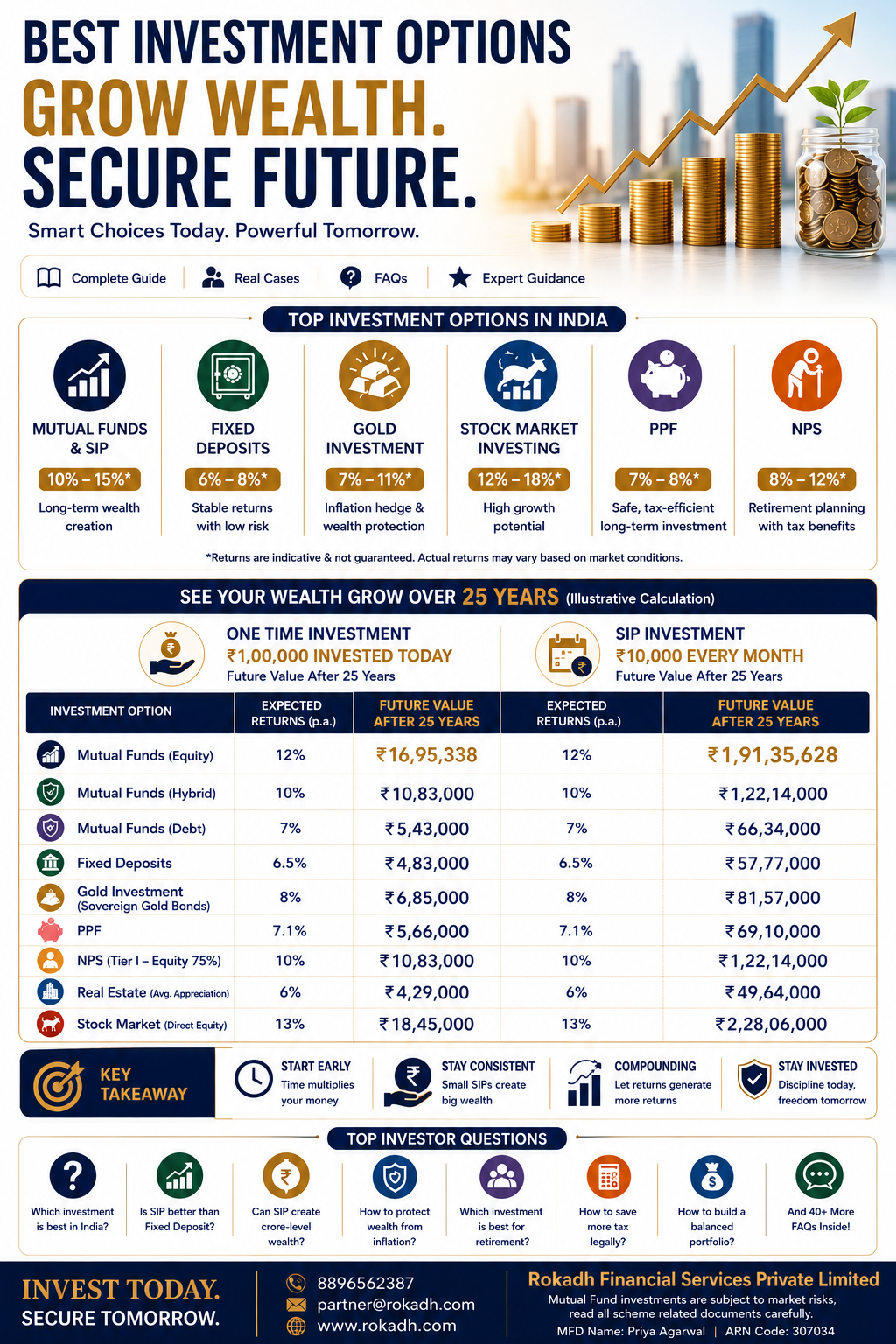
Complete Professional Guide on Mutual Funds, SIP, Stocks, Gold, Fixed Deposits, PPF, NPS, Bonds & Wealth Creation Strategy by Team Rokadh
In today’s financial environment, merely earning money is no longer enough.
The real challenge is:
- how to grow wealth,
- how to protect purchasing power,
- how to achieve financial freedom,
- and how to create stable long-term wealth without taking blind risks.
This is exactly why investors across:
- Kanpur,
- Lucknow,
- Delhi,
- Noida,
- Ghaziabad,
- Gurgaon,
- NCR,
- Bengaluru,
- Mumbai,
- and PAN India
- increasingly search:
- Best Investment Options in India,
- Best SIP Plans,
- High Return Investment Options,
- Safe Investment Plans,
- Best Wealth Creation Strategy,
- Retirement Planning Expert,
- Best Mutual Fund Investment Advisor,
- Tax Saving Investment Plans,
- Strategic Portfolio Planner.
Unfortunately, most people still invest based upon:
- emotional decisions,
- relatives’ suggestions,
- social media influencers,
- random YouTube advice,
- or unrealistic return expectations.
The result often becomes:
- poor returns,
- financial stress,
- taxation inefficiency,
- blocked liquidity,
- and long-term wealth destruction.
This detailed professional guide by:
Team Rokadh — Rokadh Financial Services Private Limited
India’s Leading Financial Services Company
explains:
- all major investment options,
- expected return ranges,
- liquidity,
- taxation,
- stability,
- suitability,
- detailed real-life case studies,
- investor profiling,
- common mistakes,
- FAQs,
- and strategic wealth advisory.
Important Factors Before Choosing Any Investment
Every investment should be evaluated professionally on:
| Factor | Why Important |
| Expected Return | Wealth growth potential |
| Liquidity | Emergency withdrawal ability |
| Stability | Capital safety |
| Risk Level | Volatility exposure |
| Taxation | Post-tax return efficiency |
| Time Horizon | Short-term vs long-term suitability |
| Inflation Protection | Real wealth growth |
| Goal Alignment | Retirement, child education, etc. |
This is exactly why professional financial planning matters.
1. Mutual Funds & SIP (Systematic Investment Plan)
Expected Return Range
- Equity Mutual Funds: ~10%–15%+ long-term potential
- Hybrid Funds: ~8%–12%
- Debt Funds: ~6%–8%
(Not guaranteed returns)
Liquidity
Generally high in open-ended funds.
Stability
Depends upon:
- equity allocation,
- debt exposure,
- fund category.
Best Suitable For
- salaried employees,
- young professionals,
- business owners,
- long-term investors,
- retirement planning,
- child education planning.
Why SIP Investing Has Become Extremely Popular
SIP encourages:
- disciplined investing,
- compounding,
- rupee cost averaging,
- long-term wealth creation.
Here is the illustrative example organized into a scannable table, showcasing the compounding effect over different time horizons:
| Monthly SIP | Investment Period | Potential Long-Term Value* |
| ₹10,000 | 10 Years | ₹28 Lakhs |
| ₹10,000 | 15 Years | ₹70 Lakhs |
| ₹10,000 | 20 Years | ₹1.50 Crore |
| ₹10,000 | 25 Years | ₹3.30 Crore |
*Illustrative projections only.
Real Case Study — Salaried IT Professional from Noida
Investor Profile
- Age: 29 Years
- Monthly Salary: ₹1.35 Lakhs
- Annual CTC: ₹19 Lakhs
- Tax Bracket: 30%
- Marital Status: Newly Married
- Lifestyle: Upper-middle-class urban lifestyle
- Monthly Expenses: ₹70,000
- Existing Savings: ₹12 Lakhs
- Goals:
- Child education planning,
- early retirement,
- wealth creation,
- tax optimization.
Major Mistakes Before Consulting Team Rokadh
The investor was:
- keeping money idle in savings accounts,
- buying random insurance-investment products,
- following social media stock tips,
- and investing emotionally.
Despite good income:
- long-term wealth visibility was weak.
Team Rokadh Strategic Advisory
Team Rokadh professionally:
- conducted risk profiling,
- analyzed liquidity requirements,
- evaluated future goals,
- calculated inflation-adjusted corpus needs.
Here is the strategic allocation breakdown organized into a clear, professional table:
| Investment Category | Suggested Allocation |
| Equity SIPs | 45% |
| Hybrid Funds | 20% |
| Emergency Fund | 15% |
| Retirement Allocation | 10% |
| Gold Diversification | 5% |
| Short-Term Liquidity | 5% |
Why Team Rokadh Recommended This Structure
Because:
- investor had long investment horizon,
- high earning capacity,
- strong future income growth potential,
- and moderate-to-high risk appetite.
Team Rokadh focused upon:
- long-term compounding,
- tax efficiency,
- financial discipline,
- and wealth scalability.
2. Fixed Deposits (FDs)
Expected Return Range
- Generally ~6%–8%
Liquidity
Moderate.
Premature withdrawal may attract penalties.
Stability
Generally considered comparatively stable.
Best Suitable For
- senior citizens,
- emergency corpus,
- conservative investors,
- short-term financial parking.
Biggest Limitation of Fixed Deposits
Inflation-adjusted real return may remain weak after:
- taxation,
- inflation impact.
Real Case Study — Business Family from Kanpur
Investor Profile
- Family Business Income: ₹45 Lakhs annually
- Tax Bracket: 30%
- Age Group: 48–55
- Lifestyle: Conservative traditional family
- Existing Corpus: ₹1.8 Crores
- Investment Pattern:
- 80% in FDs,
- savings accounts,
- physical cash reserves.
Problems Identified by Team Rokadh
- poor inflation protection,
- low post-tax returns,
- excessive idle liquidity,
- weak wealth growth.
Team Rokadh Advisory
Team Rokadh professionally advised:
- diversified portfolio allocation,
- SIP integration,
- debt-equity balance,
- retirement-focused planning,
- emergency liquidity structuring.
Why Team Rokadh Suggested Diversification
Because:
- excessive conservatism was silently reducing long-term wealth potential.
3. Gold Investment
Expected Return Range
- Historically ~7%–11% long-term range (varies significantly)
Liquidity
Generally high.
Stability
Acts as:
- inflation hedge,
- uncertainty hedge.
Best Suitable For
- diversification,
- defensive allocation,
- wealth preservation.
Types of Gold Investments
- Physical Gold
- Gold ETF
- Sovereign Gold Bonds
Real Case Study — Traditional Family from Lucknow
Investor Profile
- Age: 52
- Family Wealth: ₹2.5 Crores
- Existing Gold Allocation: ~55%
- Income Source: Real estate rental + trading
- Lifestyle: Traditional high gold preference
- Objective:
- family security,
- asset preservation.
Problems Identified
- excessive concentration risk,
- poor liquidity planning,
- inefficient asset allocation.
Team Rokadh Advisory
Team Rokadh advised:
- reducing overexposure to jewelry,
- balancing growth assets,
- integrating retirement-oriented investments.
Why Team Rokadh Suggested Reduction in Gold Exposure
Because:
- gold alone rarely creates balanced wealth creation strategy.
4. Direct Equity / Stock Market Investing
Expected Return Potential
- Potentially ~12%–18%+ long-term range
- Highly volatile
(Not guaranteed)
Liquidity
Generally high.
Stability
Low-to-moderate due to volatility.
Best Suitable For
- informed investors,
- high-risk appetite individuals,
- disciplined long-term investors.
Biggest Risk in Direct Equity
Most investors lose money because:
- emotional trading,
- speculation,
- leverage,
- random influencer tips,
- panic selling.
Real Case Study — Trader from Delhi NCR
Investor Profile
- Age: 34
- Monthly Business Income: ₹2 Lakhs+
- Tax Bracket: 30%
- Lifestyle: Aggressive wealth creation mindset
- Existing Investment Capital: ₹40 Lakhs
Problems Before Consulting Team Rokadh
Investor was:
- overtrading,
- using Telegram stock tips,
- speculative intraday trading,
- highly emotional during volatility.
Result:
- portfolio erosion,
- stress,
- inconsistent wealth growth.
Team Rokadh Strategic Advisory
Team Rokadh advised:
- long-term disciplined investing,
- controlled equity exposure,
- mutual fund integration,
- emergency reserve creation,
- and diversification.
Why Team Rokadh Recommended Strategic Reduction in Speculation
Because:
- wealth creation generally requires:
- discipline,
- consistency,
- and risk management,
- not:
- emotional speculation.
5. Public Provident Fund (PPF)
Expected Return Range
- Generally ~7%–8% (government notified and variable)
Liquidity
Low due to long lock-in.
Stability
High government-backed stability.
Best Suitable For
- conservative investors,
- long-term disciplined savers,
- retirement planning.
Real Case Study — Government Employee
Investor Profile
- Age: 41
- Government Service
- Stable Income
- Moderate Risk Appetite
- Goal:
- retirement security,
- tax efficiency.
Team Rokadh Advisory
Team Rokadh advised:
- combining PPF with SIPs,
- maintaining inflation-beating allocation,
- balancing liquidity and safety.
6. National Pension System (NPS)
Expected Return Range
- Approximately ~8%–12% long-term potential depending upon allocation
Best Suitable For
- retirement-focused investors,
- salaried employees,
- long-term planners.
Relevant Tax Benefit
Section 80CCD(1B) of Income Tax Act, 1961
Additional deduction available subject to applicable provisions.
Real Case Study — IIT Professor
Investor Profile
- Age: 46
- IIT Professor
- Stable Salary Structure
- Tax Bracket: 30%
- Goal:
- retirement security,
- inflation-adjusted pension corpus.
Problems Identified
- excessive dependence upon traditional savings,
- weak retirement growth planning.
Team Rokadh Strategic Advisory
Team Rokadh professionally integrated:
- NPS,
- SIPs,
- tax optimization,
- and long-term retirement allocation.
Why Team Rokadh Recommended This Structure
Because:
- retirement planning requires balancing:
- safety,
- growth,
- taxation,
- and longevity risk.
7. Real Estate Investment
Expected Return Potential
- Highly variable
- Rental yield often ~2%–4%
- Long-term appreciation depends upon location and market cycle
Liquidity
Low.
Stability
Depends heavily upon:
- location,
- market cycle,
- legal quality.
Best Suitable For
- long-term investors,
- diversification seekers,
- rental income planners.
Real Case Study — Property Investor from Gurgaon
Investor Profile
- Age: 50
- Business Owner
- Existing Assets: Multiple plots
- Lifestyle: Asset-heavy investor
- Goal:
- wealth preservation,
- passive income.
Problems Identified
- low liquidity,
- excessive concentration in real estate,
- poor cash-flow flexibility.
Team Rokadh Advisory
Team Rokadh professionally:
- diversified allocation,
- optimized liquidity,
- introduced financial assets,
- structured retirement cash-flow planning.
Why Team Rokadh Focuses on Asset Allocation
Because:
No single investment option is perfect for every investor.
Professional wealth planning requires balancing:
- growth,
- safety,
- taxation,
- liquidity,
- and future goals.
Why Investors Increasingly Trust Team Rokadh
1. Strategic Financial Planning
Team Rokadh focuses not merely upon:
- investment products,
- but upon:
- long-term financial outcomes.
2. Goal-Based Wealth Structuring
Every recommendation depends upon:
- age,
- income,
- goals,
- taxation,
- lifestyle,
- liabilities,
- and risk appetite.
3. Professional Portfolio Understanding
Team Rokadh professionally assists with:
- SIP Planning,
- Retirement Planning,
- Wealth Creation,
- Tax Saving Investments,
- Asset Allocation,
- Long-Term Portfolio Structuring.
35+ Common Investment Mistakes
1. Investing Without Financial Goals
One of the biggest financial mistakes.
People invest without clarity regarding:
- retirement,
- child education,
- wealth creation,
- emergency planning,
- or passive income.
Why This Becomes Dangerous
Without goals:
- investments become random,
- discipline weakens,
- emotional investing increases.
Team Rokadh Professional Advisory
Team Rokadh first professionally identifies:
- financial objectives,
- investment horizon,
- lifestyle requirements,
- future liabilities,
- before suggesting any investment strategy.
2. Delaying Investment Start
Many people think:
“I will start later after income increases.”
This delay silently destroys:
- compounding power,
- long-term wealth potential.
Real Financial Impact
A person starting SIP at:
- age 25,
- often creates significantly larger wealth than someone starting at:
- age 35,
- even with similar monthly investment.
Team Rokadh Advisory
Start early.
Even disciplined small investing matters.
3. Investing Emotionally During Market Volatility
One of the most dangerous mistakes.
Investors often:
- panic during market correction,
- stop SIPs,
- sell investments emotionally.
Result
- long-term compounding breaks,
- wealth creation gets interrupted.
Team Rokadh Strategic Guidance
Team Rokadh professionally explains:
- market cycles,
- volatility behavior,
- long-term investing psychology.
4. Chasing Unrealistic Returns
Many investors become victims of:
- “double money” schemes,
- guaranteed high-return traps,
- unregulated products.
Why Dangerous
High-return promises often involve:
- excessive risk,
- fraud,
- capital erosion.
Team Rokadh Advisory
Professional investing focuses upon:
- sustainability,
- diversification,
- risk-adjusted returns.
5. Investing Based on Social Media Advice
Following:
- influencers,
- Telegram groups,
- random YouTube tips,
- without professional understanding creates:
- speculative behavior,
- emotional investing,
- poor portfolio quality.
Team Rokadh Advisory
Investment planning should depend upon:
- your income,
- your goals,
- your risk appetite,
- not:
- viral content.
6. No Emergency Fund Before Investing
Many investors aggressively invest everything without:
- liquidity planning.
Result
Emergency situations force:
- premature withdrawals,
- loan dependency,
- financial stress.
Team Rokadh Advisory
Emergency corpus generally remains extremely important before aggressive investing.
7. Putting Entire Wealth into One Asset Class
Many investors:
- keep everything in FD,
- everything in real estate,
- everything in stocks,
- or everything in gold.
Why Dangerous
Concentration risk increases substantially.
Team Rokadh Strategic Advisory
Professional investing requires:
- diversification,
- balance,
- asset allocation.
8. Excessive Dependence Upon Fixed Deposits
Traditional investors often keep:
- entire wealth in FDs.
Problem
After:
- inflation,
- taxation,
- real wealth growth often remains weak.
Team Rokadh Guidance
FDs may help:
- stability,
- emergency planning,
- but may not alone create long-term wealth.
9. Ignoring Inflation
One of the most ignored financial risks.
Example
If inflation averages:
- 6%,
- money effectively loses purchasing power over time.
Team Rokadh Advisory
Investments should ideally:
- aim for inflation-adjusted growth.
10. Investing Without Risk Profiling
A conservative investor copying aggressive strategies often faces:
- anxiety,
- panic,
- instability.
Team Rokadh Advisory
Every investment strategy should depend upon:
- age,
- income,
- dependents,
- risk appetite,
- and goals.
11. Frequent Portfolio Switching
Constantly changing investments based upon:
- market news,
- social media,
- short-term returns,
- creates:
- instability,
- poor compounding.
Team Rokadh Guidance
Long-term discipline generally matters more than frequent switching.
12. Ignoring Taxation Impact
Many investors focus only on:
- returns,
- while ignoring:
- taxation.
Result
Actual post-tax returns become inefficient.
Team Rokadh Advisory
Tax-efficient investing remains critical for long-term wealth creation.
13. Overtrading in Stock Market
Many investors confuse:
- investing,
- with:
- gambling behavior.
Result
- stress,
- losses,
- emotional instability.
Team Rokadh Guidance
Wealth creation generally requires:
- discipline,
- not excessive speculation.
14. Investing Without Liquidity Planning
Some investors lock money entirely into:
- illiquid assets.
Result
Emergency situations create:
- financial crisis,
- forced selling.
15. Blindly Following Relatives or Friends
Financial suitability differs for every individual.
Team Rokadh Advisory
Your investment should depend upon:
- your financial profile,
- not:
- someone else’s strategy.
16. No Retirement Planning
One of the biggest long-term mistakes.
Why Dangerous
Medical inflation and longer life expectancy increase retirement pressure.
17. Ignoring Insurance Protection
Investment without:
- health insurance,
- life insurance,
- creates financial vulnerability.
18. Unrealistic Wealth Expectations
Many investors expect:
- instant wealth,
- overnight returns.
Team Rokadh Advisory
Long-term compounding generally creates sustainable wealth.
19. Investing Randomly Without Asset Allocation
Unstructured investing creates:
- imbalance,
- unnecessary volatility.
20. Panic Selling During Market Correction
Temporary volatility often scares investors.
Team Rokadh Guidance
Corrections are part of long-term markets.
21. Investing Entire Bonus or Windfall Emotionally
Sudden money often gets invested:
- without planning.
22. Ignoring Financial Documentation
Poor record management creates:
- taxation confusion,
- succession complications.
23. Weak Retirement Corpus Calculation
Most people underestimate:
- retirement expenses,
- inflation impact.
24. Depending Entirely on Savings Accounts
Idle money silently loses purchasing power.
25. Overexposure to Real Estate
Many investors block excessive wealth in:
- low-liquidity assets.
26. Investing Without Future Expense Planning
Ignoring:
- child education,
- healthcare,
- inflation,
- creates future stress.
27. Choosing Advisors Only on Return Promises
This is extremely dangerous.
Professional advisory should focus upon:
- risk management,
- long-term planning,
- sustainability.
28. Lack of Investment Discipline
Irregular investing destroys compounding.
29. Ignoring Portfolio Review
Financial circumstances continuously evolve.
30. Treating Insurance as Investment
Many insurance products may not efficiently support:
- wealth creation.
31. Investing During Emotional Highs
Greed-driven investing often creates poor decisions.
32. Ignoring Succession Planning
Lack of nomination/documentation creates family complications.
33. Copying Aggressive Investors Blindly
Different people have:
- different income,
- different liabilities,
- different goals.
34. No Professional Financial Guidance
Unstructured investing often leads to:
- confusion,
- inefficiency,
- stress.
35. Lack of Long-Term Vision
Short-term mindset weakens:
- compounding,
- wealth creation,
- financial freedom potential.
50+ Most Searched Investment FAQs
1. Which investment option is best in India?
No single investment suits everyone.
The right investment depends upon:
- age,
- income,
- goals,
- risk appetite,
- taxation,
- liquidity requirements.
2. Is SIP better than Fixed Deposit?
Both serve different purposes.
- FD may support stability.
- SIP may support long-term wealth creation.
Professional allocation matters most.
3. Can SIP create crore-level wealth?
Potentially yes over long investment horizons through:
- disciplined investing,
- compounding,
- consistency.
4. What is compounding?
Compounding means:
- returns generating further returns over time.
This becomes extremely powerful in long-term investing.
5. Is stock market risky?
Yes.
Especially without:
- discipline,
- research,
- diversification,
- professional understanding.
6. Why should investors diversify investments?
Diversification reduces:
- concentration risk,
- dependency upon one asset class.
7. Is gold a good investment?
Gold may help:
- diversification,
- inflation protection,
- uncertainty hedging.
But excessive gold exposure may reduce growth efficiency.
8. Why is retirement planning important?
Because:
- inflation,
- medical costs,
- longer life expectancy,
- increase future financial pressure.
9. Can inflation destroy savings?
Yes significantly over long periods.
10. Why should young professionals start investing early?
Because time strengthens:
- compounding power.
11. How much SIP should beginners start?
Depends upon:
- income,
- goals,
- liabilities,
- lifestyle.
12. What is emergency fund?
Emergency corpus helps manage:
- unexpected expenses,
- job loss,
- medical emergencies.
13. Is real estate always profitable?
No.
Real estate performance depends upon:
- location,
- timing,
- liquidity,
- legal quality.
14. What is risk profiling?
Understanding:
- financial capacity,
- emotional tolerance,
- investment suitability.
15. Why do investors increasingly trust Team Rokadh?
Because Team Rokadh focuses upon:
- strategic financial planning,
- disciplined wealth creation,
- and investor-specific advisory.
16. Which investment option is best for salaried employees?
Salaried individuals generally require:
- disciplined investing,
- tax-efficient planning,
- retirement-focused wealth creation,
- and liquidity balance.
The ideal investment structure usually depends upon:
- monthly salary,
- age,
- future goals,
- family responsibilities,
- and risk appetite.
Team Rokadh Professional Advisory
For most salaried professionals, Team Rokadh generally evaluates:
- emergency corpus requirement,
- insurance adequacy,
- retirement timeline,
- child education planning,
- and taxation efficiency
- before designing investment strategy.
Young professionals may require:
- higher growth allocation,
- while senior salaried employees may require:
- stability and capital protection focus.
17. Which investment option is suitable for business owners?
Business owners often have:
- irregular cash flow,
- seasonal income fluctuations,
- liquidity pressure,
- and higher financial responsibilities.
Team Rokadh Strategic Guidance
Professional investment planning for business owners generally focuses upon:
- liquidity management,
- tax efficiency,
- diversification,
- emergency reserves,
- and wealth protection.
Many business owners wrongly:
- reinvest everything back into business,
- while ignoring:
- personal wealth creation.
Team Rokadh professionally balances:
- business expansion,
- personal investments,
- and long-term financial security.
18. Which investment option is best for senior citizens?
Senior citizens generally prioritize:
- capital protection,
- regular income,
- stability,
- and liquidity.
Team Rokadh Advisory
Investment planning for senior citizens generally focuses upon:
- stability-oriented allocation,
- controlled volatility,
- medical contingency planning,
- and income-generating assets.
Excessive exposure to:
- highly volatile investments,
- may not suit conservative retirement lifestyles.
19. Which investment option is best for young investors?
Young investors usually possess:
- longer investment horizon,
- higher earning potential,
- and stronger compounding opportunity.
Team Rokadh Professional Guidance
Young investors may potentially benefit from:
- disciplined SIP investing,
- growth-oriented allocation,
- long-term compounding strategy,
- and diversified wealth creation.
The biggest advantage for young investors is:
time.
20. Why is long-term investing considered powerful?
Long-term investing allows:
- compounding,
- market cycle participation,
- disciplined wealth creation,
- and inflation-adjusted growth.
Team Rokadh Explanation
Short-term volatility often creates fear.
However, long-term disciplined investing generally allows:
Continue Reading
Related Articles
© ROKADH FINANCIAL SERVICES PRIVATE LIMITED