
Complete Professional Guide on One Person Company (OPC) Registration in India by Team Rokadh
Starting a business today is no longer only about:
- having an idea,
- or opening a bank account.
Modern businesses require:
- legal identity,
- compliance protection,
- brand credibility,
- taxation planning,
- funding readiness,
- and structured growth.
This is exactly why entrepreneurs across:
- Kanpur,
- Lucknow,
- Noida,
- Delhi,
- Ghaziabad,
- Gurgaon,
- Unnao,
- and PAN India
- increasingly search:
- Best OPC Registration Consultant,
- One Person Company Registration,
- OPC Registration Online,
- Private Limited vs OPC,
- Startup Registration in India,
- MCA Company Registration Expert,
- Company Incorporation Consultant.
This detailed professional guide by:
Team Rokadh — Rokadh Financial Services Private Limited
India’s Leading Financial Services Company
explains:
- what OPC means,
- who should register OPC,
- benefits of OPC,
- registration process,
- relevant legal provisions,
- taxation impact,
- compliance requirements,
- real business case studies,
- common mistakes,
- FAQs,
- and why professional registration support matters.
What is OPC (One Person Company)?
Relevant Provision
Section 2(62) of Companies Act, 2013
The Companies Act defines:
“One Person Company” means a company which has only one person as a member.
In simple language:
- OPC allows a single entrepreneur to run a corporate entity with limited liability protection.
Why OPC Registration Has Become Extremely Popular
Modern professionals increasingly prefer OPC because:
- legal identity improves,
- business credibility strengthens,
- compliance becomes structured,
- banking becomes easier,
- taxation planning improves,
- and business expansion becomes professional.
Major Advantages of OPC Registration
1. Limited Liability Protection
Personal assets generally remain protected from:
- business liabilities,
- business debts,
- subject to applicable legal conditions.
2. Separate Legal Entity
An OPC has:
- separate legal existence from owner.
This significantly improves:
- business professionalism,
- vendor confidence,
- customer trust.
3. Better Brand Credibility
Businesses operating through:
- registered company structure
- often appear more professional than:
- proprietorship businesses.
4. Easier Banking & Funding Opportunities
Many banks and institutions prefer:
- registered business structures.
5. Better Tax & Compliance Structuring
Professional company structuring may help:
- operational clarity,
- documentation,
- compliance discipline.
Who Should Consider OPC Registration?
OPC structure may suit:
- freelancers,
- consultants,
- digital creators,
- IT professionals,
- traders,
- startup founders,
- solo entrepreneurs,
- marketing agencies,
- e-commerce sellers,
- service providers.
Who Cannot Register OPC?
As per Companies Act provisions:
- only natural person,
- Indian citizen,
- and resident in India
- can incorporate OPC subject to applicable conditions.
Important Legal Provision for Resident Status
Rule 3 of Companies (Incorporation) Rules, 2014
Resident in India generally means:
- a person who has stayed in India for prescribed period during immediately preceding financial year.
Complete OPC Registration Process in India
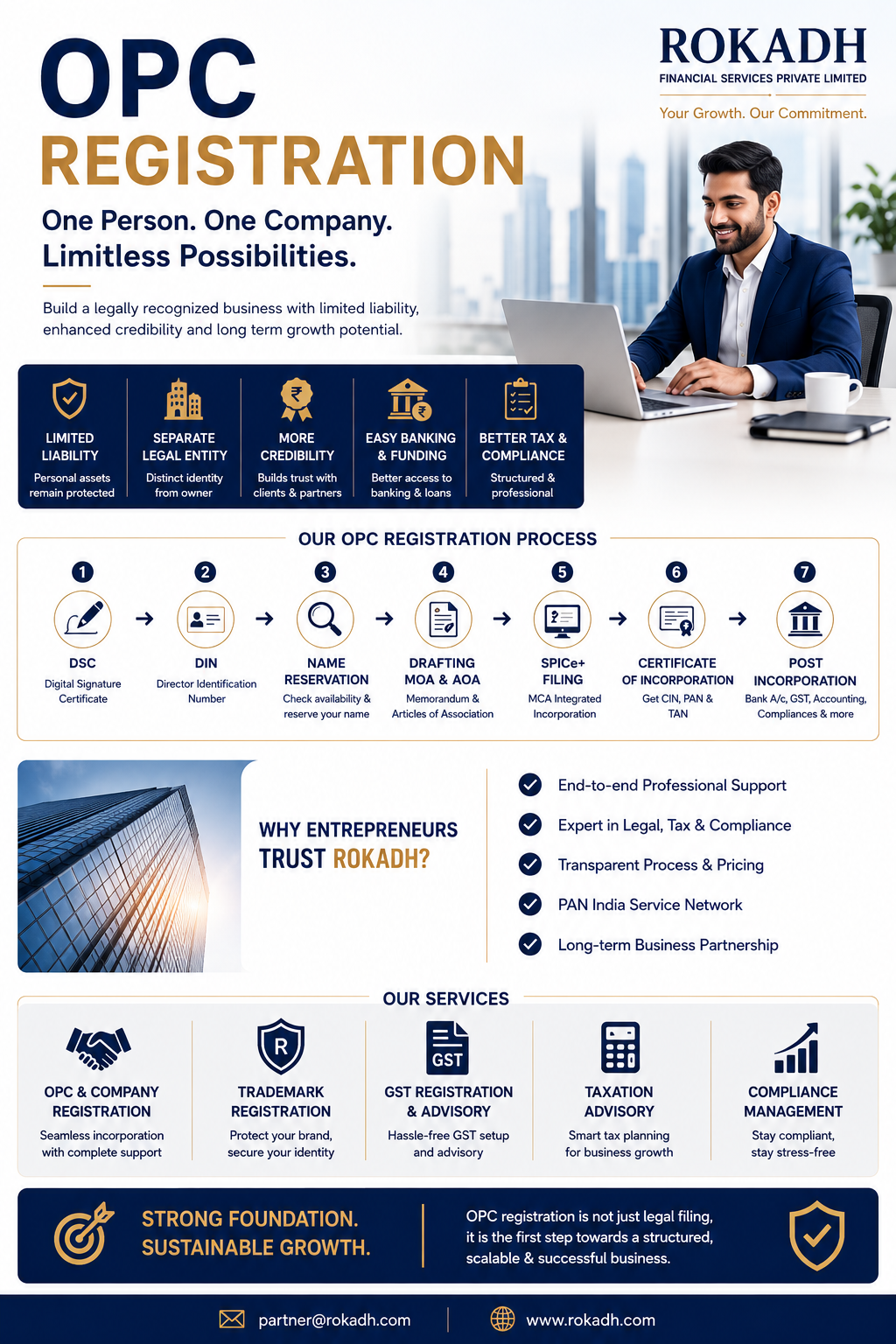
Step 1 — Digital Signature Certificate (DSC)
Since company registration is online through MCA portal:
- digital signature becomes mandatory.
Step 2 — Director Identification Number (DIN)
Relevant Provision
Section 153 of Companies Act, 2013
Every proposed director requires:
- Director Identification Number.
Step 3 — Name Reservation
Relevant Provision
Section 4 of Companies Act, 2013
Business name must:
- not violate trademark,
- not resemble existing entity,
- not violate legal restrictions.
Why Professional Name Search Matters
Improper name selection may create:
- rejection,
- trademark conflict,
- future legal disputes.
This is exactly why professional due diligence by Team Rokadh becomes important.
Step 4 — Drafting MOA & AOA
Relevant Sections
- Section 4 → Memorandum of Association
- Section 5 → Articles of Association
These documents define:
- business objectives,
- powers,
- governance structure.
Step 5 — Filing SPICe+ Forms
Company incorporation is generally processed through:
- MCA integrated incorporation system.
Step 6 — Certificate of Incorporation
Upon approval:
- CIN,
- PAN,
- TAN,
- are generally issued.
Step 7 — Post Incorporation Compliance
After incorporation, businesses may require:
- bank account opening,
- GST registration,
- accounting setup,
- compliance planning,
- trademark registration,
- professional taxation structuring.
Why Entrepreneurs Increasingly Trust Team Rokadh for OPC Registration
1. Strategic Business Understanding
Team Rokadh does not merely:
- file forms.
Team professionally evaluates:
- business model,
- taxation structure,
- scalability,
- compliance exposure,
- future funding readiness.
2. PAN India Professional Support
Businesses across:
- Kanpur,
- Lucknow,
- Delhi,
- Noida,
- Ghaziabad,
- Gurgaon,
- Unnao,
- and PAN India
- increasingly consult Team Rokadh.
3. Trademark + Compliance + Taxation Integration
Most consultants only:
- register company.
Team Rokadh strategically integrates:
- business structuring,
- trademark advisory,
- GST advisory,
- income tax planning,
- startup compliance.
4. Strong Understanding of MCA Compliance
Professional understanding helps reduce:
- rejection risk,
- documentation mistakes,
- legal exposure,
- future compliance complications.
Real Case Study — IT Consultant from Noida
Business Profile
- Age: 31
- Freelance IT Consultant
- Annual Revenue: ₹28 Lakhs
- Existing Structure: Proprietorship
- Problems:
- low corporate credibility,
- weak client trust,
- international contract issues,
- taxation confusion.
Team Rokadh Strategic Advisory
Team Rokadh professionally advised:
- OPC incorporation,
- trademark filing,
- GST structuring,
- professional invoicing setup,
- compliance planning.
Result
Within months:
- corporate credibility improved,
- international client onboarding became smoother,
- banking and documentation improved significantly.
Real Case Study — Startup Founder from Kanpur
Business Profile
- E-commerce startup founder
- Solo entrepreneur
- Seeking investment readiness
Problems Before Consulting Team Rokadh
- no legal structure,
- poor compliance understanding,
- trademark vulnerability,
- taxation confusion.
Team Rokadh Resolution
Team Rokadh professionally:
- structured OPC incorporation,
- secured trademark process,
- advised accounting system,
- created compliance roadmap.
Why Improper OPC Registration Can Become Dangerous
Improper structuring may create:
- MCA rejection,
- legal notices,
- compliance penalties,
- trademark disputes,
- taxation complications,
- banking problems.
This is exactly why professional consultation matters.
Important Compliance After OPC Registration
Annual ROC Filing
Relevant provisions include:
- Section 137,
- Section 92,
- subject to applicable compliance requirements.
Accounting & Bookkeeping
Proper financial records remain important for:
- taxation,
- banking,
- funding,
- compliance protection.
Income Tax Filing
OPC structure generally requires:
- professional tax compliance,
- return filing,
- documentation discipline.
GST Compliance
If applicable thresholds or business nature require:
- GST registration,
- GST return compliance may become mandatory.
Why Trademark Registration Should Also Be Considered
Many startups ignore:
- brand protection.
This later creates:
- legal disputes,
- branding complications,
- market confusion.
Team Rokadh strategically advises:
- trademark protection along with OPC setup.
Comparison: One Person Company (OPC) vs. Sole Proprietorship
| Basis of Comparison | One Person Company (OPC) | Sole Proprietorship |
| Legal Status | Separate Legal Entity; the company is distinct from its owner in the eyes of the law. | No Separate Legal Entity; the business and the owner are considered the same single legal entity. |
| Liability | Limited Liability; the founder's personal assets are protected up to the unpaid share capital. | Unlimited Personal Liability; personal assets (home, savings) can be seized to clear business debts. |
| Credibility & Trust | Higher Credibility; registered with the MCA, requiring transparent corporate filings that appeal to corporate clients. | Moderate Credibility; operates under basic local licenses (GST/MSME), which may look less institutional. |
| Compliance Load | Structured Compliance; requires an annual statutory audit, filing financial statements (AOC-4), and annual returns (MGT-7/7A). | Simpler Compliance; no corporate filings required. Compliance is limited to basic income tax (ITR-3/4) and GST filings. |
| Scalability | Better Scalability; can easily convert into a standard Private Limited company to add shareholders or co-founders. | Limited Scalability; cannot issue shares. Must be entirely restructured into a partnership or corporate entity to expand equity. |
| Funding Potential | Better Potential; bank loans and standard debt funding are easier to secure due to the formal corporate structure. | Comparatively Weaker; capital is strictly limited to the proprietor’s personal creditworthiness and savings. |
Strategic Recommendation for Founders
- Choose Proprietorship if: You are validating a hyper-local business idea, running a low-risk freelance service, or want to keep initial regulatory compliance costs as close to zero as possible.
- Choose OPC if: You are a solo founder launching a brand, dealing with high-value commercial contracts, or handling operational risks where protecting your personal family assets is a non-negotiable priority.
Why Investors & Clients Trust Structured Businesses More
Registered business structure generally improves:
- trust,
- credibility,
- professional positioning,
- digital reputation,
- contractual reliability.
35+ Common Mistakes in OPC Registration & Compliance
Starting a One Person Company (OPC) without proper legal and compliance understanding may create:
- MCA rejection,
- taxation complications,
- banking issues,
- trademark disputes,
- compliance penalties,
- and long-term operational risks.
Below are some of the most common mistakes professionally identified and strategically resolved by:
Team Rokadh — Rokadh Financial Services Private Limited
India’s Leading Financial Services Company
1. Choosing Wrong Business Structure
Many entrepreneurs register OPC without evaluating:
- future funding plans,
- scalability,
- taxation implications,
- ownership structure.
Team Rokadh Professional Advisory
Before registration, Team Rokadh professionally evaluates:
- business nature,
- turnover expectations,
- investment requirements,
- and future expansion goals.
2. Selecting Improper Company Name
Improper name selection often creates:
- MCA rejection,
- trademark conflicts,
- branding issues.
Team Rokadh Guidance
Professional name search and trademark due diligence are extremely important before filing incorporation application.
3. Ignoring Trademark Availability
Many startups:
- register company,
- but fail to:
- secure brand protection.
Result
Later:
- trademark objection,
- legal disputes,
- brand rebranding risks may arise.
4. Wrong Object Clause in MOA
Improper business object drafting may:
- restrict future activities,
- create legal complications.
Team Rokadh Advisory
MOA drafting should strategically align with:
- present operations,
- future expansion,
- and compliance requirements.
5. Using Incorrect Residential Address Proof
Address documentation mismatch frequently causes:
- incorporation delay,
- MCA resubmission.
6. Ignoring DSC Validity
Expired or incorrect Digital Signature Certificates create:
- filing rejection,
- procedural delay.
7. Wrong Nominee Selection
OPC requires nominee structure.
Improper nominee selection may create:
- legal succession complications.
8. Ignoring Future Taxation Impact
Many entrepreneurs focus only upon:
- incorporation,
- while ignoring:
- income tax,
- GST,
- TDS,
- compliance obligations.
9. Using Residential Address Without Proper NOC
This often creates:
- documentation objection,
- MCA resubmission.
10. Choosing OPC Despite Future Funding Needs
OPC may not always suit:
- aggressive startup funding plans.
Team Rokadh Strategic Advisory
Business structure should align with:
- long-term scalability.
11. Ignoring Annual ROC Compliance
Many entrepreneurs wrongly assume:
- incorporation is one-time process.
Result
Non-compliance may attract:
- penalties,
- director disqualification risks.
12. Not Maintaining Proper Accounting Records
Improper bookkeeping creates:
- taxation confusion,
- audit complications,
- banking issues.
13. Mixing Personal & Business Transactions
One of the biggest startup mistakes.
14. Delayed GST Registration
Ignoring GST applicability may create:
- notices,
- penalties,
- operational disruption.
15. Wrong Capital Structuring
Improper capital planning may affect:
- banking credibility,
- future expansion.
16. Copy-Paste MOA & AOA Drafting
Generic drafting often creates:
- operational mismatch,
- compliance risk.
17. Ignoring Compliance Calendar
Missed deadlines create:
- late fees,
- legal complications.
18. Using Trademarked Brand Name Accidentally
This may create:
- legal notices,
- infringement disputes.
19. Delayed PAN/TAN Compliance
This may affect:
- taxation filings,
- banking setup.
20. No Professional Compliance Planning
Many startups fail because:
- compliance ignored during early stages becomes expensive later.
21. Choosing Inexperienced Consultant
Weak professional understanding may create:
- incorrect filing,
- future compliance exposure.
22. Ignoring Startup Scalability Planning
Business structure should support:
- future growth,
- funding,
- expansion.
23. Improper Shareholding Understanding
Founders often fail to understand:
- ownership implications,
- nominee responsibilities.
24. No Business Agreement Structuring
Lack of documentation creates:
- future disputes.
25. Wrong Email & Contact Details in MCA Filing
This may create:
- communication failures,
- OTP verification problems.
26. Ignoring Professional Taxation Planning
Tax inefficiency silently impacts profitability.
27. Delayed Compliance Response
Ignoring MCA or tax notices increases legal exposure.
28. No Financial Discipline After Incorporation
Corporate structure requires:
- accounting discipline,
- documentation control.
29. Using Fake Registered Office
Extremely dangerous legally.
30. Ignoring Bank Compliance Requirements
Improper documentation may delay:
- current account activation.
31. Improper Director Documentation
Mismatch in:
- PAN,
- Aadhaar,
- address proof,
- frequently causes rejection.
32. Ignoring Digital Business Presence
Modern businesses require:
- credibility,
- branding,
- structured identity.
33. Delayed Trademark Filing
Brand theft risk increases substantially.
34. No Professional Business Structuring
Improper structuring weakens:
- operational scalability.
35. Thinking OPC Means “No Compliance”
This is one of the most dangerous misconceptions.
Even OPC structures require:
- annual filings,
- taxation compliance,
- legal discipline.
50+ Most Searched FAQs on OPC Registration
1. What is OPC Registration?
OPC means:
- One Person Company.
It allows a single entrepreneur to operate business through:
- corporate structure with limited liability.
2. Who can register OPC in India?
Generally:
- Indian citizen,
- natural person,
- resident in India,
- subject to applicable legal provisions.
3. Is OPC better than proprietorship?
OPC generally offers:
- better credibility,
- limited liability,
- separate legal identity.
4. Can OPC have only one owner?
Yes.
That is the core concept of OPC structure.
5. Is OPC legally separate from owner?
Yes.
OPC generally enjoys:
- separate legal identity.
6. Why do entrepreneurs increasingly prefer OPC?
Because it provides:
- professionalism,
- credibility,
- compliance structure,
- and legal recognition.
7. Is OPC suitable for startups?
Yes in many cases,
especially for:
- solo founders,
- consultants,
- freelancers,
- professionals.
8. Can OPC raise funding?
Funding possibilities exist,
but structure suitability depends upon:
- investor expectations,
- scalability goals.
9. What documents are required for OPC registration?
Generally:
- PAN,
- Aadhaar,
- address proof,
- photographs,
- office proof,
- subject to applicable requirements.
10. How long does OPC registration take?
Timeline depends upon:
- documentation quality,
- approval process,
- compliance accuracy.
11. Why is DSC mandatory for OPC registration?
Because MCA filing system operates digitally.
12. What is DIN?
Director Identification Number under Companies Act provisions.
13. Can NRIs register OPC?
Legal eligibility depends upon applicable provisions and residential conditions.
14. Is GST registration compulsory for OPC?
Depends upon:
- turnover,
- business activity,
- statutory applicability.
15. Is audit mandatory for OPC?
Applicability depends upon:
- turnover,
- compliance provisions.
16. Can OPC convert into Private Limited Company?
Yes subject to applicable legal provisions.
17. Why is professional MOA drafting important?
Improper drafting may create:
- operational restrictions,
- legal complications.
18. Why should startups secure trademark early?
To protect:
- brand identity,
- market reputation,
- legal ownership.
19. Can one person operate company legally through OPC?
Yes.
That is precisely why OPC structure exists.
20. Why do startups increasingly trust Team Rokadh?
Because Team Rokadh professionally integrates:
- incorporation,
- taxation,
- trademark,
- GST,
- and compliance planning together.
21. Which is better — OPC or LLP?
Both structures serve different business purposes.
OPC may suit:
- solo founders,
- independent professionals,
- consultants,
- startups requiring corporate identity.
LLP may suit:
- partnership-driven businesses,
- multi-founder professional firms.
Team Rokadh Professional Advisory
Business structure should depend upon:
- scalability,
- ownership model,
- taxation,
- compliance expectations,
- and future funding plans.
22. Which is better — OPC or Private Limited Company?
A Private Limited Company may suit:
- startups planning investors,
- multiple shareholders,
- aggressive expansion.
OPC may suit:
- single-founder controlled businesses.
Team Rokadh Guidance
Before incorporation, Team Rokadh professionally evaluates:
- funding vision,
- ownership plans,
- business scalability,
- and compliance comfort.
23. Is OPC suitable for freelancers?
Yes in many cases.
Freelancers increasingly use OPC structure for:
- better credibility,
- corporate invoicing,
- branding,
- and professional business identity.
24. Can consultants register OPC?
Yes.
Consultants including:
- tax consultants,
- IT professionals,
- marketing agencies,
- legal consultants,
- architects,
- designers,
- often prefer OPC structure.
25. Can doctors and professionals register OPC?
Yes subject to applicable professional and legal requirements.
Many professionals increasingly prefer:
- structured corporate identity.
26. Is ROC filing mandatory for OPC?
Yes.
Applicable ROC compliances generally remain mandatory.
Ignoring compliance may attract:
- penalties,
- legal notices,
- compliance exposure.
27. What happens if OPC annual filing is ignored?
Non-compliance may potentially result in:
- additional fees,
- penalties,
- legal complications,
- and compliance risks.
Team Rokadh Advisory
Annual compliance discipline remains extremely important.
28. Can OPC own trademark?
Yes.
OPC may professionally own:
- brand name,
- logo,
- tagline,
- intellectual property.
29. Why is trademark registration important after OPC incorporation?
Because incorporation and trademark are:
- completely different legal protections.
Company registration does not automatically protect:
- brand identity.
30. Why should OPC maintain separate bank account?
Mixing:
- personal and business transactions
- creates:
- accounting confusion,
- taxation complications,
- compliance risks.
31. Can OPC receive international payments?
Yes subject to:
- FEMA compliance,
- banking compliance,
- taxation requirements,
- and business nature.
32. Why is accounting important after OPC registration?
Proper bookkeeping supports:
- taxation,
- banking,
- compliance,
- investor confidence,
- and operational discipline.
33. Is GST compulsory for OPC?
GST applicability depends upon:
- turnover,
- business activity,
- interstate transactions,
- and statutory provisions.
34. Can OPC hire employees?
Yes.
An OPC may:
- employ staff,
- appoint professionals,
- expand operations.
35. Is audit mandatory for OPC?
Applicability depends upon:
- turnover,
- statutory provisions,
- and legal thresholds.
36. What is authorized capital?
Authorized capital represents:
- maximum capital limit company may issue.
37. What is paid-up capital?
Paid-up capital means:
- actual invested capital into company.
38. Can OPC convert into Private Limited Company later?
Yes subject to applicable legal provisions and procedural compliance.
39. Why do MCA applications get rejected?
Common reasons include:
- incorrect documentation,
- improper name selection,
- compliance mismatch,
- drafting errors,
- digital signature issues.
40. Why is professional drafting important during OPC registration?
Improper drafting may create:
- legal ambiguity,
- operational restrictions,
- future compliance complications.
41. What is SPICe+ Form?
SPICe+ is MCA integrated incorporation system used for:
- company incorporation,
- PAN,
- TAN,
- and related registration processing.
42. Can OPC operate PAN India?
Yes.
OPC structure may conduct business:
- across India,
- subject to applicable laws and registrations.
43. Why should startups avoid cheap registration service providers?
Low-quality incorporation support may create:
- defective documentation,
- future legal exposure,
- taxation complications,
- compliance failures.
44. Why is nominee important in OPC?
Nominee helps ensure:
- continuity mechanism,
- subject to applicable provisions.
45. Why should startups consult before incorporation instead of after problems arise?
Improper structuring during initial stage often becomes:
- expensive,
- stressful,
- and legally complicated later.
46. Can Team Rokadh help with complete startup structuring?
Yes.
Team Rokadh professionally assists with:
- OPC Registration,
- Trademark Registration,
- GST Registration,
- Taxation Planning,
- Compliance Structuring,
- Accounting Setup,
- and Strategic Business Advisory.
47. Why is compliance planning important from day one?
Because delayed compliance often creates:
- penalties,
- notices,
- operational stress,
- and legal exposure.
48. Why do modern startups increasingly prefer structured corporate identity?
Corporate identity often improves:
- business trust,
- digital reputation,
- banking credibility,
- customer confidence,
- vendor perception.
49. Can improper registration structure impact future funding or expansion?
Yes significantly.
Wrong structure may create:
- investor hesitation,
- restructuring cost,
- taxation inefficiency,
- compliance burden.
50. Why should entrepreneurs increasingly trust Team Rokadh for OPC Registration and startup advisory?
Because Team Rokadh focuses not merely upon:
- incorporation filing,
- but upon:
- strategic business structuring,
- compliance protection,
- taxation planning,
- trademark protection,
- scalability,
- and long-term business growth.
This is exactly why startups and entrepreneurs across:
- Kanpur,
- Lucknow,
- Delhi,
- Noida,
- Ghaziabad,
- Gurgaon,
- Unnao,
- and PAN India
- increasingly trust:
Team Rokadh — Rokadh Financial Services Private Limited
India’s Leading Financial Services Company
for:
- OPC Registration,
- Startup Structuring,
- Trademark Registration,
- GST Advisory,
- Taxation Compliance,
- and Strategic Business Consulting.
Final Professional Conclusion
OPC registration is not merely:
- legal filing.
It is often the first professional step toward:
- structured entrepreneurship,
- scalable business growth,
- compliance discipline,
- and corporate credibility.
This is exactly why entrepreneurs across:
- Kanpur,
- Lucknow,
- Delhi,
- Noida,
- Ghaziabad,
- Gurgaon,
- Unnao,
- and PAN India
- increasingly trust:
Team Rokadh — Rokadh Financial Services Private Limited
India’s Leading Financial Services Company
for:
- OPC Registration,
- Startup Structuring,
- Trademark Registration,
- GST Registration,
- Taxation Advisory,
- Compliance Planning,
- and Strategic Business Consulting.