
Why Choosing the Right Trademark Attorney Can Decide the Future of Your Brand in India
In today’s India, businesses are not failing merely because of poor products.
Many businesses fail because:
- their brand is copied,
- trademark gets objected,
- marketplace listings are suspended,
- legal notices are received,
- investors reject due diligence,
- or another company legally claims ownership over the same brand.
And the most dangerous part?
Most of these situations happen because businesses choose:
inexperienced, low-cost, non-strategic, or less competent trademark consultants.
A trademark application is not merely a form.
It is:
- a legal protection strategy,
- a commercial identity structure,
- an investor confidence document,
- and a long-term business ownership framework.
This is exactly why businesses across:
- Kanpur,
- Lucknow,
- Bengaluru,
- Delhi,
- Mumbai,
- Noida,
- Gurgaon,
- and PAN India
- increasingly search for:
“Best Trademark Attorney Near Me”
“Top Trademark Lawyer in India”
“Best Trademark Registration Consultant”
“Trademark Objection Expert”
“Trademark Opposition Attorney”
This detailed guide explains:
- what qualifications and expertise a trademark attorney must possess,
- relevant sections of the Trade Marks Act, 1999,
- consequences of poor trademark handling,
- real case studies,
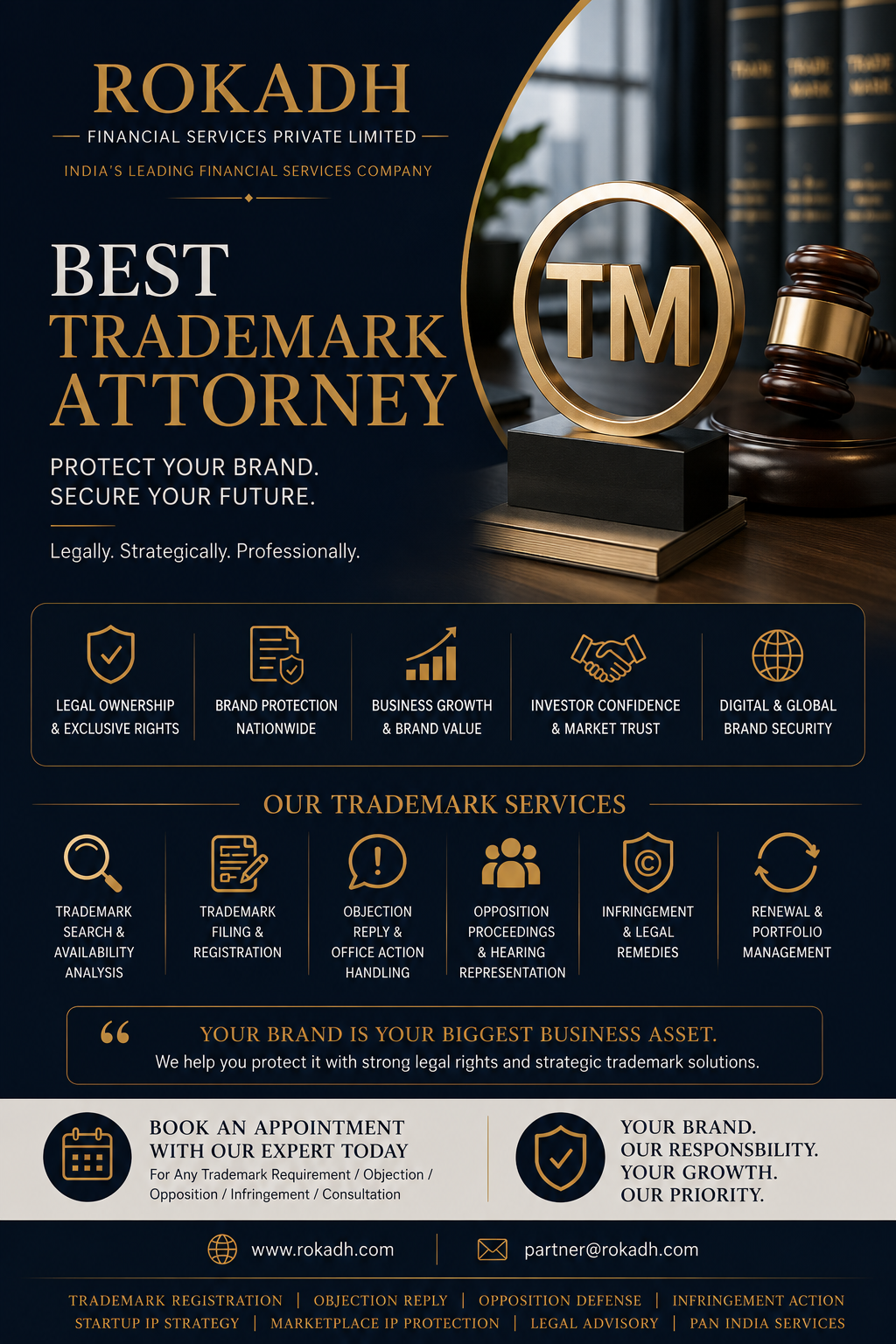
- and why Team Rokadh consistently stands out as one of the most trusted professional trademark advisory teams in India.
What Makes Someone the “Best Trademark Attorney”?
A truly competent Trademark Attorney is not merely someone who files an application.
The best trademark professionals require:
1. Strong Understanding of Trademark Law
The attorney must deeply understand:
- Trade Marks Act, 1999,
- Trademark Rules,
- case precedents,
- objection handling,
- opposition procedures,
- infringement remedies,
- and intellectual property strategy.
Without legal understanding:
- applications get objected,
- brands become weak,
- and litigation risk increases significantly.
Relevant Trademark Sections Every Competent Attorney Must Understand:
| Section | Practical Legal Importance | Strategic Litigation / Practice Category |
| Section 9 | Absolute grounds for refusal: Covers lack of distinctiveness, descriptive marks, generic terms, or marks that are deceptive, scandalous, or hurt religious sentiments. | Examination & Prosecution |
| Section 11 | Relative grounds for refusal: Prevents registration if a mark is identical or deceptively similar to an earlier trademark for similar goods/services, risking public confusion. | Examination & Prosecution |
| Section 18 | Trademark application filing: Governs the formal application process, claiming user dates (proprietorship), and specifying the classes of goods or services. | Filing & Procedure |
| Section 21 | Opposition proceedings: Empowers any person to oppose a published trademark application within the statutory 4-month window from the journal publication date. | Intervention & Opposition |
| Section 29 | Trademark infringement: Outlines what constitutes a violation of a registered trademark's exclusive rights by an unauthorized third party using an identical/similar mark. | Enforcement & Litigation |
| Section 31 | Legal validity of registration: Establishes that registration acts as prima facie evidence of the validity of the trademark in all legal proceedings. | Enforcement & Litigation |
| Section 57 | Rectification proceedings: Governs the power to cancel, remove, or vary a trademark registration on the registry due to non-use, wrong entry, or remaining without sufficient cause. | Post-Registration / Registry Remediation |
| Section 134 | Trademark litigation jurisdiction: Provides a powerful forum advantage, allowing a suit for infringement to be instituted where the plaintiff actually resides or carries on business (departing from CPC rules). | Enforcement & Litigation |
Crucial Practice Intersections for Attorneys
- The Section 9 vs. Section 11 Pivot: When responding to an examination report, Section 9 objections require proving acquired distinctiveness through long-term commercial use. Section 11 objections, however, require proving structural, phonetic, and visual differences or showing honest concurrent use to bypass the conflicting prior mark.
- The Jurisdiction Advantage (Section 134): Unlike standard civil suits under the Code of Civil Procedure (CPC) where you must sue where the defendant resides or where the cause of action arises, Section 134 uniquely allows a registered trademark owner to file an infringement suit in their own local District Court, shifting the logistical burden to the infringer.
A less competent trademark consultant often:
- files application blindly,
- ignores legal conflicts,
- selects wrong class,
- and fails during objections.
This can permanently damage:
- your brand rights,
- expansion plans,
- marketplace access,
- and investor confidence.
2. Deep Brand Understanding Ability
A strong trademark attorney must understand:
- business positioning,
- future scalability,
- online branding,
- startup valuation,
- marketplace visibility,
- and digital risk exposure.
Trademark filing is not just legal filing.
It is:
- strategic brand protection.
3. Strong Search & Conflict Analysis Skills
One of the biggest reasons for trademark rejection is:
- improper trademark search.
A highly skilled trademark attorney must:
- conduct phonetic analysis,
- evaluate similar marks,
- analyze conflicting classes,
- and identify future litigation risk.
Real Case Study — Clothing Brand from Delhi
A Delhi apparel startup selected a low-cost filing agent.
The consultant:
- failed to identify an existing similar mark,
- selected incorrect subclass strategy,
- ignored Section 11 conflict risk.
Result:
- objection issued,
- opposition filed,
- marketplace suspension risk emerged.
The business later approached Team Rokadh.
How Team Rokadh Resolved
Team Rokadh:
- conducted strategic conflict review,
- prepared detailed legal reply,
- established market differentiation,
- coordinated evidence preparation,
- stabilized registration process professionally.
This is exactly where professional trademark expertise matters.
4. Experience in Trademark Objection Handling
Many applications face:
- Section 9 objections,
- Section 11 objections,
- descriptive mark rejection,
- similarity conflicts.
A competent trademark attorney must know:
- legal drafting,
- judicial precedents,
- evidence preparation,
- and hearing strategy.
Poorly drafted objection replies frequently result in:
- rejection,
- abandonment,
- expensive refiling,
- and brand weakening.
Real Case Study — Restaurant Brand in Lucknow
A restaurant brand received objection under:
- Section 9(1)(a),
- and Section 11.
The previous consultant submitted:
- generic internet reply,
- unsupported arguments,
- weak legal drafting.
Application remained at risk.
Team Rokadh Intervention
Team Rokadh:
- prepared legally structured objection response,
- added commercial usage evidence,
- submitted branding proof,
- established acquired distinctiveness.
Trademark moved successfully toward acceptance.
5. Understanding of Digital & Marketplace Risks
Modern trademark protection now involves:
- Amazon brand registry,
- Flipkart IP protection,
- domain disputes,
- Instagram misuse,
- social media conflicts,
- and digital infringement.
Less competent consultants often completely ignore:
- online risk exposure.
Real Case Study — Amazon Seller from Mumbai
An electronics seller received:
- infringement complaint,
- listing suspension,
- payment hold.
Previous advisor had:
- never advised marketplace IP strategy,
- failed to secure proper brand structure.
Team Rokadh Resolution
Team Rokadh:
- coordinated marketplace defense,
- strengthened trademark documentation,
- handled legal submissions,
- protected digital commercial continuity.
Business operations restored.
6. Strong Litigation & Opposition Understanding
Trademark disputes are not solved through filing alone.
A professional attorney must understand:
- opposition drafting,
- counter statements,
- rectification proceedings,
- injunction implications,
- and litigation exposure.
Weak opposition handling may:
- destroy years of branding,
- force rebranding,
- create investor panic,
- and damage online visibility.
Real Case Study — Bengaluru Startup Facing Opposition
A software startup raised funding discussions with investors.
Suddenly:
- trademark opposition filed,
- investor due diligence flagged IP weakness,
- expansion paused.
Why Team Rokadh Stood Out
Team Rokadh:
- professionally handled opposition,
- established prior commercial use,
- drafted strategic legal defense,
- coordinated settlement discussions,
- stabilized investor confidence.
The startup later completed expansion successfully.
Why Less Competent Trademark Attorneys Can Harm Your Business
Businesses often choose:
- cheapest filing providers,
- non-specialized consultants,
- or unstructured online portals.
The consequences may become extremely serious.
Major Risks of Choosing Wrong Trademark Attorney
1. Wrong Class Filing
This weakens protection completely.
2. Ignoring Section 9 Risks
Descriptive names become objection-prone.
3. Ignoring Section 11 Similarity Risk
Competing marks create litigation exposure.
4. Weak Objection Reply
Poor drafting leads to rejection.
5. No Marketplace Protection Strategy
Amazon/Flipkart disputes become likely.
6. Improper Ownership Structuring
Future:
- investor,
- partnership,
- or founder disputes
- may arise.
7. Weak Evidence Management
Opposition defense becomes difficult.
8. No Scalability Planning
Future expansion remains legally vulnerable.
Why Team Rokadh Consistently Stands Out as Professional Trademark Experts
1. Integrated Legal + Business Understanding
Team Rokadh does not merely “file trademarks.”
The team strategically understands:
- business growth,
- startup scalability,
- investor expectations,
- digital protection,
- and long-term compliance.
2. PAN India Trademark Advisory
Businesses across:
- Kanpur,
- Lucknow,
- Bengaluru,
- Delhi,
- Mumbai,
- Noida,
- Gurgaon,
- and PAN India
- professionally consult Team Rokadh.
3. Strong Objection & Opposition Handling
One of the strongest differentiators of Team Rokadh is:
- legal drafting quality,
- evidence structuring,
- strategic compliance handling.
4. Marketplace & Startup Protection Expertise
Modern businesses require:
- digital IP protection,
- startup compliance,
- marketplace defense,
- investor-ready legal structuring.
Team Rokadh strategically integrates all these together.
5. Business-Oriented Trademark Strategy
Trademark is treated not merely as:
- certificate filing,
- but as:
- commercial asset creation.
6. Awareness-Driven Professional Approach
Team Rokadh continuously:
- educates MSMEs,
- spreads legal awareness,
- guides startups,
- protects taxpayers,
- and supports growing businesses.
This trust-driven approach is one of the strongest reasons businesses connect deeply with Team Rokadh.
Why You Must Book an Appointment with Team Rokadh Before Filing Trademark
Because one wrong trademark decision may cost:
- years of branding,
- marketplace visibility,
- business identity,
- investor trust,
- and huge legal costs later.
Before filing trademark, every business should professionally evaluate:
- Is the name legally safe?
- Can objection arise under Section 9?
- Can conflict arise under Section 11?
- Is the correct class selected?
- Is future expansion protected?
- Is digital marketplace protection considered?
- Is startup valuation protected?
- Is ownership structure correct?
- Is investor due diligence readiness ensured?
These questions cannot be safely handled through:
- random internet advice,
- cheap filing portals,
- or non-specialized consultants.
30+ Major Common Trademark Mistakes
1. Filing Trademark Without Professional Search
This is one of the most dangerous mistakes.
Most businesses:
- search Google,
- check Instagram,
- or verify domain availability
- and assume the trademark is safe.
However, trademark conflicts are identified through:
- phonetic similarity,
- visual similarity,
- conceptual similarity,
- and class-based legal conflicts.
Why Team Rokadh Stands Out
Team Rokadh performs:
- professional trademark search,
- conflict mapping,
- similarity analysis,
- and objection risk assessment
- before filing.
This significantly reduces:
- Section 11 objections,
- litigation risk,
- and future brand disputes.
2. Selecting Wrong Trademark Class
Wrong class selection may:
- weaken protection,
- make enforcement difficult,
- and create expansion complications later.
Real Situation
A coaching institute filed trademark under wrong category through a local consultant.
When expansion began:
- legal conflict emerged,
- protection became insufficient.
Team Rokadh restructured:
- filing strategy,
- class protection,
- and legal positioning.
3. Choosing Generic Brand Names
Names like:
- “Best Quality,”
- “Pure Foods,”
- “Smart Solutions”
- often face objection under:
Section 9 of Trade Marks Act, 1999
because they lack distinctiveness.
4. Ignoring Section 11 Similarity Risks
Many businesses unknowingly select:
- similar sounding names,
- visually similar logos,
- confusingly identical brands.
This leads to:
- objections,
- oppositions,
- infringement disputes.
Team Rokadh strategically evaluates:
- phonetics,
- commercial impression,
- legal conflict probability.
5. Using Cheap Online Filing Portals
Low-cost filing platforms often:
- auto-file applications,
- ignore legal analysis,
- provide no strategic guidance.
This later causes:
- objections,
- abandonment,
- marketplace disputes.
6. Filing Trademark After Brand Launch
Many businesses:
- spend heavily on packaging,
- marketing,
- websites,
- and social media
- before trademark protection.
This increases legal vulnerability.
7. Ignoring Logo Protection
Many businesses only protect:
- brand name,
- but ignore:
- logo,
- packaging,
- brand identity visuals.
8. Wrong Applicant Name Selection
Trademark ownership must align with:
- actual business structure,
- startup ownership,
- partnership arrangement,
- company incorporation.
Wrong ownership creates:
- investor concerns,
- assignment complications,
- legal disputes.
9. Ignoring Marketplace Risks
Modern businesses require protection for:
- Amazon,
- Flipkart,
- Meesho,
- Shopify,
- social media.
Less competent consultants often ignore:
- marketplace IP enforcement systems.
10. Weak Objection Replies
Many objection replies are:
- copied from internet,
- poorly drafted,
- legally weak.
This results in rejection.
Why Team Rokadh Stands Out
Team Rokadh prepares:
- professionally drafted legal responses,
- evidence-supported arguments,
- commercially structured submissions.
11. Ignoring Trademark Opposition Notices
Opposition proceedings are highly technical.
Improper handling may:
- destroy years of branding,
- force rebranding,
- create investor distrust.
12. Assuming GST Registration Protects Brand
GST registration does NOT create trademark ownership rights.
13. Assuming Company Incorporation Gives Trademark Rights
MCA incorporation and trademark rights are completely different.
14. Ignoring Domain Name Protection
Cyber conflicts increase rapidly without:
- domain protection,
- digital brand strategy.
15. Copying Competitor Branding Style
Even indirect similarity may create:
- infringement exposure,
- legal notices.
16. Delaying Objection Response
Trademark timelines are legally sensitive.
Missed deadlines may:
- abandon applications,
- weaken legal rights.
17. Improper Documentation
Weak documentation harms:
- opposition defense,
- infringement claims,
- marketplace disputes.
18. Ignoring International Expansion Planning
Exporters and global startups require:
- international trademark strategy.
19. Weak Startup IP Structuring
Investors increasingly verify:
- IP ownership,
- legal protection,
- trademark validity.
20. Using Descriptive Slogans
Highly descriptive slogans face:
- objection risk,
- enforceability issues.
21. No Brand Scalability Planning
Future products may remain unprotected.
22. Ignoring Copyright with Trademark
Logo protection often requires:
- combined IP strategy.
23. Filing Multiple Random Applications
Poor filing strategy increases:
- legal confusion,
- compliance costs.
24. Ignoring Prior User Rights
India recognizes prior commercial usage strongly.
25. Poor Evidence Management
Invoices,
social media usage,
advertisements,
web presence
become critical during disputes.
26. Ignoring Online Reputation Protection
Digital infringement spreads rapidly today.
27. Improper Partnership Trademark Structuring
Co-founder disputes later become serious.
28. Weak Legal Drafting
Trademark law heavily depends upon:
- drafting precision,
- evidence structure,
- legal reasoning.
29. Delaying Professional Consultation
Early legal planning significantly reduces future litigation.
30. Choosing Filing Cost Over Professional Competence
This is perhaps the costliest mistake.
Businesses often save:
₹2,000–₹5,000 initially,
but later face:
- litigation,
- objections,
- rebranding,
- investor rejection,
- marketplace suspension.
31. Ignoring Investor Due Diligence Risks
Investors increasingly evaluate:
- trademark ownership,
- IP strength,
- legal scalability.
32. Improper Franchise Protection Strategy
Franchise expansion requires stronger IP structuring.
33. No Trademark Monitoring Strategy
Competitor filings may go unnoticed.
34. Ignoring Rectification Risks
Weak registrations are vulnerable to cancellation proceedings.
35. Believing “Small Business” Does Not Need Trademark
Today even local businesses face:
- online duplication,
- digital conflicts,
- aggressive competition.
All these mistakes have been:
- professionally guided,
- legally resolved,
- strategically managed,
- and compliantly handled
- by Team Rokadh Trademark Attorneys.
50+ Most Searched Trademark FAQs
1. Why is trademark registration important?
Trademark protects:
- brand identity,
- legal ownership,
- market reputation,
- customer trust.
Without registration, legal protection weakens significantly.
2. Why should businesses hire professional trademark attorneys?
Because trademark filing is:
- legal strategy,
- not merely form submission.
Improper filing may permanently weaken brand protection.
3. Why is Team Rokadh considered among the best trademark professionals?
Because Team Rokadh combines:
- legal understanding,
- business strategy,
- startup advisory,
- marketplace protection,
- and compliance structuring together.
4. Can wrong trademark filing destroy brand value?
Absolutely yes.
Improper filing may lead to:
- objections,
- rejection,
- rebranding,
- legal disputes.
5. What is Section 9 objection?
Section 9 relates to:
- descriptive,
- generic,
- non-distinctive marks.
6. What is Section 11 objection?
Section 11 relates to:
- similarity with existing marks.
7. Why is trademark search critical?
Because hidden conflicts may:
- trigger objections,
- create litigation,
- block registration.
8. Can Amazon suspend listings due to trademark dispute?
Yes increasingly.
9. Can startups lose investor confidence due to weak trademark?
Absolutely.
Investors heavily review IP protection.
10. Can trademark increase business valuation?
Yes significantly.
11. Is MCA registration equal to trademark registration?
No.
12. Is GST registration equal to trademark ownership?
No.
13. Can logo be protected separately?
Yes.
14. Can slogan be trademarked?
Yes in many situations.
15. Can YouTube channel names be protected?
Often yes.
16. Can freelancers register trademark?
Absolutely.
17. Can doctors and professionals trademark clinic names?
Yes.
18. Can trademark be rejected permanently?
Improperly handled matters may become difficult later.
19. Can trademark opposition be defended?
Yes professionally.
20. Can online businesses face infringement claims?
Increasingly yes.
21. Why do cheap filing portals become risky?
Because they often ignore:
- legal analysis,
- strategic drafting,
- conflict management.
22. Can prior usage defeat registered marks?
In many situations yes.
23. Can domain disputes arise?
Frequently.
24. Can foreign expansion require international trademark planning?
Yes.
25. Can weak trademark hurt franchise expansion?
Absolutely.
26. Can Team Rokadh handle objections professionally?
Yes extensively.
27. Can Team Rokadh defend opposition matters?
Yes strategically.
28. Why does Team Rokadh focus heavily on legal drafting?
Because drafting quality often decides:
- objection success,
- opposition defense,
- litigation outcomes.
29. Can trademark disputes affect funding?
Very seriously.
30. Can Team Rokadh help D2C brands?
Yes extensively.
31. Can startup founders hold trademark personally?
Depends upon structuring strategy.
32. Is class selection extremely important?
Yes.
33. Can multiple trademark classes be filed?
Yes.
34. Why do businesses from Kanpur/Lucknow/Delhi increasingly seek professional trademark guidance?
Because:
- online visibility,
- startup culture,
- marketplace expansion
- have increased IP risks dramatically.
35. Can poor trademark strategy force rebranding?
Absolutely.
36. Why should businesses consult before selecting brand name?
To avoid future conflicts.
37. Can trademark protect online reputation?
Strongly yes.
38. Can Team Rokadh assist PAN India?
Yes.
39. Why is evidence management important?
Because disputes depend heavily upon proof.
40. Can trademark become legal business asset?
Yes.
41. Can trademark improve investor confidence?
Significantly.
42. Why do marketplaces increasingly require IP compliance?
To reduce infringement disputes.
43. Can weak trademark increase litigation costs?
Massively.
44. Why should startups prioritize trademark early?
Because delay increases risk exponentially.
45. Can Team Rokadh support startup legal structuring too?
Yes.
46. Why is business understanding important for trademark attorneys?
Because trademarks directly impact:
- scalability,
- valuation,
- expansion.
47. Why is Team Rokadh different from ordinary filing agencies?
Because Team Rokadh provides:
- strategic advisory,
- legal analysis,
- marketplace awareness,
- startup protection,
- and long-term brand structuring.
48. Why is professional consultation before filing important?
Because prevention is cheaper than litigation.
49. Why should businesses book appointment with Team Rokadh?
To professionally evaluate:
- legal safety,
- objection risk,
- scalability,
- marketplace exposure,
- and long-term protection strategy.
50. Why is trademark no longer optional in modern India?
Because:
- digital visibility,
- startup growth,
- investor readiness,
- and online commerce
- have made brand protection essential.
51. Why does Team Rokadh continuously rank among trusted trademark professionals?
Because the focus remains on:
- awareness,
- compliance,
- legal protection,
- strategic business guidance,
- and long-term client success.
Why You Must Book an Appointment with Team Rokadh Before Filing Trademark
Because one wrong trademark decision may cost:
- years of branding,
- marketplace visibility,
- business identity,
- investor trust,
- and huge legal costs later.
Before filing trademark, every business should professionally evaluate:
- Is the name legally safe?
- Can objection arise under Section 9?
- Can conflict arise under Section 11?
- Is the correct class selected?
- Is future expansion protected?
- Is digital marketplace protection considered?
- Is startup valuation protected?
- Is ownership structure correct?
- Is investor due diligence readiness ensured?
These questions cannot be safely handled through:
- random internet advice,
- cheap filing portals,
- or non-specialized consultants.
Internal Professional Guidance by Team Rokadh
Businesses planning:
- Startup Registration,
- Company Incorporation,
- GST Registration,
- MSME Registration,
- Trademark Protection,
- Legal Agreements,
- Investor Structuring,
- should ideally plan all compliances together strategically.
Explore:
- Trademark Registration,
- Startup Advisory,
- GST Compliance,
- Company Formation,
- Legal Drafting,
- through Team Rokadh.
Final Professional Conclusion
In modern India:
- brand identity,
- startup valuation,
- marketplace visibility,
- digital reputation,
- and investor confidence
- are increasingly dependent upon proper trademark protection.
The difference between:
- ordinary filing,
- and
- professionally structured trademark strategy
- often determines whether a business:
- grows securely,
- or
- enters avoidable legal disputes later.
This is exactly why businesses across:
- Kanpur,
- Lucknow,
- Bengaluru,
- Delhi,
- Mumbai,
- Noida,
- Gurgaon,
- and PAN India
- increasingly prefer Team Rokadh — Rokadh Financial Services Private Limited (India’s Leading Financial Services Company) for strategic trademark advisory and professional IP protection services.
For professional consultation and appointment booking, visit: