Why GSTR-3B Has Become One of the Most Important GST Compliances in India
A single mistake in GSTR-3B can lead to:
- GST notices,
- blockage of Input Tax Credit (ITC),
- interest liabilities,
- penalties,
- cancellation proceedings,
- departmental investigations,
- refund withholding,
- vendor disputes,
- and even prosecution in serious cases.
Across India, thousands of businesses receive notices every month because:
- GSTR-1 and GSTR-3B mismatched,
- ITC claimed exceeded GSTR-2B,
- tax paid under wrong head,
- outward supplies incorrectly reported,
- nil return wrongly filed,
- late filing attracted notices,
- or reconciliation was ignored.
Many taxpayers realize the seriousness only after receiving notices under Section 61, Section 73, Section 74, Rule 88C, Rule 88D, DRC-01, ASMT-10, or demand recovery proceedings.
This detailed guide is prepared for:
- Businesses
- MSMEs
- Traders
- Startups
- Manufacturers
- Service Providers
- Professionals
- E-commerce sellers
- Freelancers
- Consultants
- Exporters
- PAN India taxpayers
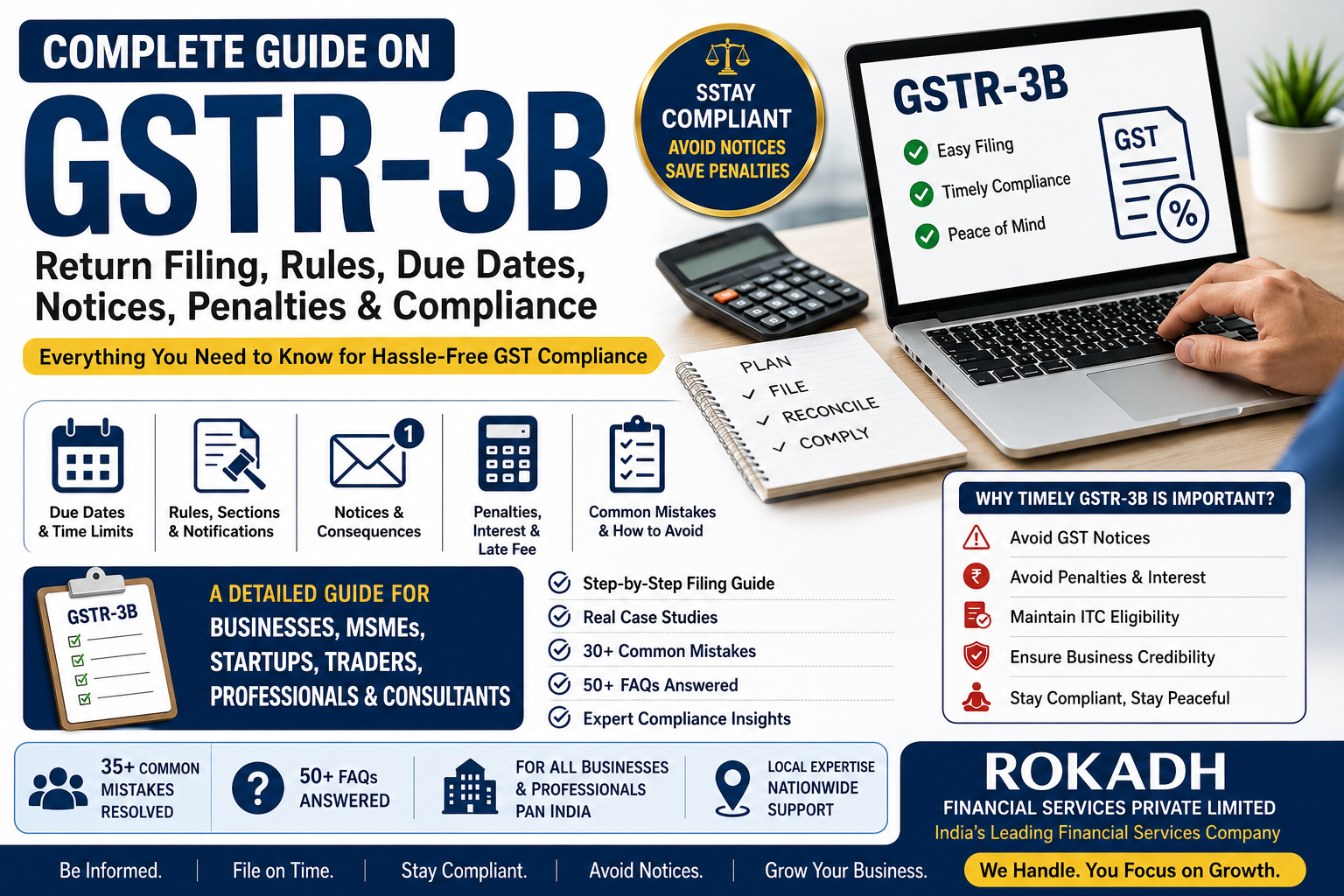
This guide explains:
- What is GSTR-3B
- Legal provisions
- Due dates
- Monthly vs QRMP filing
- Correction methods
- Notices under GST
- Penalties and consequences
- Real practical case studies
- 30+ common mistakes
- 50+ frequently searched FAQs
Throughout this guide, Team Rokadh has also explained how structured reconciliation, litigation management, and proactive compliance can help businesses avoid notices and financial losses.
What is GSTR-3B?
GSTR-3B is a self-declared summary GST return filed under Rule 61 of the CGST Rules.
It contains:
- outward taxable supplies,
- inward supplies liable to reverse charge,
- Input Tax Credit claimed,
- tax payable,
- tax paid,
- exempt supplies,
- nil rated supplies,
- and interest/late fee details.
It is one of the most critical GST returns because tax liability is discharged through GSTR-3B.
Failure to correctly file GSTR-3B may directly impact:
- GST compliance rating,
- ITC eligibility,
- vendor reconciliation,
- departmental scrutiny,
- and future litigation exposure.
Legal Provisions Governing GSTR-3B
Important sections and rules applicable:
- Section 39 of CGST Act – Furnishing of returns
- Rule 61 – Form and manner of furnishing return
- Section 50 – Interest on delayed payment
- Section 47 – Late fee for delayed filing
- Section 73 – Non-fraud demand proceedings
- Section 74 – Fraud/suppression proceedings
- Rule 88C – Difference between GSTR-1 and GSTR-3B
- Rule 88D – Excess ITC claimed in GSTR-3B over GSTR-2B
- Section 61 – Scrutiny of returns
- Section 16 – Conditions for claiming ITC
Internal Compliance Advisory by Team Rokadh
Businesses should not treat GSTR-3B as a mere monthly formality. It is one of the most litigated GST compliances in India. Team Rokadh regularly assists businesses with GST reconciliation, litigation support, notice handling, and PAN India GST compliance management.
Who is Required to File GSTR-3B?
Almost every regular GST registered taxpayer is required to file GSTR-3B.
This includes:
- Proprietorships
- Partnership firms
- LLPs
- Private Limited Companies
- OPCs
- Traders
- Manufacturers
- Service providers
- Freelancers
- E-commerce sellers
- Startups
- Consultants
Except:
- Composition taxpayers,
- ISD,
- non-resident taxable persons,
- and a few special category registrations.
Monthly vs Quarterly GSTR-3B Filing (QRMP Scheme)
Monthly Filing
Taxpayers having aggregate turnover exceeding ₹5 crore in preceding financial year are generally required to file monthly GSTR-3B.
Due Date
20th of next month.
Example:
- April return → Due by 20th May.
Quarterly Filing Under QRMP Scheme
Taxpayers with turnover up to ₹5 crore may opt QRMP scheme.
Due Dates
- 22nd of month succeeding quarter for some states
- 24th for other states
However, PMT-06 monthly tax payment may still apply.
Heads of GSTR-3B and How to Fill Them Correctly
Table 3.1 – Outward Taxable Supplies
Includes:
- taxable outward supplies,
- zero-rated supplies,
- nil rated supplies,
- exempt supplies,
- reverse charge supplies.
Common Risk
Mismatch with GSTR-1 triggers Rule 88C notice.
Real Case Story – Manufacturing Company Received Rule 88C Notice
A Ludhiana-based steel trader reported:
- ₹2.84 crore sales in GSTR-1
- ₹2.31 crore taxable value in GSTR-3B.
The taxpayer later received auto-generated intimation under Rule 88C.
The notice stated:
“Difference has been observed between tax liability reported in FORM GSTR-1 and FORM GSTR-3B. You are requested to either pay differential tax along with interest or explain the difference.”
The proposed differential liability exceeded ₹9.72 lakh.
Upon detailed reconciliation, Team Rokadh identified:
- export invoices duplicated in GSTR-1,
- debit note reporting overlap,
- cancelled invoices still reflected.
After preparing detailed reconciliation and documentary submissions:
- differential liability reduced drastically,
- final additional tax liability became NIL,
- interest exposure avoided,
- further scrutiny proceedings closed.
Compliance Guidance by Team Rokadh
Monthly reconciliation between books, GSTR-1 and GSTR-3B is essential to avoid automated notices.
Table 3.1(d) – Reverse Charge Liability
Businesses must report GST payable under reverse charge mechanism.
Common transactions:
- GTA services,
- advocate fees,
- import of services,
- director remuneration,
- ocean freight (where applicable),
- notified supplies.
Real Case Story – Director Salary Triggered GST Inquiry
A Delhi startup paid large remuneration to directors.
Department alleged:
- GST under reverse charge unpaid,
- interest applicable under Section 50,
- penalty proceedings may initiate.
Proposed exposure:
- Tax: ₹4.18 lakh
- Interest: ₹1.26 lakh
- Penalty proceedings proposed separately.
Team Rokadh examined:
- employment contracts,
- TDS deduction under salary provisions,
- PF records,
- payroll classification.
It was successfully demonstrated that payments were employer-employee salary transactions and not liable under reverse charge.
Result:
- entire GST demand dropped,
- NIL liability finalized.
Strategic Advisory by Team Rokadh
Proper structuring of director remuneration and documentation is critical to avoid unnecessary GST disputes.
Table 4 – Input Tax Credit (ITC)
This is one of the most scrutinized tables.
Businesses report:
- eligible ITC,
- reverse charge ITC,
- ineligible credits,
- reclaimed credits.
Major Legal Provision
Section 16 read with Rule 36.
Common Trigger
ITC claimed in excess of GSTR-2B.
This may trigger Rule 88D notice.
Rule 88D Notices – Excess ITC Claimed
What Happens?
If ITC in GSTR-3B exceeds ITC available in GSTR-2B beyond prescribed tolerance, system-generated notices may arise.
Real Case Story – Excess ITC Notice of ₹28.64 Lakh
A Jaipur electronics wholesaler claimed ITC based on purchase register.
However:
- several vendors had not filed GSTR-1,
- ITC failed to reflect in GSTR-2B.
Department issued notice:
“Excess Input Tax Credit appears to have been availed in FORM GSTR-3B as compared to FORM GSTR-2B.”
Proposed reversal:
- ITC: ₹28.64 lakh
- Interest exposure separately applicable.
Team Rokadh:
- conducted vendor-wise reconciliation,
- obtained vendor compliance proofs,
- secured pending return filings,
- submitted invoice trail and payment evidence.
Final outcome:
- over ₹24 lakh credit successfully defended,
- balance reconciled through vendor correction,
- major litigation avoided.
Compliance Support
Businesses with large vendor bases should conduct monthly ITC reconciliation. Team Rokadh provides vendor compliance monitoring and GST litigation support across India.
Due Dates for GSTR-3B Filing
Monthly Filers
Due date: 20th of succeeding month.
QRMP Filers
Due date:
- 22nd or 24th of succeeding month after quarter.
Late Filing Consequences
- Interest under Section 50
- Late fee under Section 47
- E-way bill restriction
- ITC blockage
- GST notices
- Bank loan issues
- Vendor compliance impact
Late Fee on GSTR-3B
Late fee generally:
- ₹50 per day (CGST + SGST)
- ₹20 per day for NIL returns
Subject to maximum caps.
Interest Under Section 50
Interest generally applicable:
- 18% on delayed tax payment
What Happens if GSTR-3B is Not Filed?
Consequences may include:
- late fee,
- interest,
- blocking of e-way bill generation,
- suspension of GST registration,
- cancellation proceedings,
- assessment notices,
- recovery proceedings.
Read complete blog written over GST notices
Notices Related to GSTR-3B
1. GSTR-3A Notice
Issued for non-filing of GST return.
Timeline
Generally issued after failure to file returns.
Consequences
- best judgment assessment,
- late fee,
- penalty,
- cancellation proceedings.
Real Case Story – Restaurant Owner Ignored Notices
A restaurant owner in Ahmedabad ignored several reminders.
Eventually:
- registration suspension initiated,
- bank loan processing impacted.
Outstanding exposure exceeded ₹6.42 lakh including late fee and interest.
Team Rokadh:
- reconstructed records,
- filed pending returns,
- negotiated discrepancies,
- restored compliance.
Final exposure reduced substantially.
2. ASMT-10 Notice – Scrutiny Notice
Issued under Section 61.
Department identifies discrepancies.
Common Reasons
- mismatch in turnover,
- ITC mismatch,
- tax short payment,
- abnormal ratios.
Time Limit
Taxpayer generally gets 30 days to respond unless extended.
Real Case Story – Exporter Received ASMT-10
A Surat textile exporter received scrutiny notice citing:
- mismatch between books and returns,
- refund inconsistency,
- ITC irregularity.
Potential demand exceeded ₹18 lakh.
Team Rokadh:
- prepared reconciliation statement,
- mapped shipping bills,
- correlated LUT exports,
- submitted invoice-wise ITC evidence.
Final outcome:
- scrutiny dropped,
- refund preserved,
- no tax demand raised.
3. DRC-01 Notice Under Section 73
Issued for:
- tax short paid,
- excess ITC,
- incorrect refund,
- non-fraud cases.
Time Limit
Generally within prescribed statutory limitation before adjudication.
Consequences
- tax,
- interest,
- penalty.
Real Case Story – Construction Company Tax Demand
A construction company received DRC-01 proposing:
- Tax: ₹41 lakh
- Interest: ₹11 lakh
- Penalty exposure.
Issue:
Department alleged mismatch in project taxation.
Team Rokadh:
- segregated exempt and taxable contracts,
- reconciled RERA data,
- validated GST rates,
- presented contract-wise taxation matrix.
Final demand drastically reduced.
Huge litigation risk prevented.
4. Section 74 Fraud Notices
Applicable in cases involving:
- fraud,
- suppression,
- wilful misstatement.
Consequences
Severe consequences including:
- 100% penalty,
- prosecution exposure,
- attachment proceedings.
Strategic Litigation Advisory
Such notices require immediate professional handling.
How to Correct Mistakes in GSTR-3B?
Errors may be corrected through:
- subsequent month adjustments,
- GSTR-1 amendment,
- DRC payment,
- reconciliation disclosure,
- annual return corrections.
Time Limit for Corrections
Generally up to:
- 30th November following end of financial year,
- or date of annual return filing, whichever earlier.
Real Case Story – Wrong Tax Head Payment
A Maharashtra trader accidentally paid:
- IGST instead of CGST-SGST.
Interest exposure and notice risk arose.
Team Rokadh:
- filed PMT-09 correction,
- prepared legal representation,
- avoided duplicate tax payment.
Business cash flow protected.
30+ Common GSTR-3B Mistakes
1. Filing GSTR-3B Without Reconciliation
A wholesaler filed returns directly from estimated turnover.
Result:
Mismatch notices started within months.
Team Rokadh implemented monthly reconciliation system and stabilized compliance.
2. Claiming ITC Without GSTR-2B Matching
A trader claimed purchase ITC from non-compliant vendors.
Rule 88D notice received.
Team Rokadh conducted vendor-level recovery and compliance tracking.
3. Ignoring Rule 88C Notices
A business ignored system-generated mismatch intimation.
Demand proceedings escalated.
Team Rokadh intervened before adjudication stage.
4. Wrong GST Rate Applied
Incorrect classification caused short tax payment.
Team Rokadh reclassified products and reduced litigation risk.
5. Reporting B2C as B2B
Customer ITC mismatch complaints arose.
Team Rokadh corrected invoices and reconciled GST records.
6. Non-Disclosure of Reverse Charge Liability
GTA payments omitted.
Department proposed interest and penalty.
Team Rokadh regularized liability with proper disclosures.
7. Filing NIL Return Despite Business Activity
An MSME accidentally filed NIL return.
Large turnover mismatch triggered scrutiny.
Team Rokadh corrected subsequent filings and defended proceedings.
8. Excess ITC Claim on Capital Goods
Improper ITC eligibility calculation caused notice.
Team Rokadh reconciled depreciation and ITC treatment.
9. Ignoring Vendor Compliance
Suppliers stopped filing returns.
Purchaser ITC blocked.
Team Rokadh established vendor compliance monitoring system.
10. Delayed GSTR-3B Filing Repeatedly
Continuous delays led to registration suspension risk.
Team Rokadh restored regular compliance cycle.
11. Wrong Place of Supply Reporting
Interstate and intrastate tax paid incorrectly.
Team Rokadh corrected liability allocation.
12. Non-Reversal of Ineligible ITC
Blocked credits wrongly claimed.
Team Rokadh reversed ineligible credits strategically.
13. Mismatch Between Books and GST Returns
Financial statements differed from GST turnover.
Scrutiny proceedings initiated.
Team Rokadh prepared detailed reconciliation statements.
14. Incorrect Export Reporting
Zero-rated supplies reported incorrectly.
Refund stuck.
Team Rokadh corrected export disclosures.
15. Wrong HSN/SAC Classification
Taxpayer faced tax rate dispute.
Team Rokadh rebuilt product classification structure.
16. Claiming ITC on Personal Expenses
Luxury expenses claimed as business credit.
Department objected.
Team Rokadh regularized books and compliance.
17. Failure to Maintain Documentation
Invoices unavailable during scrutiny.
Team Rokadh reconstructed records from vendors and ERP.
18. Ignoring GST Portal Notices
Auto-generated communications ignored.
Proceedings escalated.
Team Rokadh centralized notice monitoring.
19. Wrong Adjustment in Credit Notes
Sales return adjustments mismatched.
Team Rokadh corrected reporting trail.
20. Excess Refund Claim
Refund mismatch triggered verification.
Team Rokadh validated shipping and tax records.
21. Filing Returns from Estimated Figures
Actual books finalized later.
Massive mismatches arose.
Team Rokadh shifted client to data-driven compliance model.
22. Non-Reconciliation of E-Way Bills
Transport data mismatched with GST turnover.
Team Rokadh reconciled movement records.
23. Ignoring Interest Liability
Tax paid later but interest unpaid.
Additional notices received.
Team Rokadh computed correct liability and settled exposure.
24. Wrong QRMP Eligibility Understanding
Business wrongly opted quarterly scheme.
Team Rokadh regularized return structure.
25. Incorrect Amendment Reporting
Prior period corrections reported wrongly.
Team Rokadh restructured amendment disclosures.
26. Improper Job Work Reporting
Department questioned movement of goods.
Team Rokadh prepared documentation trail.
27. Failure to Reverse ITC on Non-Payment to Vendors
180-day payment condition violated.
Team Rokadh recalculated reversals and avoided larger litigation.
28. Wrong Tax Payment Through Cash/Credit Ledger
Utilization hierarchy violated.
Team Rokadh optimized ledger utilization.
29. Mismatch Between GSTR-1 and GSTR-3B
One of the most common causes of notices.
Team Rokadh established monthly cross-check process.
30. Ignoring Annual GST Reconciliation
Small monthly differences accumulated into huge annual exposure.
Team Rokadh performed annual GST health review.
31. Non-Disclosure of Advances
Advance tax liability missed.
Team Rokadh corrected tax position.
32. Wrong ITC Reversal Under Rule 42/43
Common among mixed supply businesses.
Team Rokadh recomputed reversals scientifically.
33. Wrong GST on Discounts
Improper post-sale discount adjustments.
Team Rokadh corrected valuation methodology.
34. Duplicate Invoice Reporting
Duplicate liability generated.
Team Rokadh reconciled invoice series.
35. Failure to Maintain Branch-Wise Reconciliation
Multi-state businesses faced compliance chaos.
Team Rokadh centralized GST reporting controls.
50+ Frequently Asked Questions
1. What is GSTR-3B?
A summary GST return through which tax liability is discharged.
Team Rokadh helps businesses file accurate GSTR-3B with proper reconciliation.
2. Who must file GSTR-3B?
Most regular GST registered taxpayers.
3. What is the due date for monthly filers?
20th of succeeding month.
4. What is QRMP scheme?
Quarterly return filing scheme for eligible taxpayers.
5. What is the turnover limit for QRMP?
Generally up to ₹5 crore aggregate turnover.
6. What if GSTR-3B is filed late?
Interest and late fee apply.
Team Rokadh assists in delayed compliance regularization.
7. Can late fee be waived?
Sometimes government issues relief notifications.
8. Can GSTR-3B be revised?
No direct revision facility exists.
Adjustments are generally made subsequently.
9. What is Rule 88C notice?
Mismatch between GSTR-1 and GSTR-3B.
10. What is Rule 88D notice?
Excess ITC claimed compared to GSTR-2B.
11. Can GST registration be cancelled for non-filing?
Yes.
12. What is GSTR-3A?
Notice for non-filing of GST returns.
13. What is ASMT-10?
Scrutiny notice for discrepancies.
14. What is DRC-01?
Demand notice proposing tax liability.
15. What is Section 73?
Non-fraud demand proceedings.
16. What is Section 74?
Fraud/suppression related proceedings.
17. Can ITC be denied if supplier does not file return?
Yes, disputes may arise.
Team Rokadh assists in vendor compliance management.
18. What is GSTR-2B?
Auto-generated ITC statement.
19. Is reconciliation mandatory?
Practically yes for safe compliance.
20. Can GST notices be automated?
Yes. Many notices are system-generated.
21. What happens if notice ignored?
Demand proceedings may escalate.
22. Can interest apply even if tax already paid later?
Yes.
23. What if wrong GST head used?
Correction mechanisms may be available.
24. Can exports trigger notices?
Yes, especially refund mismatches.
25. What if books differ from GST returns?
Scrutiny risk increases.
26. Is GST audit still applicable?
Departmental verification powers continue.
27. Can e-way bill mismatch trigger GST notice?
Yes.
28. Can nil return create problems?
Wrong NIL return may trigger scrutiny.
29. What if vendor invoice missing in GSTR-2B?
Vendor follow-up required.
30. What is blocked ITC?
Credits restricted under Section 17(5).
31. Can personal expenses ITC be claimed?
Generally not.
32. Can GST department freeze bank account?
In serious proceedings, yes.
33. What is best judgment assessment?
Assessment when taxpayer defaults.
34. Can GST refunds be withheld?
Yes, under certain proceedings.
35. Can GST notices come through portal only?
Yes, portal communications are legally important.
36. How much penalty may apply?
Depends on section and nature of default.
37. What is reverse charge?
Recipient pays GST instead of supplier.
38. Can startups receive GST scrutiny?
Absolutely yes.
39. Can freelancers receive notices?
Yes, especially for turnover mismatch.
40. Is legal drafting important in notices?
Very important.
Team Rokadh prepares structured factual and legal submissions.
41. Can old GST defaults affect loan approvals?
Yes.
42. Can GST mismatch affect income tax scrutiny?
Yes, cross-verification increasingly occurs.
43. What if return filed with wrong figures?
Correction strategy should be implemented immediately.
44. Can GST registration suspension be revoked?
Yes, subject to compliance.
45. Can notices be resolved at NIL demand?
Yes, if proper reconciliation exists.
Team Rokadh has handled several such cases.
46. What documents should be maintained?
Invoices, books, reconciliations, bank records, agreements.
47. Can GST department issue retrospective demands?
Within statutory limitation periods, yes.
48. Can interest exceed tax amount?
In prolonged disputes, it may become substantial.
49. Is GST compliance important for business valuation?
Absolutely yes.
50. How can businesses avoid GST notices?
Through structured reconciliation and professional compliance systems.
Team Rokadh assists businesses PAN India.
51. Why should businesses seek professional GST support?
Because GST litigation and reconciliations have become highly technical.
Team Rokadh provides:
- GST filing,
- GST litigation,
- notice handling,
- reconciliation,
- departmental representation,
- startup compliance,
- MSME compliance,
- PAN India support.
Final Conclusion
GSTR-3B is not merely a monthly compliance form.
It is one of the most sensitive GST disclosures directly connected with:
- tax liability,
- ITC eligibility,
- vendor compliance,
- notices,
- departmental scrutiny,
- refunds,
- and long-term business credibility.
Small mistakes today can become major financial disputes tomorrow.
Businesses across India are increasingly facing:
- automated GST notices,
- ITC mismatch proceedings,
- reconciliation demands,
- scrutiny actions,
- and recovery proceedings.
A proactive compliance system is far more economical than reactive litigation.
Compliance & Litigation Support by Rokadh Financial Services Private Limited
Rokadh Financial Services Private Limited supports businesses across India with:
- GSTR-3B filing,
- GST reconciliation,
- GST notices,
- GST litigation,
- Rule 88C and 88D responses,
- Section 73 and 74 proceedings,
- startup GST advisory,
- MSME GST compliance,
- departmental representation,
- PAN India GST support.
Businesses seeking GST Registration and structured GST compliance, notice management, and litigation assistance may connect with Team Rokadh for professional support.