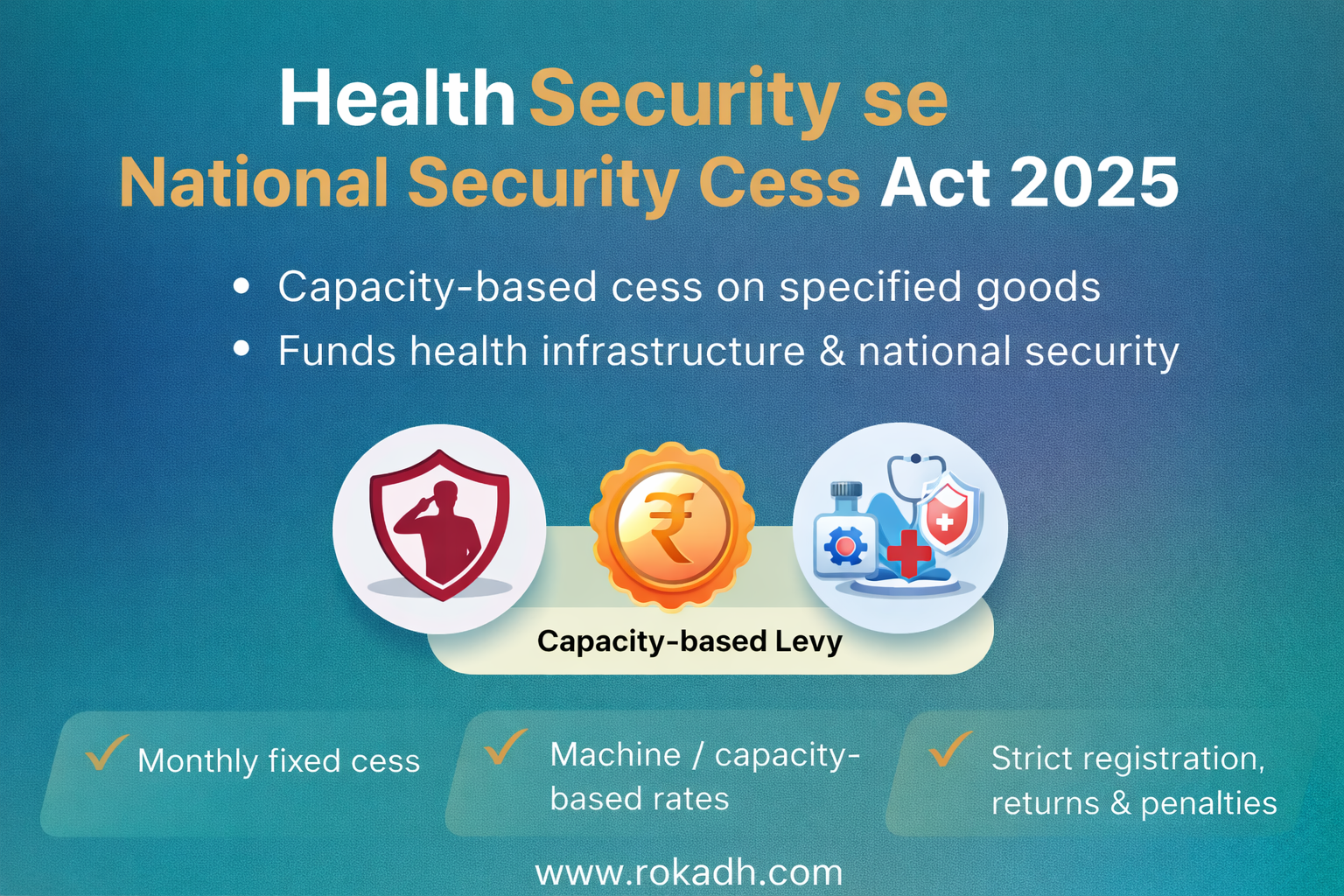
In a significant move to strengthen India’s public health infrastructure and national security, the Government has introduced the Health Security se National Security Cess Act, 2025.
This new legislation marks a shift toward capacity-based taxation for specified goods, specifically targeting the manufacturing sector of items like Pan Masala.
At Rokadh, we believe in empowering businesses with clear, actionable insights into new regulatory frameworks. Here is a comprehensive breakdown of what you need to know about this new levy.
What is the Health Security se National Security Cess?
The Cess is a specialized levy aimed at augmenting resources for public health and national security. Unlike traditional taxes that may be based on actual production volume, this Cess is primarily linked to the production capacity of the machines installed or the processes undertaken by a manufacturer.
Who is a "Taxable Person"?
Under Section 3 of the Act, a taxable person is anyone who owns, possesses, operates, or manages a machine or process used to manufacture "specified goods". Key details include:
- Broad Scope: It includes those operating through job-workers, hired labor, or any other arrangement.
- Irrespective of Schemes: You are liable even if you are under a composition scheme or other concessional tax levies.
- Control over Capacity: Ownership or possession of the machine is sufficient to trigger liability, regardless of the actual quantity produced.
Key Compliance Requirements
The Health Security se National Security Cess Rules, 2026, which come into effect on February 1, 2026, outline strict compliance procedures.
1. Registration (Rule 4)
Every taxable person must apply for registration via Form HSNS REG-01 on the common portal (cbic-gst.gov.in).
- Factory-wise Registration: If you operate multiple factories, a separate application is required for each location.
- Provisional ID: Upon successful submission, a temporary registration number is issued to allow for immediate cess payments.
2. Mandatory Declarations (Rule 9)
Within seven days of receiving registration, manufacturers must file a declaration in Form HSNS DEC-01. This declaration must detail all machines and their technical specifications, including the "maximum rated speed".
3. Payment and Returns (Rules 13 & 14)
- Monthly Payment: The Cess must be paid electronically by the 7th day of each month.
- Monthly Returns: A return in Form HSNS RET-01 must be filed by the 20th of the succeeding month.
- Interest on Delay: Any delay in payment attracts interest as per Section 17 of the Act.
How is the Cess Calculated?
Schedule II – Monthly Cess Slabs
Under the Health Security se National Security Cess Act, 2025, the cess payable by a manufacturer using machines depends on two key factors:
- Maximum rated speed of the machine (pouches per minute)
- Net weight of each pouch (packing size)
The cess is payable per machine per month, irrespective of actual production.
1️⃣ Machines with Maximum Rated Speed Up to 500 per minute
- If the pouch weight is up to 2.5 grams, the monthly cess is ₹101.00 lakhs per machine.
- If the pouch weight is above 2.5 grams and up to 10 grams, the monthly cess is ₹364.00 lakhs per machine.
- If the pouch weight is above 10 grams, the monthly cess is ₹849.00 lakhs per machine.
2️⃣ Machines with Maximum Rated Speed From 501 to 1000 per minute
- For pouch weight up to 2.5 grams, the monthly cess is ₹202.00 lakhs per machine.
- For pouch weight above 2.5 grams and up to 10 grams, the monthly cess is ₹728.00 lakhs per machine.
- For pouch weight above 10 grams, the monthly cess is ₹1,698.00 lakhs per machine.
3️⃣ Machines with Maximum Rated Speed From 1001 to 1500 per minute
- If the pouch weight is up to 2.5 grams, the monthly cess payable is ₹303.00 lakhs per machine.
- If the pouch weight is above 2.5 grams and up to 10 grams, the monthly cess payable is ₹1,092.00 lakhs per machine.
- If the pouch weight is above 10 grams, the monthly cess payable is ₹2,547.00 lakhs per machine.
4️⃣ Machines with Maximum Rated Speed Above 1500 per minute
For machines having a rated speed exceeding 1500 pouches per minute, the cess is calculated using a statutory formula:
- For pouch weight up to 2.5 grams, the monthly cess is calculated as:
- ₹101.00 lakhs × (Maximum Rated Speed ÷ 450)
- For pouch weight above 2.5 grams and up to 10 grams, the monthly cess is calculated as:
- ₹364.00 lakhs × (Maximum Rated Speed ÷ 450)
- For pouch weight above 10 grams, the monthly cess is calculated as:
- ₹849.00 lakhs × (Maximum Rated Speed ÷ 450)
Important Points to Remember
- The cess is fixed per month, not linked to actual production or sales.
- Each machine is assessed individually.
- Even if a machine operates for part of the month, full monthly cess is payable (subject to abatement rules).
- Incorrect declaration of machine speed or pouch weight can lead to higher cess, penalties, and prosecution.
Provisions for Non-Operation (Abatement)
If a machine is non-operational for a continuous period of 15 days or more, manufacturers can apply for "Abatement" (a reduction in the Cess amount).
- Prior Intimation: You must notify the proper officer at least three working days before the machine stops.
- Sealing: The machine must be sealed by an officer to ensure no production occurs during the abatement period.
Enforcement and Penalties
The Act provides the authorities with robust powers, including physical inspection of factories, search and seizure, and even arrest for significant contraventions. Operating without registration can lead to heavy penalties and a retrospective determination of liability.
Final Thoughts
The Health Security se National Security Cess represents a new era of capacity-based taxation in India. For manufacturers, the key to navigating this change lies in accurate technical declarations and timely monthly compliance.
For more expert analysis on tax regulations and financial updates, stay tuned to Rokadh.com or connect with us on given mail ID.