
Complete Legal Guide on Trademark Registration Process, Objection, Opposition, Hearing, Reply Filing, Timelines, Sections, Case Studies & Professional Trademark Protection by Team Rokadh
In modern India, a trademark is no longer merely:
- a logo,
- a business name,
- or a tagline.
A trademark today represents:
- business identity,
- legal ownership,
- startup valuation,
- customer trust,
- investor confidence,
- digital branding,
- and long-term commercial goodwill.
Yet every year, thousands of startups, MSMEs, professionals, e-commerce sellers and growing businesses across:
- Kanpur,
- Lucknow,
- Delhi,
- Noida,
- Agra,
- Gurgaon,
- NCR,
- Bengaluru,
- Mumbai,
- and PAN India
- lose valuable trademark rights because:
- trademark applications were filed casually,
- legal objections were poorly handled,
- opposition replies were weak,
- or inexperienced consultants handled the process incorrectly.
The biggest misconception among applicants is:
“Trademark filing means trademark protection.”
In reality:
Trademark registration is:
- a legal process,
- a technical examination,
- a rights verification procedure,
- and often a litigation-sensitive intellectual property matter under the Trade Marks Act, 1999.
This is exactly why businesses increasingly search:
- Best Trademark Attorney in India,
- Trademark Objection Reply Expert,
- Trademark Opposition Lawyer,
- Trademark Hearing Consultant,
- Trademark Registration Expert,
- Best Trademark Consultant Near Me,
- Trademark Lawyer for Startups,
- Trademark Registration in Kanpur,
- Trademark Attorney in Lucknow,
- Trademark Consultant in Delhi NCR,
- Trademark Expert in Bengaluru & Mumbai.
This detailed guide by:
Team Rokadh — Rokadh Financial Services Private Limited (India’s Leading Financial Services Company)
explains:
- complete trademark registration process,
- relevant provisions of Trade Marks Act, 1999,
- trademark objection,
- trademark opposition,
- reply filing,
- hearing process,
- timelines,
- legal strategy,
- common mistakes,
- FAQs,
- and why Team Rokadh is increasingly trusted for professional trademark advisory and brand protection across India.
What is Trademark Under Indian Law?
Relevant Provision — Section 2(zb) of Trade Marks Act, 1999
As per Section 2(zb):
A trademark means:
a mark capable of being represented graphically and capable of distinguishing goods or services of one person from those of others.
A trademark may include:
- word mark,
- logo,
- tagline,
- symbol,
- shape,
- packaging identity,
- brand signature.
Why Trademark Registration is Extremely Important
Trademark registration protects:
- brand identity,
- legal ownership,
- market reputation,
- digital presence,
- business goodwill.
Without trademark protection:
- competitors may copy branding,
- marketplaces may suspend listings,
- investors may reject due diligence,
- legal disputes may arise.
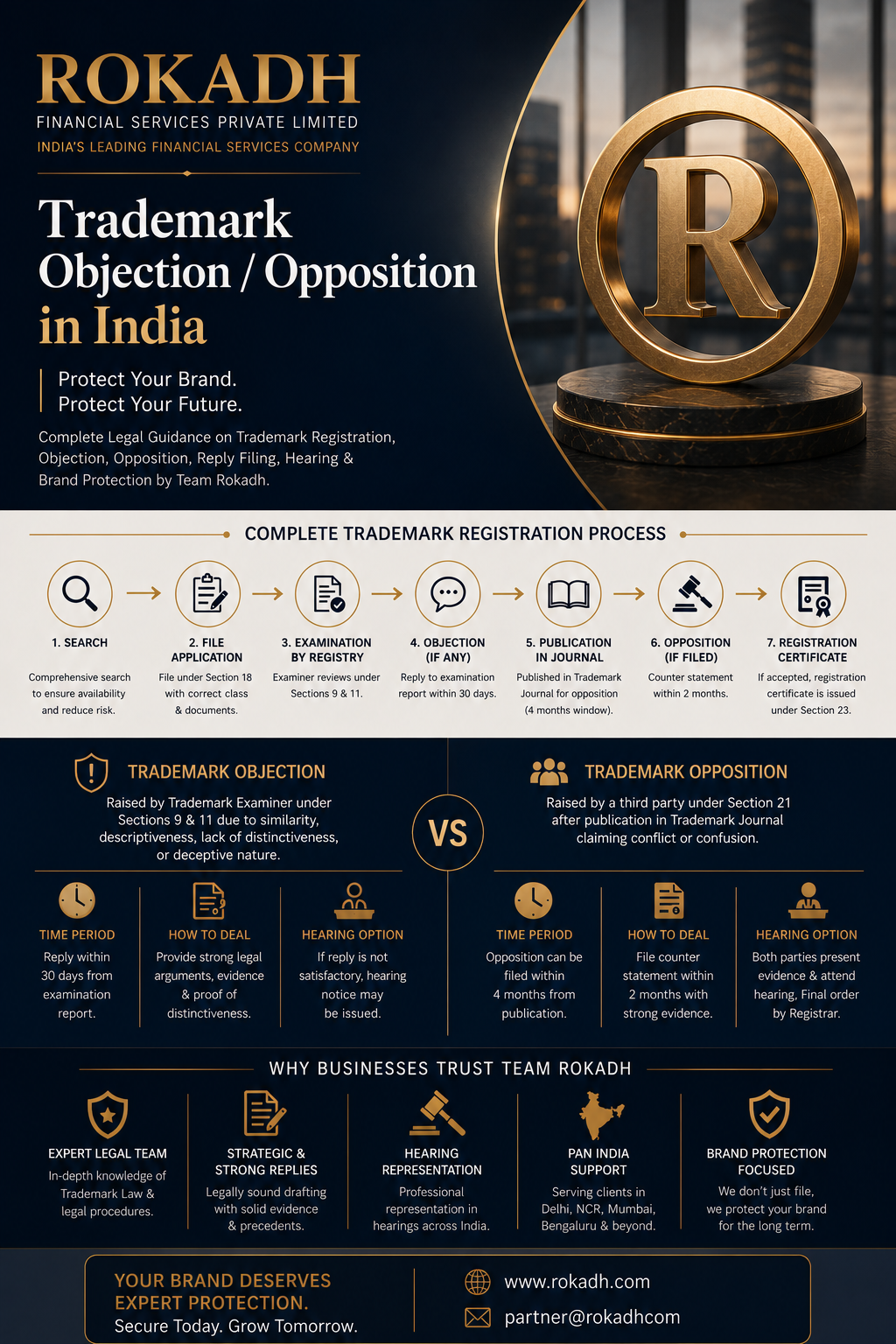
Complete Trademark Registration Process in India
Step 1 — Trademark Search
Before filing, professional trademark search is extremely important.
A proper search helps identify:
- similar marks,
- phonetic conflicts,
- class conflicts,
- litigation risk,
- objection probability.
Why Team Rokadh Stands Out
Team Rokadh performs:
- advanced trademark search,
- legal conflict analysis,
- phonetic review,
- industry risk evaluation,
- before filing any trademark.
This significantly reduces:
- Section 11 objections,
- opposition risk,
- rejection probability.
Step 2 — Selection of Correct Trademark Class
Trademark protection depends heavily upon:
- proper class selection.
India follows:
NICE Classification System
Incorrect class selection may:
- weaken protection,
- create litigation exposure,
- fail to protect actual business operations.
Step 3 — Trademark Filing
Trademark application is filed under:
Section 18 of Trade Marks Act, 1999
Application may be filed for:
- word mark,
- logo,
- tagline,
- device mark,
- composite mark.
Documents generally include:
- PAN,
- Aadhaar,
- incorporation documents,
- logo,
- authorization,
- MSME certificate (if applicable).
Step 4 — Examination by Trademark Registry
Trademark Examiner reviews application under:
- Section 9,
- Section 11,
- and other applicable provisions.
At this stage:
- trademark may be accepted,
- objected,
- or hearing may be scheduled.
Step 5 — Trademark Objection (If Raised)
This is where most businesses panic.
But legally:
Trademark objection does NOT mean rejection.
It means:
- examiner requires clarification,
- evidence,
- legal justification,
- or explanation.
Trademark Objection Explained in Detail
Relevant Legal Sections for Trademark Objection
Section 9 — Absolute Grounds for Refusal
Trademark may face objection if:
- descriptive,
- generic,
- non-distinctive,
- deceptive,
- offensive,
- common in trade practice.
Section 11 — Relative Grounds for Refusal
Trademark may face objection if:
- similar to existing mark,
- phonetically similar,
- commercially confusing,
- deceptively similar.
Common Reasons for Trademark Objection
- weak brand distinctiveness,
- generic words,
- copied naming pattern,
- improper search,
- wrong class,
- descriptive tagline,
- similar sounding mark,
- weak documentation.
Trademark Objection Timeline
| Stage | Timeline |
| Examination Report Issued | Usually 1–6 months after filing |
| Reply Filing | Generally within 30 days |
| Hearing Notice | Issued if the examiner is not satisfied with the reply |
| Hearing Decision | Depends upon the specific case |
How to Reply Trademark Objection Professionally
Professional objection reply generally includes:
- legal arguments,
- case laws,
- trademark differentiation,
- prior use evidence,
- commercial distinctiveness,
- brand identity proof,
- affidavit,
- advertisements,
- invoices,
- digital presence proof.
Why Weak Trademark Objection Reply Becomes Dangerous
Weak replies often:
- fail legally,
- ignore precedents,
- lack evidence,
- misunderstand Sections 9 & 11.
This may result in:
- abandonment,
- rejection,
- future litigation,
- loss of branding rights.
Real Case Study — Startup Brand from Noida
A startup filed trademark through low-cost portal.
The portal:
- never conducted proper search,
- ignored existing similar marks,
- filed weak application.
Result:
- objection under Section 11,
- hearing notice issued,
- startup investors raised concerns.
How Team Rokadh Resolved
Team Rokadh:
- prepared detailed legal reply,
- established brand distinction,
- submitted prior use proof,
- represented hearing professionally.
Trademark moved toward acceptance successfully.
Trademark Hearing Explained
If examiner remains unsatisfied:
- hearing opportunity may be granted.
At hearing stage:
- legal representation,
- argument quality,
- evidence presentation,
- and trademark strategy
- become extremely important.
Why Trademark Hearing Representation Matters
Poor hearing representation may:
- destroy registration chances,
- weaken legal standing,
- permanently damage branding strategy.
Why Businesses Across India Trust Team Rokadh for Trademark Hearings
Team Rokadh professionally handles:
- legal drafting,
- hearing preparation,
- evidence strategy,
- objection reply,
- commercial distinction arguments,
- startup brand protection.
Step 6 — Publication in Trademark Journal
If accepted:
- trademark gets published in Journal.
This opens:
Opposition Window
Trademark Opposition Explained in Detail
Trademark opposition means:
third party legally challenges your trademark registration.
Opposition generally claims:
- trademark similarity,
- confusion,
- bad faith filing,
- prior rights conflict.
Relevant Provision — Section 21 of Trade Marks Act, 1999
Section 21 governs:
- opposition filing,
- counter statement,
- evidence procedure,
- hearing,
- final order.
Trademark Opposition Timeline:
| Stage | Timeline |
| Journal Publication | Published |
| Opposition Filing | Within 4 months |
| Counter Statement | Within 2 months |
| Evidence Stage | Several months |
| Hearing | Scheduled by Registry |
| Final Decision | Depends on complexity |
How to Handle Trademark Opposition Professionally
Professional opposition handling includes:
- legal counter statement,
- evidence affidavit,
- prior use documents,
- sales records,
- advertisements,
- domain proof,
- online presence evidence,
- legal precedents.
Why Trademark Opposition Becomes Extremely Serious
Trademark opposition is:
- intellectual property litigation.
Poor handling may result in:
- rejection,
- business confusion,
- rebranding cost,
- marketplace conflict,
- startup valuation issues.
Real Case Study — Fashion Brand from Mumbai
A fashion startup received opposition from existing apparel company.
Previous consultant:
- filed weak counter statement,
- ignored commercial differentiation,
- failed strategically.
Team Rokadh Intervention
Team Rokadh:
- rebuilt legal defense,
- prepared evidence professionally,
- established coexistence arguments,
- strategically represented brand rights.
Trademark protection became commercially stabilized.
Why Team Rokadh Stands Out as Trademark Objection & Opposition Experts
1. Strong Understanding of Trade Marks Act, 1999
Team Rokadh professionally understands:
- Section 9,
- Section 11,
- Section 18,
- Section 21,
- trademark hearing process,
- evidence strategy,
- startup IP protection.
2. Startup & Business Understanding
Team Rokadh understands:
- startups,
- D2C brands,
- MSMEs,
- technology companies,
- manufacturers,
- digital businesses.
3. Strong Legal Drafting Expertise
Professional drafting significantly impacts:
- objection success,
- hearing outcome,
- opposition defense.
4. PAN India Trademark Advisory
Businesses across:
- Kanpur,
- Lucknow,
- Delhi,
- NCR,
- Gurgaon,
- Noida,
- Bengaluru,
- Mumbai,
- and PAN India
- professionally consult Team Rokadh.
5. Strategic Brand Protection Approach
Team Rokadh focuses not merely on:
- filing trademark,
- but upon:
- long-term brand security and commercial protection.
35+ Major Trademark Objection & Opposition Mistakes
1. Filing Trademark Without Professional Search
This is the biggest mistake.
Applicants blindly file:
- without phonetic analysis,
- without class verification,
- without conflict evaluation.
Result:
- Section 11 objection,
- opposition risk,
- legal conflict.
Team Rokadh Advisory
Always conduct:
- professional trademark search,
- legal risk analysis,
- phonetic conflict review.
2. Choosing Generic Brand Name
Words commonly used in trade become difficult to register under:
Section 9
Example:
- “Best Quality Shoes”
- “Fresh Milk”
- “Smart Mobile”
Such marks lack distinctiveness.
3. Using Descriptive Tagline
Descriptive slogans often face objection.
4. Selecting Wrong Trademark Class
Weakens legal protection significantly.
5. Filing Through Cheap Online Portals
Most portals only:
- upload forms,
- not:
- legally protect brand.
6. Ignoring Examination Report
Application may become abandoned permanently.
7. Missing Reply Deadline
Very dangerous legally.
8. Weak Objection Reply Drafting
Poor drafting remains one of biggest reasons for rejection.
9. No Prior Use Evidence
Commercial distinctiveness becomes difficult to establish.
10. Ignoring Similar Existing Marks
Triggers opposition later.
11. Ignoring Trademark Journal Monitoring
Many applicants assume:
once trademark is filed, the work is complete.
This assumption becomes dangerous.
After acceptance, the trademark gets published in:
Trademark Journal
At this stage:
- competitors,
- prior trademark owners,
- market rivals
- can file opposition under:
Section 21 of Trade Marks Act, 1999
Many businesses:
- never monitor publication,
- miss opposition notices,
- fail to respond timely.
Result:
- trademark rights become weak,
- applications may fail,
- costly legal disputes arise.
Team Rokadh Advisory
Team Rokadh continuously monitors:
- trademark status,
- journal publication,
- opposition exposure,
- registry updates,
- ensuring businesses remain legally protected at every stage.
12. Weak Hearing Preparation
Trademark hearing is not:
- casual discussion,
- or mere attendance.
It is:
- legal representation before Trademark Authority.
Many applicants:
- attend hearing without preparation,
- fail to understand examiner concern,
- present weak arguments,
- or rely upon inexperienced consultants.
Result:
- rejection probability increases significantly.
Team Rokadh Resolution
Team Rokadh professionally prepares:
- legal arguments,
- case-law references,
- distinctiveness defense,
- commercial usage evidence,
- industry differentiation strategy.
This significantly improves:
- hearing confidence,
- legal positioning,
- and registration possibility.
13. Not Understanding Section 9 Properly
Most applicants fail to understand:
Section 9 objections.
Section 9 primarily relates to:
- descriptiveness,
- lack of distinctiveness,
- generic words,
- common industry terminology.
Example:
- “Pure Milk”
- “Fast Delivery”
- “Quality Furniture”
Such marks generally face:
- higher objection risk.
Team Rokadh Advisory
Team Rokadh strategically advises:
- unique brand creation,
- stronger distinctiveness,
- commercially protectable identity,
- before filing application.
14. Not Understanding Section 11 Properly
Section 11 objections relate to:
- similarity with existing marks,
- phonetic resemblance,
- deceptive confusion.
Many businesses wrongly assume:
“spelling difference means safety.”
Legally:
- pronunciation,
- visual impression,
- commercial confusion
- all matter significantly.
Team Rokadh Resolution
Team Rokadh performs:
- phonetic analysis,
- legal conflict review,
- registry comparison,
- market confusion evaluation,
- before filing.
15. Filing Descriptive Tagline
Descriptive taglines are highly objection-prone.
Examples:
- “India’s Best Service”
- “Fastest Delivery”
- “Pure Quality”
Such phrases often lack:
- distinctiveness,
- proprietary character.
Team Rokadh Advisory
Team Rokadh helps businesses create:
- legally stronger taglines,
- commercially distinctive branding,
- protectable intellectual property.
16. Weak Logo Distinctiveness
Many logos:
- use generic symbols,
- copied designs,
- common industry visuals.
This weakens:
- trademark enforceability,
- legal exclusivity.
Team Rokadh Resolution
Team Rokadh strategically reviews:
- visual uniqueness,
- commercial distinction,
- conflict possibility,
- before filing logo marks.
17. Using Common Industry Terms
Businesses often use:
- generic industry words,
- ordinary commercial phrases.
Result:
- weaker legal rights,
- objection risk,
- opposition vulnerability.
Team Rokadh Advisory
Strong brands are:
- unique,
- memorable,
- legally distinctive.
18. Missing Opposition Deadline
Trademark opposition timelines are extremely strict.
Failure to respond within prescribed period may:
- destroy registration opportunity permanently.
Team Rokadh Resolution
Team Rokadh maintains:
- timeline tracking,
- compliance reminders,
- procedural management,
- ensuring legal deadlines are professionally protected.
19. Weak Counter Statement Drafting
Many applicants file:
- generic counter statements,
- copied legal language,
- weak factual defense.
This weakens:
- opposition defense,
- commercial credibility.
Team Rokadh Advisory
Every counter statement must be:
- fact-specific,
- legally reasoned,
- commercially strategic.
20. Improper Evidence Affidavit
Trademark matters heavily depend upon:
- evidence quality.
Weak affidavits damage:
- legal standing,
- prior use claims,
- brand distinction defense.
Team Rokadh Resolution
Team Rokadh professionally structures:
- evidence affidavits,
- supporting exhibits,
- commercial proof,
- brand usage records.
21. No Market Usage Documentation
Many startups fail to maintain:
- invoices,
- advertisements,
- brochures,
- online presence records.
Later:
- proving trademark use becomes difficult.
Team Rokadh Advisory
Businesses should preserve:
- every branding document,
- social media campaigns,
- customer invoices,
- marketplace screenshots.
22. Ignoring Domain Ownership Evidence
In digital businesses:
- domain ownership supports trademark defense.
Many businesses:
- fail to secure domain early,
- lose digital branding consistency.
Team Rokadh Resolution
Team Rokadh strategically advises:
- domain integration,
- digital IP alignment,
- brand consistency protection.
23. Weak Brand Protection Planning
Many businesses:
- file one trademark,
- ignore future expansion.
Later:
- competitors register similar marks in other classes.
Team Rokadh Advisory
Trademark strategy must align with:
- future business growth,
- expansion roadmap,
- product diversification.
24. No Professional Legal Review
Trademark law is technical.
Casual filing often creates:
- future litigation,
- rejection risk,
- weak protection.
Team Rokadh Resolution
Every filing is strategically reviewed from:
- legal,
- commercial,
- and scalability perspective.
25. Delaying Trademark Filing
Many founders wait until:
- business grows,
- funding starts,
- competitors emerge.
This delay becomes dangerous.
Team Rokadh Advisory
Trademark filing should ideally happen:
- at brand planning stage itself.
26. Filing Multiple Weak Marks
Some applicants:
- file random variations,
- weakly structured marks,
- inconsistent branding.
This weakens:
- brand identity,
- legal consistency.
Team Rokadh Resolution
Team Rokadh helps businesses build:
- structured trademark portfolio strategy.
27. No Startup IP Strategy
Startups often focus only on:
- product,
- marketing,
- funding.
But ignore:
- intellectual property foundation.
Team Rokadh Advisory
Strong IP significantly impacts:
- valuation,
- investor confidence,
- acquisition potential.
28. Ignoring Trademark Renewal Planning
Trademark rights require:
- periodic renewal.
Failure may:
- lapse rights,
- weaken ownership.
Team Rokadh Resolution
Team Rokadh professionally manages:
- renewal tracking,
- portfolio continuity,
- IP protection lifecycle.
29. Using Copyrighted Logo Elements
Many businesses unknowingly use:
- copied icons,
- stock graphics,
- copyrighted visual assets.
This creates:
- litigation risk,
- ownership conflict.
Team Rokadh Advisory
Always ensure:
- original creative identity,
- legally safe logo creation.
30. Ignoring International Expansion Planning
Businesses planning exports or global operations require:
- international trademark consideration.
Team Rokadh Advisory
Team Rokadh strategically advises:
- scalable trademark structuring,
- international branding protection,
- future expansion readiness.
31. Treating Trademark as Mere “Certificate”
Trademark is not merely:
- government paper.
It is:
- business identity,
- commercial goodwill,
- legal asset,
- valuation driver.
Team Rokadh Perspective
Professional trademark protection should always be treated strategically.
32. Weak Brand Documentation
Poor documentation weakens:
- opposition defense,
- commercial evidence,
- legal enforceability.
Team Rokadh Advisory
Businesses should maintain:
- organized branding records,
- sales proof,
- advertising evidence,
- customer visibility records.
33. Ignoring Trademark Monitoring
Competitors may:
- imitate branding,
- file deceptively similar marks.
Team Rokadh Resolution
Team Rokadh professionally assists in:
- trademark watch,
- monitoring strategy,
- legal risk management.
34. Depending Entirely on Automated Filing Platforms
Technology helps filing,
but cannot replace:
- legal interpretation,
- strategic defense,
- commercial analysis.
Team Rokadh Advantage
Team Rokadh combines:
- legal expertise,
- commercial understanding,
- startup advisory,
- intellectual property strategy.
35. Choosing Cost Over Competence
This remains the biggest mistake.
Cheap filing later becomes:
- expensive litigation,
- rebranding cost,
- startup valuation damage.
Team Rokadh Advisory
Trademark filing should always prioritize:
- competence,
- strategy,
- legal quality,
- not merely:
- low pricing.
10+ Most Asked / Searched Trademark Objection & Opposition FAQs
1. What is trademark objection?
Legal concern raised by examiner during examination stage.
2. What is trademark opposition?
Third-party legal challenge after journal publication.
3. Can trademark objection be resolved?
Yes professionally through:
- legal drafting,
- evidence,
- hearing representation.
4. Can trademark opposition become dangerous?
Yes significantly.
5. What is Section 9 objection?
Absolute grounds objection.
6. What is Section 11 objection?
Similarity/confusion objection.
7. What is Section 18?
Trademark application filing provision.
8. What is Section 21?
Trademark opposition provision.
9. Can trademark hearing save application?
Yes strategically.
10. Why is professional trademark drafting important?
Because trademark law heavily depends upon:
- legal interpretation,
- evidence,
- commercial positioning.
11. Ignoring Trademark Journal Monitoring
Many applicants assume:
once trademark is filed, the work is complete.
This assumption becomes dangerous.
After acceptance, the trademark gets published in:
Trademark Journal
At this stage:
- competitors,
- prior trademark owners,
- market rivals
- can file opposition under:
Section 21 of Trade Marks Act, 1999
Many businesses:
- never monitor publication,
- miss opposition notices,
- fail to respond timely.
Result:
- trademark rights become weak,
- applications may fail,
- costly legal disputes arise.
Team Rokadh Advisory
Team Rokadh continuously monitors:
- trademark status,
- journal publication,
- opposition exposure,
- registry updates,
- ensuring businesses remain legally protected at every stage.
12. Weak Hearing Preparation
Trademark hearing is not:
- casual discussion,
- or mere attendance.
It is:
- legal representation before Trademark Authority.
Many applicants:
- attend hearing without preparation,
- fail to understand examiner concern,
- present weak arguments,
- or rely upon inexperienced consultants.
Result:
- rejection probability increases significantly.
Team Rokadh Resolution
Team Rokadh professionally prepares:
- legal arguments,
- case-law references,
- distinctiveness defense,
- commercial usage evidence,
- industry differentiation strategy.
This significantly improves:
- hearing confidence,
- legal positioning,
- and registration possibility.
13. Not Understanding Section 9 Properly
Most applicants fail to understand:
Section 9 objections.
Section 9 primarily relates to:
- descriptiveness,
- lack of distinctiveness,
- generic words,
- common industry terminology.
Example:
- “Pure Milk”
- “Fast Delivery”
- “Quality Furniture”
Such marks generally face:
- higher objection risk.
Team Rokadh Advisory
Team Rokadh strategically advises:
- unique brand creation,
- stronger distinctiveness,
- commercially protectable identity,
- before filing application.
14. Not Understanding Section 11 Properly
Section 11 objections relate to:
- similarity with existing marks,
- phonetic resemblance,
- deceptive confusion.
Many businesses wrongly assume:
“spelling difference means safety.”
Legally:
- pronunciation,
- visual impression,
- commercial confusion
- all matter significantly.
Team Rokadh Resolution
Team Rokadh performs:
- phonetic analysis,
- legal conflict review,
- registry comparison,
- market confusion evaluation,
- before filing.