
Why Choosing the Right Income Tax Consultant Can Protect Your Business, Wealth, Compliance & Peace of Mind
In today’s India, Income Tax compliance is no longer limited to:
- filing an ITR,
- paying taxes,
- or replying to notices.
Modern taxation now directly impacts:
- business growth,
- startup funding,
- banking credibility,
- loan approvals,
- GST reconciliations,
- TDS compliance,
- foreign remittances,
- high-value transactions,
- and even your digital financial footprint.
Yet every year, thousands of taxpayers:
- receive scrutiny notices,
- face penalties,
- lose refunds,
- face AIS/TIS mismatches,
- receive defective return notices,
- or suffer unnecessary tax demand
- simply because they relied upon:
inexperienced, low-cost, or less competent tax consultants.
The biggest misconception among taxpayers is:
“Income Tax filing is just data entry.”
In reality:
Income Tax practice requires:
- deep legal understanding,
- strategic tax planning,
- compliance interpretation,
- litigation handling,
- reconciliation expertise,
- and risk management.
This is exactly why businesses, professionals, startups, salaried employees, NRIs, freelancers and MSMEs across:
- Kanpur,
- Lucknow,
- Bengaluru,
- Delhi,
- Mumbai,
- Noida,
- Gurgaon,
- and PAN India
- increasingly search for:
- Best Income Tax Consultant Near Me,
- Best Tax Advisor in India,
- Top Income Tax Expert,
- Income Tax Notice Specialist,
- ITR Filing Expert,
- Tax Litigation Consultant.
This detailed guide explains:
- what makes an Income Tax Consultant truly competent,
- relevant sections of Income Tax Act, 1961,
- risks of poor tax handling,
- real case studies,
- common taxpayer mistakes,
- most searched FAQs,
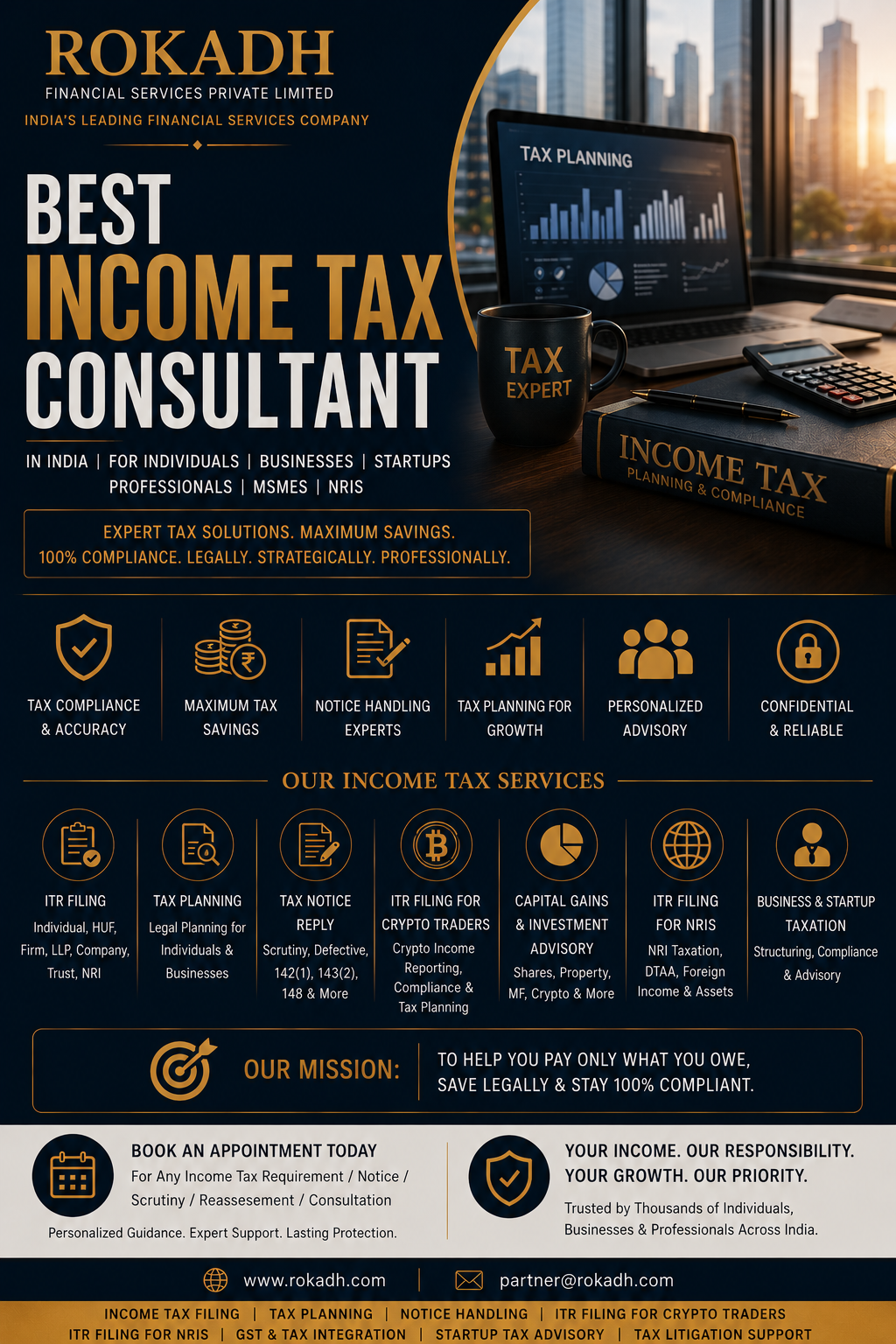
- and why Team Rokadh consistently stands out as one of India’s most trusted professional tax advisory teams.
What Makes Someone the “Best Income Tax Consultant”?
The best Income Tax Consultant is not merely someone who:
- uploads ITR forms,
- calculates tax,
- or files returns.
A truly competent consultant requires:
- legal understanding,
- analytical ability,
- compliance strategy,
- practical exposure,
- reconciliation expertise,
- litigation handling capability,
- and business understanding.
Essential Qualifications & Understanding Required for a Top Income Tax Consultant
1. Deep Understanding of Income Tax Act, 1961
A competent consultant must understand:
- charging provisions,
- residential status,
- deductions,
- presumptive taxation,
- reassessment proceedings,
- TDS provisions,
- capital gains,
- scrutiny assessments,
- penalties,
- prosecution risks,
- appellate remedies.
Without proper understanding:
- incorrect ITR filing,
- tax demand,
- notice exposure,
- and litigation risks increase massively.
Important Sections Every Competent Income Tax Consultant Must Understand
| Section | Statutory Purpose | Core Category |
| Section 44AD | Presumptive taxation scheme for eligible businesses (turnover limits apply) | Tax Schemes & Exemptions |
| Section 44ADA | Presumptive taxation scheme for specified professionals | Tax Schemes & Exemptions |
| Section 54 | Capital gains exemption on the sale of a residential house property upon reinvestment | Tax Schemes & Exemptions |
| Section 80C | Deductions for specified investments (PPF, ELSS, LIC, etc.) up to ₹1.5 Lakh | Deductions & Tax Planning |
| Section 80D | Deductions for medical insurance premiums and preventive health check-ups | Deductions & Tax Planning |
| Section 194 Series | Core Domestic TDS provisions covering salary, interest, contract payments, professional fees, etc. | Withholding Tax (TDS/TCS) |
| Section 206AB | Special provision for deduction of TDS at higher rates for non-filers of ITR | Withholding Tax (TDS/TCS) |
| Section 139 | Overarching statutory framework governing the filing of Income Tax Returns | ITR Filing & Compliance |
| Section 139(1) | Mandatory timelines and criteria for filing the original, timely tax return | ITR Filing & Compliance |
| Section 139(5) | Provision to file a revised return to rectify omissions or wrong statements | ITR Filing & Compliance |
| Section 139(9) | Defective return framework requiring rectification of filing anomalies within 15 days | ITR Filing & Compliance |
| Section 234F | Statutory late filing fees applicable when an ITR is submitted past the due date | Interest, Fees & Penalties |
| Section 234A/B/C | Mandatory interest provisions for delay in filing (234A), default in advance tax (234B), and deferment of advance tax installments (234C) | Interest, Fees & Penalties |
| Section 270A | Levying of penalty for under-reporting (50% of tax) or misreporting (200% of tax) of income | Interest, Fees & Penalties |
| Section 271AAC | Severe penalty (typically 10%) on unexplained income, investment, or cash taxed under Section 115BBE | Interest, Fees & Penalties |
| Section 142(1) | Inquiry notice issued to produce accounts, documents, or file a return prior to assessment | Assessment & Litigation |
| Section 143(1) | Automated summary processing of the return, checking for arithmetical errors and issuing intimations | Assessment & Litigation |
| Section 143(2) | Notice for regular scrutiny assessment, indicating that the return has been flagged for detailed audit | Assessment & Litigation |
| Section 148 | Notice issued for reassessment when the department has reason to believe income has escaped assessment | Assessment & Litigation |
Strategic Practice Intersections
- The Compliance Chain: A delay under Section 139(1) automatically triggers late filing fees under Section 234F, accumulation of interest under Section 234A, and strips the taxpayer of the right to carry forward business losses (except house property losses).
- Data Matching (TDS vs. Return): Mismatches between the Section 194 series TDS credits claimed in the return and the data reflected in Form 26AS/AIS are the primary cause for automated adjustments and demands under Section 143(1).
- The Presumptive Escape Hatch: Clients opting out of Section 44AD/ADA because their declared profits are lower than the prescribed percentages ($6\%/8\%$ or $50\%$) are immediately pushed into maintaining statutory books of accounts, making them prone to documentation checks if hit with a Section 142(1) or 143(2) notice.
A less competent tax consultant may:
- ignore critical provisions,
- mismatch AIS/TIS,
- wrongly claim deductions,
- improperly disclose income,
- or fail to reconcile GST with ITR.
The consequences can become extremely expensive.
2. Strong Understanding of Business & Financial Structuring
The best Income Tax Consultant must understand:
- business models,
- startup structures,
- GST impact,
- banking trails,
- financial statements,
- digital transactions,
- and compliance integration.
Income Tax today is deeply connected with:
- GST,
- MCA,
- banking,
- TDS,
- investments,
- and foreign transactions.
3. Expertise in Notice Handling
Modern taxpayers increasingly receive:
- AIS mismatch notices,
- TDS mismatch notices,
- scrutiny notices,
- defective return notices,
- reassessment notices,
- GST reconciliation inquiries.
Handling notices requires:
- legal drafting,
- factual reconciliation,
- strategic presentation,
- and departmental understanding.
Real Case Study — Salaried Employee from Bengaluru
A salaried employee filed ITR through a low-cost online portal.
The portal:
- ignored AIS mismatch,
- failed to disclose FD interest,
- wrongly claimed deductions.
Result:
- Section 143(1) tax demand generated,
- refund blocked,
- future scrutiny risk increased.
How Team Rokadh Resolved
Team Rokadh:
- reconciled AIS/TIS,
- corrected income mismatch,
- revised computation professionally,
- prepared departmental response.
Taxpayer’s demand reduced substantially and compliance stabilized.
4. Strong Litigation & Assessment Understanding
A highly competent consultant must understand:
- faceless assessments,
- reassessment proceedings,
- penalty notices,
- appellate remedies,
- and scrutiny defense.
Poor handling can:
- increase tax demand,
- trigger penalties,
- damage business credibility.
Real Case Study — Trader from Kanpur
A trader received:
- Section 148 reassessment notice,
- GST turnover mismatch allegation,
- unexplained cash credit concerns.
Previous consultant:
- failed to reconcile GST and Income Tax data,
- ignored banking narration,
- submitted weak explanations.
Team Rokadh Intervention
Team Rokadh:
- reconciled GST turnover,
- prepared ledger-based explanation,
- structured legal submissions,
- defended compliance professionally.
The matter was substantially stabilized.
5. Understanding of AIS, TIS & Data Analytics
Income Tax Department today uses:
- AIS,
- TIS,
- Annual Information Statements,
- banking intelligence,
- GST integration,
- PAN analytics,
- and digital transaction monitoring.
Less competent consultants often fail to:
- reconcile data properly,
- disclose correct transactions,
- or identify hidden mismatch risks.
Real Case Study — Freelancer from Mumbai
A freelancer received:
- tax mismatch communication,
- professional receipt discrepancy notice.
The previous consultant:
- ignored foreign receipts,
- improperly classified income.
Team Rokadh Resolution
Team Rokadh:
- reconciled banking entries,
- classified receipts properly,
- reviewed FEMA and tax implications,
- corrected compliance structure.
Taxpayer avoided larger future litigation exposure.
Why Less Competent Income Tax Consultants Become Dangerous
Choosing inexperienced consultants may result in:
- defective ITR filing,
- refund blockage,
- scrutiny notices,
- penalties,
- prosecution risk,
- GST mismatch,
- loan rejection,
- and investor due diligence failure.
Major Risks of Choosing Wrong Tax Consultant
1. Wrong ITR Selection
Wrong ITR form may invalidate compliance.
2. Ignoring AIS/TIS Reconciliation
This is now one of the biggest reasons for notices.
3. Improper GST & Income Tax Reconciliation
Mismatch creates:
- scrutiny,
- reassessment,
- penalty risk.
4. Incorrect Deduction Claims
Wrong claims increase:
- tax demand,
- notice exposure.
5. Ignoring Capital Gains Reporting
Department heavily tracks:
- shares,
- mutual funds,
- property,
- crypto,
- high-value transactions.
6. Weak Notice Reply Drafting
Poor drafting weakens defense significantly.
7. Delayed Return Filing
This impacts:
- refunds,
- carry forward losses,
- and compliance profile.
8. Ignoring Presumptive Taxation Rules
Wrong presumptive claims frequently trigger notices.
Why Team Rokadh Consistently Stands Out as Best Income Tax Consultants
1. Integrated Tax + Business + Compliance Understanding
Team Rokadh understands:
- taxation,
- GST,
- business structuring,
- startup growth,
- financial systems,
- and compliance integration together.
2. Strong Notice Handling Expertise
Team Rokadh professionally handles:
- scrutiny notices,
- reassessment notices,
- defective return notices,
- GST mismatches,
- AIS/TIS discrepancies,
- and faceless assessments.
3. PAN India Professional Tax Advisory
Businesses and taxpayers across:
- Kanpur,
- Lucknow,
- Bengaluru,
- Delhi,
- Mumbai,
- Noida,
- Gurgaon,
- and PAN India
- professionally consult Team Rokadh.
4. Awareness-Focused Professional Approach
Rather than merely filing returns, Team Rokadh continuously:
- educates taxpayers,
- spreads compliance awareness,
- guides MSMEs,
- and helps businesses remain compliant and financially secure.
5. Strong Reconciliation & Analytical Expertise
One of Team Rokadh’s strongest differentiators is:
- detailed reconciliation,
- strategic tax analysis,
- compliance verification,
- and risk identification.
Why You Must Book Appointment with Team Rokadh Before Filing ITR
Before filing Income Tax Return, every taxpayer should professionally evaluate:
- Is AIS reconciled?
- Is GST matching with ITR?
- Is proper ITR selected?
- Is deduction legally valid?
- Is capital gain disclosed properly?
- Is TDS reflected correctly?
- Is residential status correctly identified?
- Is refund protected?
- Is notice risk minimized?
- Is future scrutiny exposure evaluated?
These questions cannot be safely handled through:
- random internet advice,
- unqualified filing portals,
- or low-cost data entry operators.
Internal Professional Guidance by Team Rokadh
Businesses and taxpayers planning:
- ITR Filing,
- GST Compliance,
- Startup Registration,
- Trademark Protection,
- MSME Registration,
- Company Incorporation,
- Tax Planning,
- Notice Handling,
- should ideally structure compliance strategically together.
Explore:
- Income Tax Filing,
- GST Advisory,
- Tax Notice Support,
- Startup Compliance,
- Business Structuring,
- through Team Rokadh.
35+ Major Common Income Tax Mistakes
In today’s digital taxation environment, the Income Tax Department is no longer dependent only upon manual scrutiny.
Modern tax monitoring now includes:
- AIS (Annual Information Statement),
- TIS (Taxpayer Information Summary),
- GST integration,
- banking analytics,
- property transactions,
- mutual fund tracking,
- stock market reporting,
- TDS reconciliation,
- foreign remittance monitoring,
- and AI-based compliance verification.
Because of this, even a small mistake in ITR filing today may lead to:
- notices,
- penalties,
- refund blockage,
- reassessment,
- scrutiny,
- prosecution exposure,
- and financial stress.
Unfortunately, most taxpayers realize the importance of a competent Income Tax Consultant only after:
- receiving notices,
- facing tax demand,
- losing refund,
- or entering litigation.
Below are the most common mistakes made by:
- salaried employees,
- business owners,
- freelancers,
- startups,
- professionals,
- NRIs,
- traders,
- and MSMEs across India,
- all professionally resolved and strategically handled by Team Rokadh Income Tax Consultants.
1. Filing Wrong ITR Form
This is one of the biggest and most dangerous mistakes.
Using:
- ITR-1 instead of ITR-3,
- ITR-4 incorrectly,
- or wrong presumptive taxation structure
- may trigger:
- defective return notice under Section 139(9),
- scrutiny risk,
- reassessment exposure.
Why Team Rokadh Stands Out
Team Rokadh performs:
- income source analysis,
- compliance mapping,
- and legal eligibility verification
- before selecting ITR forms.
2. Ignoring AIS & TIS Reconciliation
Today the department heavily tracks:
- interest income,
- stock market transactions,
- mutual funds,
- GST turnover,
- foreign remittances,
- property purchases,
- credit card spends.
Ignoring AIS mismatch is one of the biggest reasons for notices under:
- Section 143(1),
- Section 142(1),
- and reassessment proceedings.
Real Case Study — Salaried Employee from Noida
A salaried employee filed ITR through an unstructured online portal.
The portal ignored:
- FD interest mismatch,
- mutual fund redemption,
- and dividend disclosure.
Result:
- tax demand generated,
- refund blocked,
- compliance risk increased.
Team Rokadh Resolution
Team Rokadh:
- reconciled AIS/TIS,
- revised tax computation,
- prepared departmental response,
- professionally stabilized compliance.
3. Wrong Residential Status Selection
Improper residential status creates:
- global income disclosure risk,
- tax treaty issues,
- and NRI compliance complications.
Relevant sections:
- Section 6,
- RNOR provisions,
- NRI taxation rules.
4. Ignoring Foreign Income Disclosure
Foreign assets and overseas income require proper disclosure.
Non-disclosure may create:
- severe penalty exposure,
- black money law implications,
- and scrutiny proceedings.
5. Wrong Claim under Section 80C
Many taxpayers wrongly claim:
- ineligible LIC,
- duplicate tuition fees,
- unsupported investments.
This increases:
- deduction disallowance risk,
- notice exposure.
6. Incorrect Claim under Section 80D
Medical insurance deduction frequently gets:
- overclaimed,
- duplicated,
- or unsupported.
7. Ignoring Capital Gains Reporting
The department now automatically tracks:
- stocks,
- mutual funds,
- crypto,
- property sales.
Failure to disclose may trigger:
- reassessment under Section 148,
- penalty proceedings.
Real Case Study — Investor from Mumbai
An investor sold shares but failed to report:
- short-term capital gains,
- dividend income.
Previous consultant ignored AIS reconciliation.
Team Rokadh Resolution
Team Rokadh:
- computed proper gains,
- reconciled broker reports,
- revised disclosures,
- professionally protected compliance.
8. Improper Presumptive Taxation under Section 44AD
Many businesses wrongly:
- suppress turnover,
- claim presumptive taxation incorrectly,
- or violate audit applicability.
9. Wrong Use of Section 44ADA
Professionals often misuse presumptive provisions without understanding:
- actual eligibility,
- turnover limits,
- and professional classification.
10. Ignoring GST & ITR Reconciliation
One of the most common reasons for notices today.
Mismatch between:
- GST turnover,
- GSTR-1,
- GSTR-3B,
- and ITR turnover
- creates major scrutiny risk.
Real Case Study — Trader from Kanpur
A trader received:
- GST mismatch notice,
- reassessment inquiry.
Previous consultant:
- never reconciled GST with books and ITR.
Team Rokadh Resolution
Team Rokadh:
- prepared turnover reconciliation,
- explained debit/credit notes,
- structured legal submissions,
- stabilized departmental proceedings.
11. Ignoring TDS Mismatch
TDS mismatches frequently lead to:
- refund reduction,
- tax demand.
12. Wrong HRA Claim
Improper HRA claims are heavily scrutinized now.
13. Fake Deduction Documentation
This can trigger:
- penalties under Section 270A,
- scrutiny proceedings.
14. Delayed Return Filing
Late filing impacts:
- refund,
- carry forward losses,
- compliance rating.
15. Ignoring Advance Tax Liability
This triggers:
- interest under Sections 234B & 234C.
16. Improper Cash Deposit Explanation
Especially post-AIS integration.
17. Ignoring Property Transaction Reporting
Department tracks:
- property purchase,
- sale,
- stamp duty valuation.
18. Incorrect Home Loan Deduction
Wrong:
- self-occupied,
- let-out,
- co-owner claims
- create notice risk.
19. Improper Freelance Income Reporting
Digital income must be properly structured.
20. Ignoring Crypto Transactions
Department increasingly monitors VDA reporting.
21. Wrong Agricultural Income Disclosure
Improper exemption claims may trigger inquiry.
22. Ignoring Business Expense Documentation
Weak documentation weakens scrutiny defense.
23. Filing Return Without Reviewing AIS
Extremely dangerous in modern tax environment.
24. Ignoring High-Value Transactions
Department tracks:
- luxury spends,
- foreign travel,
- investments,
- banking transactions.
25. Wrong Loss Carry Forward Claim
Timelines matter significantly.
26. Improper Partnership Income Disclosure
Creates mismatch and scrutiny risk.
27. Ignoring Professional Tax & TDS Compliance
Especially for businesses and professionals.
28. Weak Notice Reply Drafting
Poor drafting increases:
- tax demand,
- litigation exposure.
29. Depending Entirely on Auto-Filled Data
Auto-filled data is NOT always complete.
30. Ignoring Reassessment Notices
Extremely dangerous legally.
31. Incorrect Tax Regime Selection
Old vs New regime comparison requires strategic planning.
32. Ignoring NRI Taxation Rules
Especially:
- RNOR,
- DTAA,
- foreign assets.
33. Wrong Income Head Classification
Business income,
capital gains,
and other sources
must be properly classified.
34. Filing Returns Merely for Loan Purposes
Many taxpayers:
- manipulate figures,
- overstate income.
This later creates:
- tax mismatch,
- scrutiny exposure.
35. Choosing Cheap Filing Agents Instead of Professional Advisors
This remains one of the costliest mistakes.
Taxpayers save:
₹500–₹2,000 initially,
but later face:
- notices,
- litigation,
- penalties,
- blocked refunds,
- and compliance stress.
All these issues have been:
- professionally resolved,
- strategically guided,
- compliantly managed,
- and legally defended
- by Team Rokadh Income Tax Consultants.
50+ Most Searched Income Tax FAQs
1. Why is professional Income Tax consultation important?
Because taxation today involves:
- legal interpretation,
- reconciliation,
- analytics,
- and compliance strategy,
- not merely ITR filing.
2. Why is Team Rokadh considered among the best Income Tax Consultants?
Because Team Rokadh combines:
- tax expertise,
- GST understanding,
- business advisory,
- litigation support,
- and compliance structuring together.
3. Can wrong ITR filing trigger notices?
Absolutely yes.
4. What is AIS?
AIS means Annual Information Statement containing:
- investments,
- TDS,
- transactions,
- property details,
- stock market data.
5. Why is AIS reconciliation critical?
Because mismatch often triggers notices.
6. What is Section 143(1) notice?
It is computerized return processing adjustment.
7. What is Section 143(2) scrutiny notice?
Detailed departmental examination of return.
8. What is Section 148 reassessment?
Reopening of assessment for escaped income.
9. Can GST mismatch create Income Tax notice?
Very frequently today.
10. Why is Team Rokadh strong in GST-ITR reconciliation?
Because the team deeply understands:
- GST,
- books,
- taxation,
- and analytics integration.
11. Can wrong deductions increase scrutiny risk?
Absolutely.
12. Can stock market transactions trigger notices?
Yes.
13. Can crypto transactions create tax exposure?
Increasingly yes.
14. Can foreign remittance trigger inquiry?
Yes.
15. What is RNOR status?
Resident but Not Ordinarily Resident under Section 6.
16. Why is residential status important?
It determines:
- global taxation scope,
- foreign income disclosure.
17. Can Team Rokadh handle NRI taxation?
Yes professionally.
18. Can refund get blocked due to mismatch?
Very commonly.
19. Can revised return correct mistakes?
Yes under Section 139(5), subject to timelines.
20. Can notice be ignored safely?
Never advisable.
21. Can salaried employees receive scrutiny notices?
Absolutely yes.
22. Can freelancers use Section 44ADA?
Subject to eligibility.
23. Can businesses use Section 44AD?
Subject to turnover conditions.
24. Why is old vs new regime comparison important?
Because wrong regime selection increases tax burden.
25. Can Team Rokadh assist in tax planning?
Yes strategically.
26. Can businesses face penalty for wrong reporting?
Yes under multiple provisions.
27. Can improper HRA claims trigger notice?
Yes increasingly.
28. Why should taxpayers review AIS before filing?
Because department already has transaction data.
29. Can poor notice reply increase tax demand?
Absolutely.
30. Why is legal drafting important in notice handling?
Because departmental interpretation matters heavily.
31. Can Team Rokadh handle faceless assessments?
Yes professionally.
32. Can online filing portals miss critical issues?
Frequently.
33. Why should startups hire professional tax consultants?
Because investors review:
- tax compliance,
- litigation exposure,
- and financial credibility.
34. Can Team Rokadh help PAN India?
Yes.
35. Why is bookkeeping important for taxation?
Because weak books weaken compliance defense.
36. Can notices impact business reputation?
Yes significantly.
37. Can poor compliance affect bank loans?
Absolutely.
38. Can businesses face prosecution for serious defaults?
Yes in severe cases.
39. Why should taxpayers avoid low-cost filing agents?
Because taxation is strategic legal compliance.
40. Can Team Rokadh support startups and MSMEs?
Yes extensively.
41. Can TDS mismatch reduce refund?
Yes.
42. Why do professionals increasingly need tax advisory?
Because digital transactions and analytics have increased dramatically.
43. Can incorrect presumptive taxation trigger scrutiny?
Yes.
44. Why should taxpayers maintain documentation properly?
Because assessments heavily depend on evidence.
45. Can Team Rokadh help in appeal matters?
Yes professionally.
46. Why is compliance planning important before filing ITR?
Because prevention is cheaper than litigation.
47. Can improper tax structuring impact valuation?
Absolutely.
48. Why does Team Rokadh stand out from ordinary tax filing agencies?
Because Team Rokadh focuses upon:
- strategic advisory,
- legal compliance,
- reconciliation,
- analytics,
- and long-term protection.
49. Why should taxpayers book appointment with Team Rokadh?
To professionally evaluate:
- notice risk,
- deduction validity,
- compliance strength,
- reconciliation accuracy,
- and long-term tax security.
50. Why is professional tax advisory becoming essential in India?
Because the Income Tax Department today is:
- data-driven,
- analytics-driven,
- technology-driven.
Professional compliance is now essential.
51. Why do businesses and professionals increasingly trust Team Rokadh?
Because Team Rokadh continuously focuses on:
- awareness,
- compliance,
- strategic advisory,
- professional protection,
- and taxpayer education.
Final Professional Conclusion
Today, Income Tax compliance is no longer merely about:
- filing returns,
- or
- paying taxes.
It directly impacts:
- business reputation,
- startup scalability,
- investor confidence,
- banking profile,
- financial credibility,
- and long-term compliance security.
The difference between:
- ordinary tax filing,
- and
- professionally structured tax advisory
- often determines whether a taxpayer:
- remains compliant confidently,
- or
- enters unnecessary notices, litigation and penalties later.
This is exactly why taxpayers and businesses across:
- Kanpur,
- Lucknow,
- Bengaluru,
- Delhi,
- Mumbai,
- Noida,
- Gurgaon,
- and PAN India
- increasingly trust Team Rokadh — Rokadh Financial Services Private Limited (India’s Leading Financial Services Company) for strategic tax advisory and professional compliance management.
For professional consultation and appointment booking, visit: