
Complete Guide for Startup Registration, Private Limited Company, LLP, ROC Compliance & Business Structuring in India
Starting a business in India is no longer only about:
- obtaining a Certificate of Incorporation,
- opening a current account,
- or getting GST registration.
In India, company registration directly affects:
- startup funding,
- investor confidence,
- taxation,
- ROC compliance,
- legal protection,
- trademark ownership,
- banking credibility,
- and long-term business growth.
Yet every year, thousands of startups and businesses across India face:
- ROC penalties,
- director disqualification,
- GST cancellation,
- tax notices,
- shareholder disputes,
- startup compliance failures,
- and funding rejection
- simply because they selected:
inexperienced or low-cost company registration consultants.
This is exactly why entrepreneurs increasingly search:
- Best Company Registration Consultant in India,
- Best Startup Registration Consultant,
- Best Private Limited Company Registration Expert,
- LLP Registration Consultant Near Me,
- ROC Compliance Expert,
- Startup Legal Advisor India.
This detailed guide explains:
- how company registration works in India,
- legal provisions under Companies Act, 2013,
- startup structure selection,
- compliance requirements,
- real business case studies,
- common incorporation mistakes,
- and why Team Rokadh is increasingly trusted for professional company registration advisory across India.
Why Choosing the Right Company Registration Consultant is Extremely Important
Most founders believe:
“Company registration is only online filing.”
That assumption later becomes expensive.
Company incorporation actually determines:
- tax efficiency,
- founder ownership rights,
- compliance burden,
- investment readiness,
- legal protection,
- startup scalability,
- and future exit planning.
A weak incorporation structure today may create:
- shareholder disputes tomorrow,
- taxation inefficiency later,
- or investor rejection during due diligence.
What Makes Someone the Best Company Registration Consultant?
The best company registration consultant is not merely someone who:
- files SPICe+ forms,
- issues incorporation certificates,
- or obtains PAN/TAN.
A truly professional consultant must deeply understand:
- Companies Act, 2013,
- startup structuring,
- taxation,
- ROC compliance,
- founder agreements,
- business scalability,
- trademark integration,
- and investor expectations.
Important Sections of Companies Act, 2013 Every Consultant Must Good grip on:
| Section | Statutory Purpose | Core Corporate Category |
| Section 3 | Formulates the basic requirements for setting up a company (Public, Private, or One Person Company). | Inception & Structure |
| Section 4 | Governs the Memorandum of Association (MoA), defining the company's core purpose, name, and scope of operations. | Inception & Structure |
| Section 7 | Outlines the exact legal process and documentation required for the formal Incorporation of a Company with the ROC. | Inception & Structure |
| Section 12 | Mandates maintaining a physical Registered Office and communicating any address changes to the ROC within prescribed timelines. | Inception & Structure |
| Section 56 | Regulates the formal Transfer and Transmission of Securities (shares) between shareholders, essential during funding rounds. | Equity & Governance |
| Section 149 | Dictates Director Provisions, including the mandatory minimum/maximum number of directors and the inclusion of resident/women directors. | Equity & Governance |
| Section 117 | Requires specific Board and Shareholder Resolutions (like special resolutions) to be filed with the ROC using Form MGT-14. | Management & Meetings |
| Section 173 | Governs Board Meetings, mandating the minimum frequency of meetings (minimum 4 per year) and notice periods. | Management & Meetings |
| Section 134 | Places the responsibility on the board to sign off on Financial Statements and Board Reports, ensuring transparency. | Financials, Audit & Compliance |
| Section 139 | Mandates the statutory Appointment of Auditors at the first AGM and subsequent rotations to oversee corporate accounts. | Financials, Audit & Compliance |
| Section 92 | Requires the preparation and filing of the Annual Return (Form MGT-7) with the ROC within 60 days of the AGM. | Financials, Audit & Compliance |
| Section 455 | Allows a company formed for a future project or holding an asset/intellectual property to apply for Dormant Company status to lower compliance costs. | Exit & Inactivity |
| Section 248 | Outlines the power of the ROC or the company itself to Strike Off its name from the register to close down operations completely. | Exit & Inactivity |
Strategic Governance Intersections for Startups
- The Funding Trigger (Section 56): When an early-stage startup closes an investment round, Section 56 governs how existing equity is split or transferred to incoming angel investors or VC funds. Failing to execute Form SH-4 properly can stall equity allocation.
- The Severe Non-Compliance Trap (Section 92 & 134): Missing the annual ROC filing deadlines for financial statements (AOC-4 under Section 134) and annual returns (MGT-7 under Section 92) attracts heavy daily penalties and can result in the disqualification of directors under Section 164.
- Operational Inactivity (Section 455 vs. 248): If a founder pivots or pauses business operations but intends to use the brand name or IP later, they should proactively apply for Dormant Status (Section 455). Leaving it completely inactive without filing annual returns will prompt the ROC to issue a forced Strike-Off notice under Section 248, potentially freezing bank accounts.
A less competent consultant may:
- choose wrong structure,
- ignore compliance planning,
- create weak ownership arrangements,
- or expose founders to future legal complications.
Types of Business Structures in India
Choosing correct business structure is one of the most important decisions.
1. Private Limited Company
Best for:
- startups,
- scalable businesses,
- investor-backed companies,
- technology businesses.
Major Advantages
- Limited liability
- Better investor preference
- Strong legal identity
- Easier funding opportunities
Relevant Provisions
- Governed primarily under Companies Act, 2013.
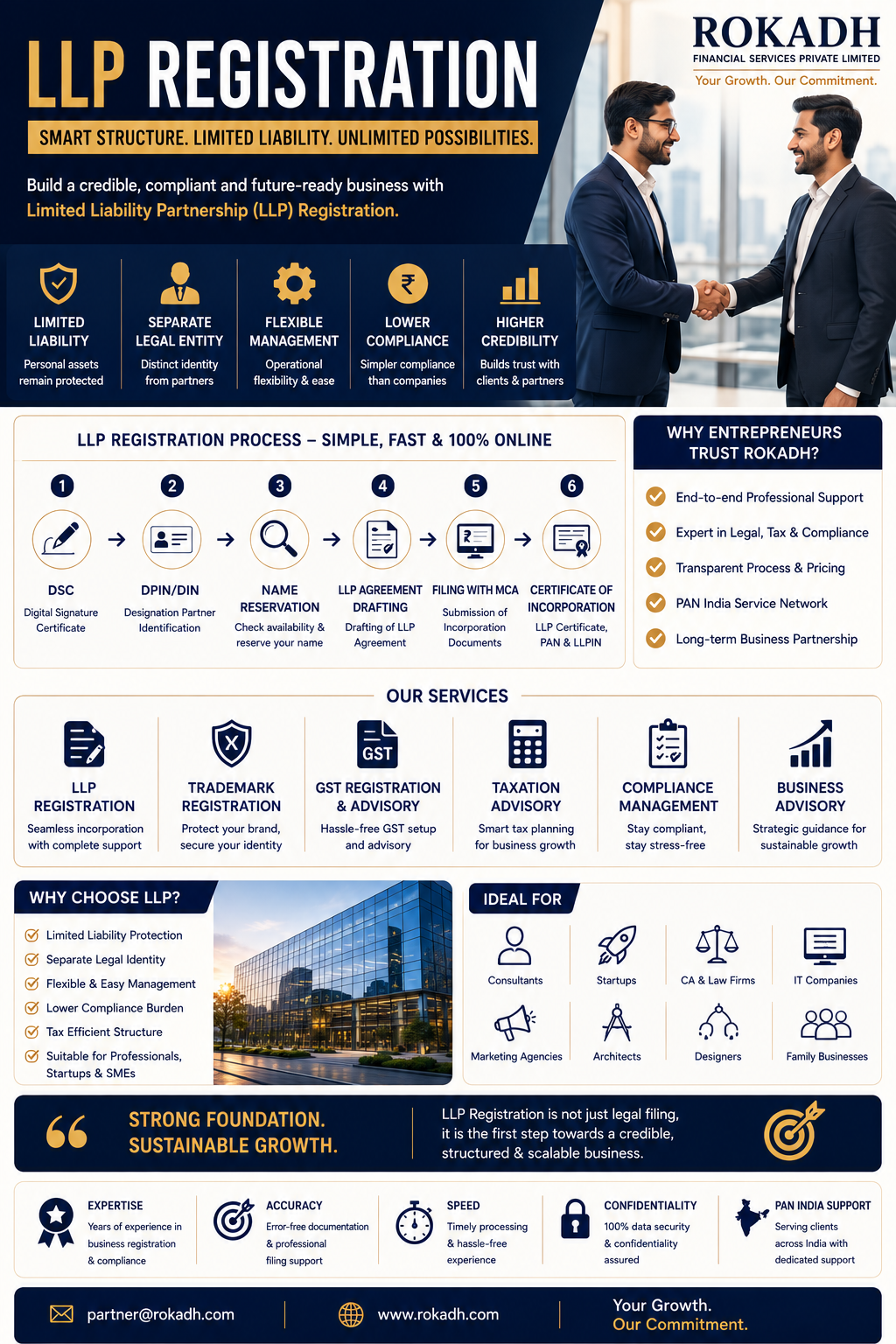
2. Limited Liability Partnership (LLP)
Best for:
- professionals,
- consultants,
- service firms,
- small partnerships.
Major Advantages
- Lower compliance burden
- Limited liability
- Flexible management structure
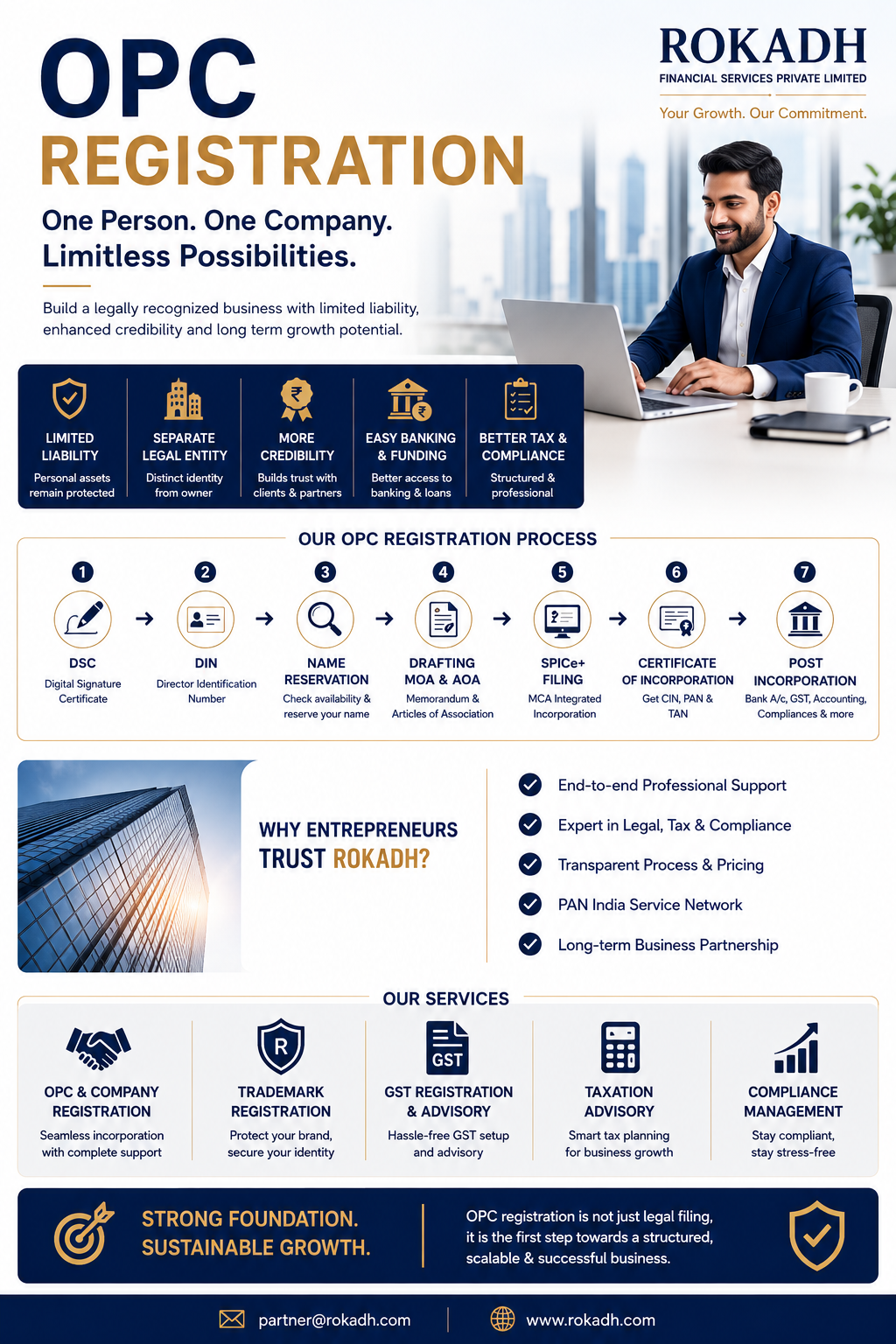
3. One Person Company (OPC)
Best for:
- solo founders,
- single entrepreneurs.
4. Partnership Firm
Best for:
- traditional small businesses.
5. Proprietorship
Best for:
- small-scale operations,
- freelancers,
- early-stage testing businesses.
However:
- legal protection remains weak,
- scalability becomes difficult.
Real Case Study — Startup Founder from Bengaluru
A technology founder initially started operations through proprietorship because:
- local consultant advised “simple structure.”
Later:
- investor discussions started,
- ESOP planning became necessary,
- equity dilution became difficult,
- startup valuation process suffered.
How Team Rokadh Resolved
Team Rokadh:
- professionally restructured business,
- incorporated Private Limited Company,
- designed founder shareholding structure,
- aligned startup legal framework,
- integrated ROC and taxation compliance.
This significantly improved investor confidence.
Why Wrong Company Structure Becomes Dangerous
Improper incorporation planning may later create:
- funding barriers,
- excessive taxation,
- ROC penalties,
- compliance burden,
- founder disputes,
- and business instability.
Major Risks of Choosing Wrong Company Registration Consultant
1. Wrong Entity Structure
A wrong structure impacts:
- taxation,
- funding,
- compliance,
- and scalability.
2. Improper Shareholding Planning
Weak equity structuring creates:
- founder conflicts,
- investment disputes,
- and dilution complications.
3. No Founder Agreement Planning
This is one of the biggest startup risks in India.
4. Weak ROC Compliance Advisory
Many consultants disappear after incorporation.
Founders later face:
- penalties,
- DIN deactivation,
- strike-off risk.
5. No GST & Tax Planning Integration
Business structure and taxation are deeply connected.
6. Ignoring Trademark Integration
Brand ownership often becomes legally vulnerable.
7. No Scalability Planning
Future expansion becomes difficult.
Real Case Study — E-commerce Business from Delhi
An e-commerce seller incorporated business through a low-cost portal.
The consultant:
- ignored trademark planning,
- selected improper shareholding structure,
- provided no compliance roadmap.
Within two years:
- investor due diligence raised concerns,
- GST reconciliation issues emerged,
- founder disputes increased.
Team Rokadh Intervention
Team Rokadh:
- professionally restructured compliance,
- corrected documentation,
- stabilized legal positioning,
- integrated trademark protection,
- streamlined ROC compliance.
Business operations became investor-ready.
Why ROC Compliance is Extremely Important
Company registration is only the beginning.
After incorporation, businesses must comply with:
- annual filings,
- board meetings,
- financial statements,
- auditor appointment,
- share allotment reporting,
- director disclosures.
Failure may trigger:
- heavy penalties,
- director disqualification,
- DIN deactivation,
- strike-off proceedings.
Relevant ROC Compliance Provisions
| Compliance Requirement | Governing Section | Statutory Purpose & Impact | Actionable ROC Filing / Timeline |
| Registered Office | Section 12 | Mandates having a valid physical address for formal communication and displaying the company name outside. | Form INC-22 must be filed within 30 days of any change in the office address. |
| Annual Return | Section 92 | Provides a comprehensive annual snapshot of management, shareholding structure, and debt profile. | Form MGT-7 / MGT-7A must be filed within 60 days of the Annual General Meeting (AGM). |
| Financial Statements | Section 134 | Covers the approval and filing of Balance Sheets, P&L accounts, and the mandatory Director's Report. | Form AOC-4 must be filed within 30 days of the conclusion of the AGM. |
| Auditor Appointment | Section 139 | Governs the mandatory appointment of the first statutory auditor and subsequent re-appointments/rotations. | Form ADT-1 must be filed within 15 days of appointing the auditor at the AGM. |
| Board Meetings | Section 173 | Prescribes the rules for conducting board meetings, including quorum requirements and the gap between two meetings. | First meeting within 30 days of incorporation; minimum 4 meetings every calendar year (gap not to exceed 120 days). |
Critical Compliance Risk Note
Failing to adhere to Sections 92 and 134 (Annual Filings) for a continuous period of two financial years allows the ROC to assume the company is not carrying on any business. This gives the department the statutory power to initiate a forced Strike-Off of the company name under Section 248 and freeze operational bank accounts.
Real Case Study — Startup from Mumbai
A startup ignored ROC compliance for two years because:
- consultant stopped responding after incorporation.
Consequences:
- penalties accumulated,
- directors panicked,
- investors delayed funding discussions.
Team Rokadh Resolution
Team Rokadh:
- reconstructed compliance records,
- completed pending ROC filings,
- regularized legal defaults,
- professionally stabilized company standing.
Why Team Rokadh Consistently Stands Out as Best Company Registration Consultants
1. Strategic Business Structuring Approach
Team Rokadh does not merely:
- register companies.
The team strategically understands:
- startup growth,
- taxation,
- investor readiness,
- ROC compliance,
- trademark protection,
- and long-term scalability.
2. Integrated Compliance Expertise
Team Rokadh professionally integrates:
- Company Registration,
- GST Registration,
- Income Tax Compliance,
- ROC Filing,
- Trademark Registration,
- Startup Advisory,
- and Legal Structuring together.
3. Strong Startup & MSME Advisory
Businesses across India increasingly trust Team Rokadh for:
- startup registration,
- founder structuring,
- compliance planning,
- and business protection.
4. PAN India Professional Advisory
Businesses from:
- Kanpur,
- Lucknow,
- Bengaluru,
- Delhi,
- Mumbai,
- Noida,
- Gurgaon,
- and across India
- professionally consult Team Rokadh.
5. Awareness-Driven Professional Approach
Team Rokadh continuously:
- educates entrepreneurs,
- spreads legal awareness,
- guides MSMEs,
- supports startups,
- and protects businesses through structured compliance advisory.
Why You Must Consult Team Rokadh Before Registering Company
Before incorporation, every founder should professionally evaluate:
- Which business structure is legally suitable?
- What will be future tax impact?
- Will investors prefer this structure?
- Is GST planning integrated?
- Is trademark ownership protected?
- Is founder equity properly planned?
- Is compliance burden manageable?
- Is startup valuation structure optimized?
These critical decisions cannot be safely handled through:
- random online filing portals,
- low-cost agents,
- or inexperienced consultants.
Internal Professional Guidance by Team Rokadh
Businesses planning:
- Company Registration,
- LLP Registration,
- Startup India Registration,
- GST Registration,
- Trademark Registration,
- ROC Compliance,
- Income Tax Filing,
- Startup Funding Preparation,
- should ideally structure everything strategically together.
Explore:
- Startup Advisory,
- ROC Compliance,
- GST Services,
- Trademark Protection,
- Tax Advisory,
- through Team Rokadh.
35+ Major Common Mistakes During Company Registration & Startup Compliance:
In India, most startups and businesses focus heavily on:
- logo design,
- website creation,
- marketing,
- product launch,
- and sales growth.
But very few founders properly focus on:
- legal structuring,
- ROC compliance,
- taxation planning,
- founder protection,
- startup documentation,
- and business scalability framework.
This becomes one of the biggest reasons why many startups later face:
- compliance notices,
- founder disputes,
- GST issues,
- taxation inefficiencies,
- investor rejection,
- and legal complications.
Unfortunately, most founders realize the importance of a competent Company Registration Consultant only after:
- penalties start,
- due diligence fails,
- or investors raise legal concerns.
Below are the most common company registration and startup compliance mistakes made by:
- startups,
- entrepreneurs,
- professionals,
- e-commerce sellers,
- MSMEs,
- freelancers,
- and growing businesses across India,
- all strategically resolved by Team Rokadh Best Company Registration Consultants.
1. Choosing Wrong Business Structure
This is one of the biggest and most expensive startup mistakes.
Many businesses randomly choose:
- Proprietorship,
- LLP,
- or Private Limited Company
- without understanding:
- taxation,
- funding capability,
- compliance burden,
- scalability,
- investor preference.
Why Team Rokadh Stands Out
Team Rokadh professionally analyzes:
- business model,
- future scalability,
- turnover projections,
- founder objectives,
- taxation impact
- before recommending any structure.
2. Incorporating Company Only for “GST Purpose”
Many businesses incorporate blindly merely because:
- someone suggested GST registration.
This creates:
- unnecessary ROC compliance burden,
- annual filing obligations,
- audit complications.
Real Case Study — Startup Founder from Delhi
A founder incorporated Private Limited Company through a low-cost portal only for GST purposes.
Within one year:
- annual ROC filing penalties started,
- compliance costs increased,
- directors became confused.
Team Rokadh Resolution
Team Rokadh:
- professionally reviewed structure,
- analyzed actual business requirements,
- streamlined compliance,
- stabilized legal obligations.
3. Improper Shareholding Structure
Weak shareholding planning later creates:
- founder disputes,
- equity conflicts,
- investor complications,
- dilution issues.
4. Ignoring Founder Agreement
One of the biggest startup risks in India.
Many founders trust relationships instead of legal structuring.
Later:
- ownership disputes arise,
- operational control issues emerge,
- legal battles begin.
5. Wrong Director Selection
Choosing directors casually creates:
- compliance risks,
- DIN-related complications,
- future governance problems.
6. Ignoring ROC Compliance After Incorporation
Many consultants disappear after incorporation.
Businesses later miss:
- annual returns,
- board meetings,
- financial filings,
- statutory disclosures.
This may trigger:
- penalties,
- director disqualification,
- strike-off risk.
Real Case Study — Startup from Mumbai
A startup failed to file:
- annual return,
- financial statements,
- auditor appointment filings.
Result:
- ROC penalties accumulated heavily.
Team Rokadh Intervention
Team Rokadh:
- reconstructed records,
- filed pending compliance,
- regularized defaults,
- stabilized ROC standing professionally.
7. Weak MOA & AOA Drafting
Generic MOA/AOA drafting often becomes dangerous.
Poor drafting impacts:
- investor onboarding,
- operational flexibility,
- business expansion.
8. Ignoring Trademark Protection During Incorporation
Many startups:
- launch brand first,
- register company later,
- but ignore trademark filing.
Result:
- brand ownership disputes,
- legal notices,
- forced rebranding risks.
9. Choosing Cheap Online Portals Instead of Professional Consultants
This remains one of the costliest startup mistakes.
Cheap filing portals usually focus only on:
- form filing,
- not:
- legal structuring,
- compliance planning,
- scalability.
10. No Taxation Planning During Incorporation
Business structure directly impacts:
- Income Tax,
- GST,
- TDS,
- startup valuation.
11. Improper Capital Structure
Wrong authorized capital planning creates:
- future filing complications,
- additional ROC costs.
12. Ignoring Startup India Eligibility
Many startups lose:
- tax benefits,
- recognition advantages,
- investor confidence opportunities.
13. No Compliance Calendar
This later creates:
- missed filings,
- penalties,
- compliance stress.
14. Improper Registered Office Documentation
ROC notices frequently arise because of weak documentation.
15. Ignoring Section 92 ROC Filing Requirements
Annual Return filing is mandatory.
Ignoring this creates:
- penalties,
- compliance default.
16. Ignoring Section 134 Financial Statement Compliance
Financial statements must comply properly.
17. Weak Accounting & Bookkeeping Structure
Poor bookkeeping weakens:
- funding readiness,
- taxation compliance,
- investor due diligence.
18. Ignoring GST Integration
Business incorporation and GST planning are deeply connected.
19. Wrong LLP Structuring
Many LLPs are created without:
- partner planning,
- compliance understanding,
- taxation evaluation.
20. No Scalability Planning
A structure suitable today may fail tomorrow.
Real Case Study — E-commerce Seller from Bengaluru
An online seller started operations through proprietorship.
Later:
- Amazon brand expansion,
- investor onboarding,
- vendor agreements
- became difficult.
Team Rokadh Resolution
Team Rokadh:
- professionally restructured business,
- incorporated scalable entity,
- integrated trademark planning,
- aligned taxation and compliance.
21. Ignoring ESOP Planning
Technology startups later struggle with employee retention.
22. No Investor Readiness Structuring
Weak governance scares investors.
23. Improper Director KYC Compliance
This may deactivate DIN.
24. Ignoring Event-Based ROC Filings
Many founders assume only annual filings matter.
Wrong assumption.
25. No Professional Advisory During Share Transfer
Share transfer errors become legally dangerous.
26. Improper PAN/TAN Integration
Banking and taxation issues arise later.
27. Wrong Object Clause in MOA
This later restricts:
- expansion,
- funding,
- business diversification.
28. Ignoring Startup Valuation Planning
Very important for future investment rounds.
29. Weak Documentation During Funding Discussions
Investor due diligence becomes difficult.
30. Ignoring Data & Compliance Security
Modern startups require structured compliance management.
31. No Intellectual Property Structuring
Trademark and ownership planning remain weak.
32. Improper Partnership Conversion
Conversion requires strategic legal planning.
33. Weak Compliance Advisory for MSMEs
Many MSMEs operate without proper structure.
34. Ignoring Tax Audit Exposure
Future turnover growth may trigger complications.
35. Treating Company Registration as Mere “Certificate Work”
This remains the biggest mistake.
Company incorporation is:
- business architecture,
- legal foundation,
- taxation structure,
- investor framework.
All these major startup and compliance issues have been:
- strategically guided,
- professionally resolved,
- compliantly managed,
- and legally stabilized
- by Team Rokadh Best Company Registration Consultants.
50+ Most Asked / Searched FAQs for Company Registration & Startup Compliance
1. Why is professional company registration important?
Because incorporation affects:
- taxation,
- compliance,
- funding,
- legal protection,
- and scalability.
2. Why is Team Rokadh considered among the best company registration consultants?
Because Team Rokadh combines:
- startup understanding,
- taxation expertise,
- ROC compliance,
- trademark protection,
- and business structuring together.
3. Which is better — LLP or Private Limited Company?
Depends upon:
- business model,
- funding requirement,
- scalability,
- compliance preference.
4. Can wrong structure create tax inefficiency?
Absolutely yes.
5. Can investors reject poorly structured startups?
Very frequently.
6. Why is ROC compliance important?
Because non-compliance creates:
- penalties,
- director disqualification,
- strike-off risks.
7. Can startup founders become personally liable?
In certain cases yes.
8. Why should founders avoid cheap incorporation portals?
Because legal structuring matters more than mere filing.
9. Can Team Rokadh help PAN India?
Yes professionally.
10. Why is shareholding planning critical?
Because future founder disputes become expensive.
11. Why is trademark planning important during incorporation?
To protect:
- brand ownership,
- business identity,
- future expansion.
12. Can Team Rokadh handle ROC annual compliance?
Yes extensively.
13. What is DIN?
Director Identification Number.
14. Can DIN become deactivated?
Yes due to non-compliance.
15. Why is MOA drafting important?
Because it defines business powers and scope.
16. What is AOA?
Articles governing company operations.
17. Can Team Rokadh help startups professionally structure ownership?
Yes strategically.
18. Why is GST integration important during incorporation?
Because taxation and business structure are interconnected.
19. Can improper structure affect funding?
Absolutely.
20. Why do startups increasingly trust Team Rokadh?
Because Team Rokadh focuses on:
- long-term business protection,
- not merely incorporation.
21. Can businesses change structure later?
Yes but restructuring may become costly.
22. What is Startup India registration?
Government recognition for eligible startups.
23. Can Team Rokadh help with Startup India registration?
Yes professionally.
24. Why is compliance calendar important?
To avoid penalties and missed filings.
25. Can weak bookkeeping impact startup growth?
Significantly.
26. Why should founders maintain proper agreements?
To avoid ownership disputes.
27. Can Team Rokadh assist in investor readiness?
Yes strategically.
28. Why is founder equity planning important?
Because future dilution affects control.
29. Can online sellers benefit from Private Limited structure?
Very often yes.
30. Why do startups require professional tax planning?
Because taxation affects profitability and valuation.
31. Can ROC penalties become heavy?
Yes significantly.
32. Why should startups integrate trademark protection early?
To avoid future legal conflicts.
33. Can Team Rokadh assist in trademark registration also?
Yes professionally.
34. What is authorized capital?
Maximum capital company can issue.
35. Why is registered office compliance important?
ROC communications depend upon it.
36. Can Team Rokadh help businesses scale compliantly?
Yes strategically.
37. Why do investors prefer properly governed companies?
Because governance reflects business reliability.
38. Can Team Rokadh support MSMEs?
Yes extensively.
39. Why is annual ROC filing mandatory?
Because Companies Act requires it.
40. Can startup valuation suffer due to compliance issues?
Absolutely.
41. Why is professional advisory essential before incorporation?
Because prevention is cheaper than litigation.
42. Can founders lose control due to weak structuring?
Yes.
43. Why is documentation critical during due diligence?
Investors verify legal stability.
44. Can Team Rokadh help with LLP registration?
Yes professionally.
45. Why should startups avoid casual legal structuring?
Because future disputes become expensive.
46. Can weak incorporation affect banking credibility?
Yes.
47. Why is startup scalability planning important?
Because businesses evolve rapidly.
48. Why does Team Rokadh stand out from ordinary registration agencies?
Because Team Rokadh focuses on:
- strategic advisory,
- legal protection,
- compliance management,
- and business scalability.
49. Why should founders book appointment with Team Rokadh?
To professionally evaluate:
- structure suitability,
- compliance exposure,
- taxation impact,
- investor readiness,
- and long-term scalability.
50. Why is company registration becoming more strategic in India?
Because businesses today are:
- compliance-driven,
- investor-driven,
- technology-driven.
Professional structuring is now essential.
51. Why do startups, founders and businesses increasingly trust Team Rokadh?
Because Team Rokadh continuously focuses on:
- awareness,
- legal protection,
- startup scalability,
- strategic compliance,
- and long-term business growth.
Final Professional Conclusion
In modern India, company registration is no longer merely:
- legal formality.
It is:
- a strategic business foundation.
The difference between:
- ordinary incorporation,
- and
- professionally structured company registration
- often determines whether a startup:
- scales professionally,
- or
- enters avoidable legal, taxation and compliance complications later.
This is exactly why startups, entrepreneurs, professionals and MSMEs increasingly trust:
Team Rokadh — Rokadh Financial Services Private Limited (India’s Leading Financial Services Company)
for:
- strategic company registration,
- startup legal structuring,
- ROC compliance,
- taxation integration,
- and long-term business protection.
For professional consultation and appointment booking, visit: