
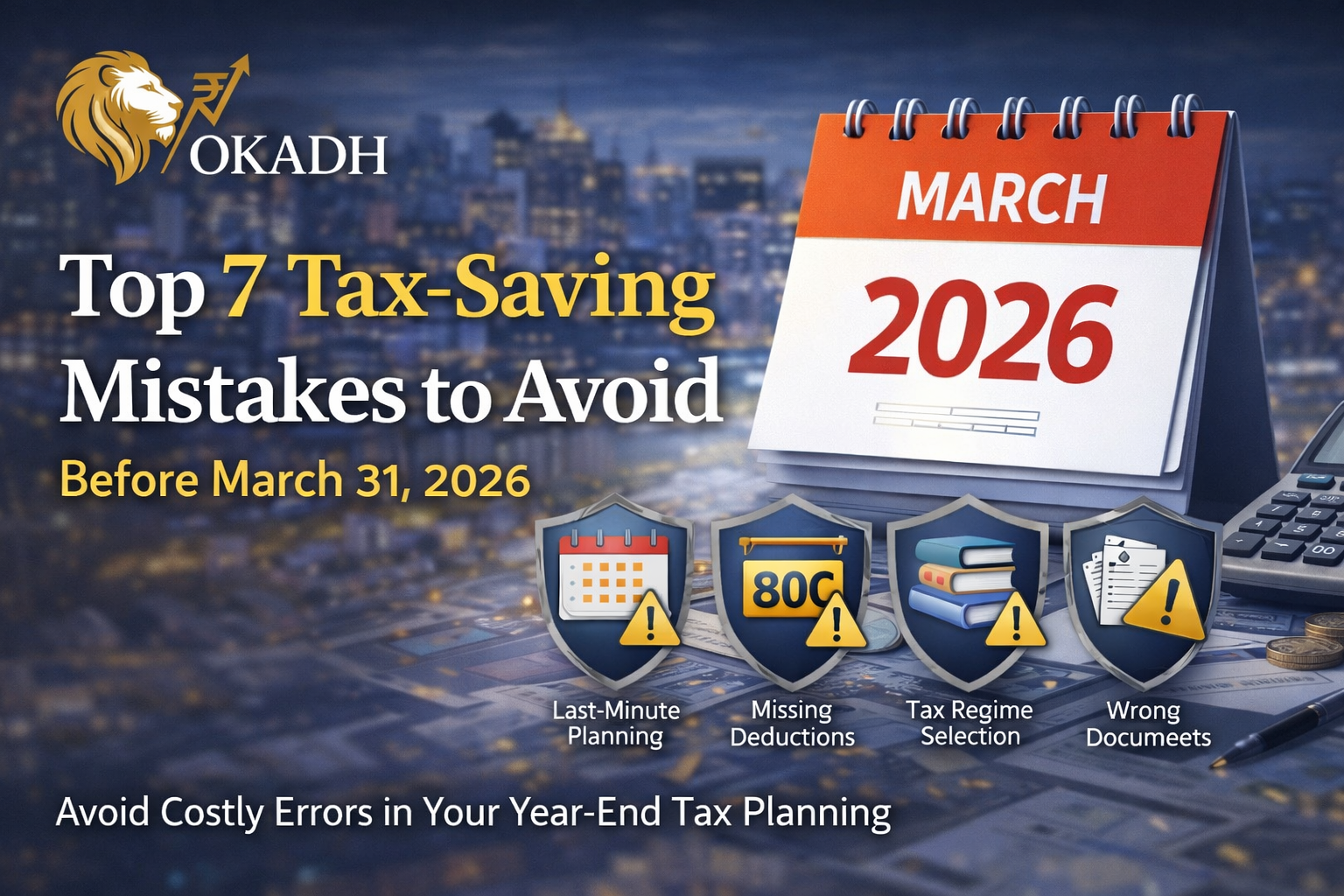
As the financial year 2025–26 approaches its end, taxpayers across India rush to make last-minute investments and declarations to save income tax. While tax planning is essential, poor planning or incorrect decisions can lead to missed deductions, higher tax liability, and even notices from the Income Tax Department.
Every year, many taxpayers repeat the same mistakes—investing without understanding eligibility, relying on assumptions, or ignoring regime selection. With March 31, 2026 being the final deadline for tax-saving actions for FY 2025–26, it is crucial to plan wisely and avoid common pitfalls.
This blog highlights the Top 7 Tax-Saving Mistakes you must avoid before March 31, 2026, and explains how to make informed, compliant, and effective tax-saving decisions.
1. Investing at the Last Minute Without a Tax Strategy
One of the most common mistakes taxpayers make is last-minute tax-saving investments purely to exhaust Section 80C limits.
Why This Is a Problem:
- Investments are made without understanding lock-in periods
- Products may not suit financial goals or risk profile
- Poor liquidity planning
- Higher chances of documentation errors
Smart Approach:
Tax planning should be done at the beginning of the financial year, not in March. Investments should align with:
- Long-term goals
- Risk appetite
- Cash flow needs
- Applicable tax regime
📌 Tax saving should be a by-product of financial planning, not the sole objective.
2. Ignoring the Choice Between Old and New Tax Regime
Many taxpayers fail to evaluate which tax regime is beneficial for them and continue with the default option.
Key Issue:
- The New Tax Regime offers lower slab rates but removes most deductions
- The Old Tax Regime allows deductions like 80C, 80D, HRA, LTA, etc.
Choosing the wrong regime can lead to higher tax liability, even after investments.
What You Should Do:
- Compare tax liability under both regimes
- Evaluate salary structure and deductions
- Choose the regime that minimizes tax legally
📌 There is no “one-size-fits-all” regime.
3. Claiming Deductions Without Proper Proof
Another serious mistake is claiming deductions without valid documentation, assuming they won’t be scrutinized.
Common Examples:
- Fake rent receipts for HRA
- Unsupported medical insurance claims
- Incorrect tuition fee claims
- Overstated donations
Consequences:
- Disallowance of deductions
- Tax demand with interest
- Penalties and notices
Best Practice:
- Maintain proper receipts and proofs
- Ensure deductions are actually eligible
- Submit correct documents to employer or tax consultant
📌 Incorrect claims can cost more than the tax saved.
4. Not Utilizing Section 80C Fully or Using It Incorrectly
Section 80C allows deductions up to ₹1.5 lakh, yet many taxpayers either:
- Do not fully utilize it, or
- Invest in unsuitable instruments
Common Mistakes:
- Ignoring EPF, PPF, or ELSS
- Investing only for tax, not returns
- Forgetting tuition fees or home loan principal eligibility
Smart Utilization:
Popular eligible investments include:
- EPF / VPF
- PPF
- ELSS mutual funds
- Life insurance premium
- Home loan principal
- Children’s tuition fees
📌 Choose instruments that balance tax savings and long-term wealth creation.
5. Overlooking Section 80D (Health Insurance Deduction)
Many taxpayers focus only on Section 80C and ignore Section 80D, missing out on valuable deductions.
Deduction Limits:
- ₹25,000 for self & family
- Additional ₹25,000 for parents
- ₹50,000 if parents are senior citizens
Common Oversight:
- Not renewing health insurance on time
- Assuming employer insurance is sufficient
- Not claiming preventive health check-ups
📌 Health insurance offers both financial protection and tax benefits.
6. Not Considering Other Eligible Deductions & Exemptions
Taxpayers often miss deductions beyond the popular sections.
Commonly Missed Benefits:
- Section 80CCD(1B): Additional ₹50,000 for NPS
- Section 24(b): Home loan interest
- HRA exemption
- LTA exemption
- Interest on education loan (Section 80E)
- Donations under Section 80G
Result:
Higher tax outflow due to lack of awareness.
📌 A comprehensive review of income and expenses helps unlock hidden tax benefits.
7. Not Filing or Revising Income Tax Return Properly
Even after making correct investments, taxpayers sometimes:
- File incorrect returns
- Miss deadlines
- Fail to revise errors
Consequences:
- Loss of refunds
- Notices from the department
- Late fees and interest
Best Practice:
- File ITR accurately and on time
- Verify regime selection
- Revise return if mistakes are identified
📌 Tax-saving is incomplete without correct return filing.
Key Tax Planning Tips Before March 31, 2026
✔ Review your income and deductions early
✔ Compare Old vs New Tax Regime
✔ Avoid last-minute rushed investments
✔ Keep documentation ready
✔ Seek professional guidance if required
Why Professional Tax Planning Matters
Tax laws, deductions, and regimes are evolving. A professional approach ensures:
- Maximum legal tax savings
- Compliance with tax laws
- Reduced risk of notices
- Better long-term financial planning
How Rokadh Can Help You Save Tax Smartly
At Rokadh, we assist individuals, professionals, startups, and businesses with:
- Tax planning & advisory
- Regime comparison
- Income tax return filing
- Investment-linked tax optimization
- Compliance support
Our approach focuses on accuracy, compliance, and long-term benefit, not shortcuts.
Conclusion
With March 31, 2026 approaching, avoiding common tax-saving mistakes is just as important as making investments. Smart planning, informed decisions, and timely action can significantly reduce tax liability while keeping you fully compliant.
Instead of rushing in March, plan wisely—and save tax the right way.
About Rokadh
Rokadh is a trusted platform for Income Tax, GST, ROC, Startup, Trademark, and NRI compliance services, helping taxpayers and businesses stay compliant and financially efficient.