
By: Rokadh Financial Services Private Limited
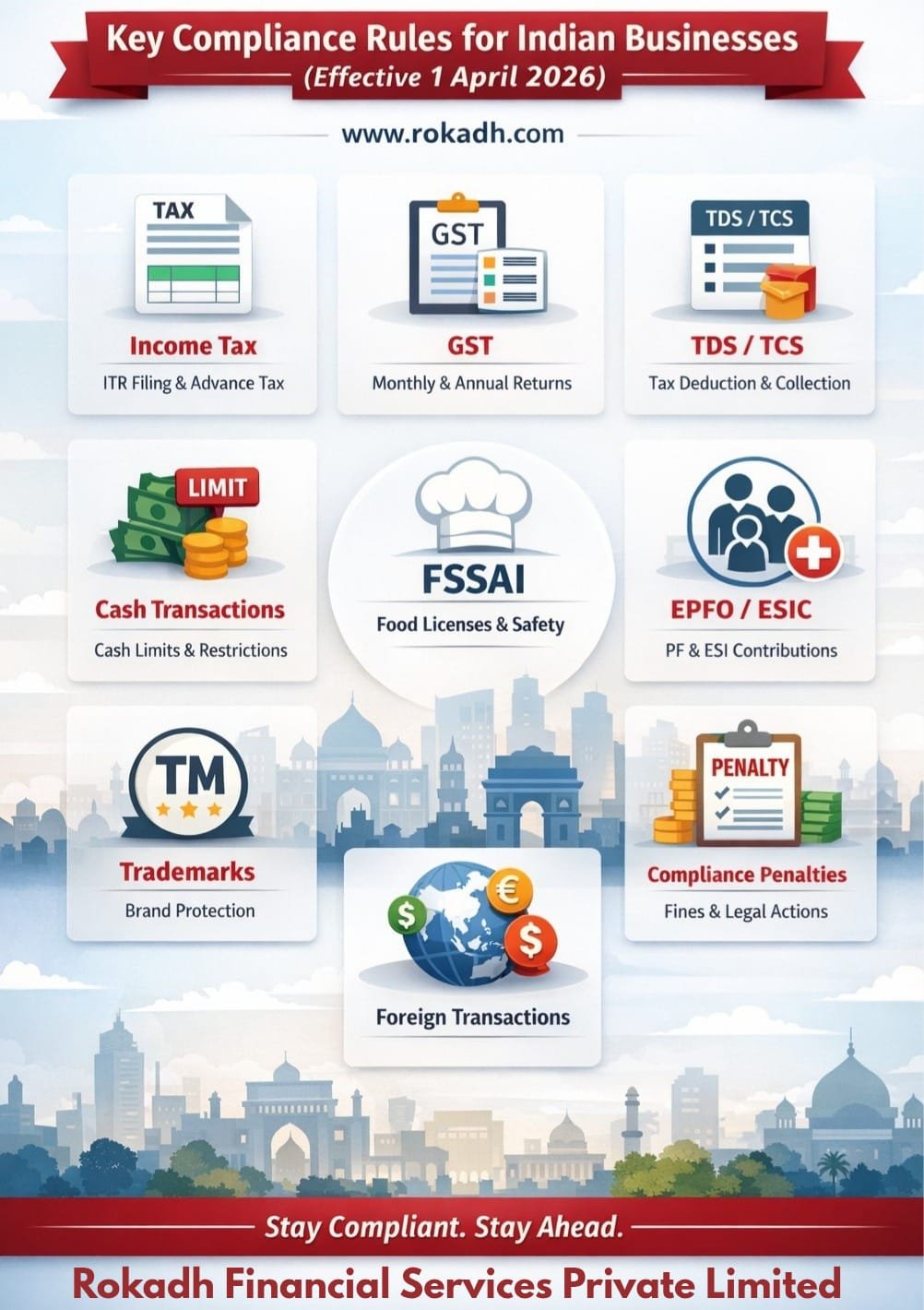
As we stand on the threshold of 1st April 2026, the Indian economic landscape is no longer just "evolving"—it has been fundamentally re-engineered. For a startup in Bangalore, a manufacturer in Kanpur, or a high-net-worth investor in Mumbai, the "Rules of Business" have shifted from periodic filings to real-time, data-driven transparency.
At Rokadh Financial Services Private Limited, we understand that compliance isn't just a legal requirement; it is a strategic asset. In an era where AI-driven tax bots scan your bank statements and GST filings simultaneously, a single oversight can freeze your operations. This 2026-27 Master Blueprint breaks down every critical regulation you must master to thrive.
1. Income Tax: The "Simplified" High-Stakes Game
The Union Budget 2026 has made the New Tax Regime the absolute benchmark for efficiency. The goal is clear: lower rates, fewer deductions, and higher compliance.
A. The New Slab Structure (FY 2026-27)
Effective 01.04.2026, the tax brackets provide the highest "tax-free" threshold in Indian history.
| Taxable Income (₹) | Tax Rate (%) | Effective Impact |
| Up to 4,00,000 | Nil | Pure Tax-Free Zone |
| 4,00,001 – 8,00,000 | 5% | Ideal for Entry-level Professionals |
| 8,00,001 – 12,00,000 | 10% | Zero Tax with Sec 87A Rebate |
| 12,00,001 – 16,00,000 | 15% | Middle Management Sweet Spot |
| 16,00,001 – 20,00,000 | 20% | Standard Corporate Rate |
| 20,00,001 – 24,00,000 | 25% | High-Earner Bracket |
| Above 24,00,000 | 30% | HNI & Elite Tier |
The Sec 87A Advantage: If your net taxable income is ₹12,00,000 or less, your tax liability is Nil. This is a massive boost for the consumption economy in cities like Kanpur and Lucknow.
B. Section 43B(h): The MSME "Ticking Time Bomb"
If you are a business owner, your accounting software must now have an "MSME Alert."
- The Rule: Payments to Micro and Small enterprises (not Medium) must be made within 15 days (default) or 45 days (with written agreement).
- The 2026 Enforcement: Any payment pending beyond these days as of March 31, 2026, will be disallowed as an expense. You will pay tax on that "unpaid" amount.
- Action Plan: Collect Udyam Registration Certificates from every vendor. If they are "Micro" or "Small," prioritize their payments over all others.
2. GST: Real-Time Governance & The 3-Year Barrier
The Goods and Services Tax system has moved away from "Self-Assessment" toward "System-Verification."
A. The 30-Day E-Invoicing Rule
For businesses with an Aggregate Annual Turnover (AATO) exceeding ₹10 Crores, the generation of the Invoice Reference Number (IRN) is now strictly time-bound.
- The Deadline: You must report the invoice on the IRP portal within 30 days of the invoice date.
- The Penalty: If you report it on day 31, the invoice is considered legally void. Your customer cannot claim Input Tax Credit (ITC), and you may face a penalty for "issuing an incorrect document."
B. The 3-Year "Sunset" Clause
Starting April 2026, the GST portal will physically prevent you from filing any return (GSTR-1, 3B, 9) that is more than 3 years old. If you have old "backlog" filings, the window is closing permanently.
C. GSTR-2B Persistence
In 2026, "Provisional ITC" is a myth. You can only claim credit if the supplier has filed their return and it reflects in your GSTR-2B. Monthly reconciliation is no longer a "good practice"—it is a survival necessity.
3. FSSAI: The Shift to Perpetual Licensing
For the food industry—from cloud kitchens in Delhi to exporters in Kanpur—the FSSAI has simplified the bureaucratic burden.
- Perpetual Validity: No more annual renewals. Once you get your FSSAI license after 01.04.2026, it is valid forever, provided you pay a small annual fee and file your Form D1 (Annual Return) by 31st May every year.
- Increased Thresholds: Small businesses with turnover up to ₹1.5 Crores can now operate with a simple Registration (₹100/year) instead of a State License. This saves thousands in professional fees and compliance costs.
4. Cash Transactions & Digital Footprints
The 2026-27 rules make cash "toxic" for business health.
- Rule 161 (High-Value Cash): If you deposit or withdraw more than ₹20 Lakhs in cash in a financial year, the bank will trigger an automatic Income Tax Insight report.
- Section 269ST: Receiving ₹2 Lakhs in cash for a single transaction (even from family) carries a 100% penalty.
- Digital Audit Trail: The IT department's AI (Project Insight) now cross-links your high-value credit card spends with your declared income. If you spend ₹10 Lakhs on a luxury watch but declare ₹5 Lakhs income, expect a "Notice for Scrutiny" within 48 hours.
5. Labor Laws: The Social Security Code 2020
The long-awaited labor reforms are now the operational standard.
- Gratuity for All: The 5-year eligibility for gratuity is abolished for Fixed-Term Employment. If you hire a consultant or worker for a 12-month contract, you must pay pro-rata gratuity at the end of the term.
- The Wage Definition: Ensure your "Allowances" do not exceed 50% of the total salary. If they do, the excess is treated as "Wages," increasing your PF and ESIC liability. Rokadh Financial Services Private Limited provides expert salary restructuring to ensure you remain compliant without inflating costs.
6. FEMA: Global Ambitions for Indian Startups
With India aiming to be a global export hub, the FEMA (Export/Import) Regulations 2026 provide much-needed flexibility.
- Export Realization: You now have 15 months to bring foreign exchange back to India. For those exporting to "difficult" markets, this provides a massive liquidity cushion.
- LRS for Investments: The Liberalised Remittance Scheme (LRS) limit remains $250,000, but the TCS (Tax Collected at Source) is now a flat 20% on all remittances above ₹7 Lakhs (excluding education/medical).
7. Mutual Fund Investors: The New Wealth Matrix
Investment strategy in 2026 is driven by Tax-Efficiency.
- Equity Funds: Hold for >12 months to get the 12.5% LTCG rate. Remember, the first ₹1.25 Lakhs of profit is tax-free.
- Debt Funds: There is no "Long Term" in debt anymore. Every rupee earned is taxed at your Slab Rate (up to 30%). Investors are shifting to Arbitrage Funds to get equity-like taxation with debt-like risk.
- STCG: Short-term gains on equity are now taxed at 20%. Avoid "churning" your portfolio unnecessarily.
8. TDS & TCS: The New "Act 2025" Framework
As of 1st April 2026, the transition to the Income Tax Act, 2025 has streamlined several TDS provisions, but it has also introduced stricter reporting for digital and partner-level transactions.
A. New Section 194T: TDS on Partner Payments
For the first time, partnership firms and LLPs must deduct TDS on payments made to their own partners.
- The Rule: TDS at 10% must be deducted on salary, remuneration, commission, or interest paid to a partner.
- Threshold: This applies if the aggregate payment exceeds ₹20,000 in a financial year.
- Why it matters: This ensures that "profit-sharing" disguised as remuneration is tracked in real-time.
B. Virtual Digital Assets (VDA) & Crypto TDS
With the Income Tax (First Amendment) Rules, 2026, the net for digital assets has widened to include the Digital Rupee (CBDC) and e-wallets.
- Section 194S: 1% TDS remains applicable on the transfer of VDAs.
- Thresholds: ₹50,000 for "Specified Persons" (Individuals/HUF not liable for audit) and ₹10,000 for others.
- New Reporting: Transactions involving the Digital Rupee must now be reported alongside crypto trades.
C. Updated TDS Rate Chart (FY 2026-27)
| Section | Nature of Payment | New Threshold (₹) | Rate (%) |
| 194C | Payment to Contractors (Single/Annual) | 30,000 / 1,00,000 | 1% (Ind) / 2% (Co) |
| 194J | Professional Fees (increased limit) | 50,000 | 10% |
| 194I | Rent (Land/Building) | 50,000 per month | 10% |
| 194Q | Purchase of Goods (Turnover > ₹10Cr) | 50,00,000 | 0.1% |
| 194T | Partner Salary/Remuneration | 20,000 | 10% |
Warning: If a deductee does not provide a PAN, the TDS rate automatically jumps to a minimum of 20% (Section 206AA)
9. Trademarks: Protecting Your Brand in 2026
In a digital-first economy, your "Brand Name" is your most valuable asset. For startups in Kanpur or Bangalore, trademarking is no longer a luxury—it’s a defensive necessity.
A. The 2026 Trademark Landscape
The IP India portal has been upgraded for Automated Examination, significantly reducing the time it takes to get your "TM" status.
- Concessional Fees for Startups: To encourage innovation, the government offers a 50% subsidy on filing fees for DPIIT-recognized startups and MSMEs.
- Startup/Individual Fee: ₹4,500 (E-filing).
- Large Corporate Fee: ₹9,000 (E-filing).
- The ® Symbol vs. ™ Symbol:
- You can use the ™ symbol the moment you receive your application number (Day 1).
- You can only use the ® symbol after the final Registration Certificate is issued (typically 6–18 months).
B. The Step-by-Step Registration Process
- Public Search: Always conduct a thorough search on the IP India database to ensure your name isn't "confusingly similar" to an existing one.
- Class Selection: Goods and services are divided into 45 Classes. Selecting the wrong class can make your trademark legally useless. (e.g., Class 35 for retail/marketing, Class 42 for software).
- Examination Report: Within 3–6 months, the Registry issues a report. If there are "Objections" (e.g., the name is too descriptive), you must file a professional response within 30 days.
- Journal Publication: Once accepted, your mark is published in the Trademark Journal for 4 months to allow for public "Opposition."
C. Why Every Small Business Needs a Trademark
- Legal Monopoly: It gives you the exclusive right to use the brand name across India.
- Amazon/Flipkart Brand Registry: To protect your listings from "hijackers" on e-commerce platforms, a registered trademark is mandatory.
- Valuation: A registered brand increases the "Goodwill" of your company during fundraising or a business sale.
10. Summary of Critical Deadlines (Post-April 1)
- 7th of Every Month: Deadline for depositing TDS/TCS for the previous month.
- 15th of Every Month: Deadline for filing PF/ESIC returns.
- 31st May: Deadline for filing the FSSAI Annual Return (Form D1) to keep your perpetual license active.
- Quarterly (31st July/Oct/Jan/May): TDS Return filing (Forms 24Q, 26Q, 27Q).
At Rokadh Financial Services, we assist you with end-to-end Trademark Filing and TDS Management. Don't let compliance paperwork slow down your business growth.
Secure your brand today. Reach out to us for a Free Trademark Search.
11. City-Specific Compliance Hubs: Why Location Matters
For Businesses in Kanpur:
As a major industrial hub, Kanpur businesses must focus heavily on GST E-Way Bill compliance and MSME Section 43B(h). With the tanning and textile industries heavily reliant on small vendors, missing a 45-day payment window could result in massive tax outflows.
For Startups in Bangalore/Pune:
The focus should be on FEMA (for SaaS exports) and the Social Security Code (for gig-worker compliance). Ensure your ESOP structures are updated to reflect the 2026 tax perquisite rules.
12. 40+ FAQs
I. Income Tax & MSME Compliance
- What is the effective tax-free income limit for FY 2026-27?
Under the New Tax Regime, the zero-tax limit is ₹12 Lakhs (after including the Section 87A rebate of ₹60,000).
- Is the Old Tax Regime still available?
Yes, but the New Tax Regime is now the default. You must explicitly opt for the Old Regime at the time of filing or with your employer.
- What is the "45-day rule" for MSMEs?
Under Section 43B(h), payments to Micro and Small enterprises must be made within 45 days (if there is a written agreement) or 15 days (if no agreement) to claim the expense as a tax deduction.
- Does the 45-day rule apply to Medium Enterprises?
No, it only applies to 'Micro' and 'Small' enterprises registered under the Udyam portal.
- What happens if I pay an MSME vendor on the 46th day?
The deduction is disallowed for that financial year. You can only claim it in the year you actually make the payment.
- Is the Standard Deduction available in the New Regime?
Yes, a standard deduction of ₹75,000 is available for salaried individuals and pensioners.
- How do I check if my vendor is a Micro or Small enterprise?
Ask for their Udyam Registration Certificate, which specifies their category based on investment and turnover.
- Can I claim 80C deductions (LIC, PPF) in the New Regime?
No, most Chapter VI-A deductions are not available in the New Tax Regime.
- What is the tax rate for income above ₹24 Lakhs?
It is taxed at the highest bracket of 30%.
- How does the marginal relief work for income slightly above ₹12 Lakhs?
If your income is just above ₹12 Lakhs (e.g., ₹12.1 Lakhs), your tax is capped so it doesn't exceed the amount by which your income exceeds ₹12 Lakhs.
II. GST & E-Invoicing
- What is the 3-year time bar in GST?
From 2026, you cannot file any GST return (GSTR-1 or 3B) if it is more than 3 years past its original due date.
- Who must generate an E-invoice (IRN) in 2026?
Any business with an Aggregate Annual Turnover (AATO) exceeding ₹10 Crores in any previous financial year (from 2017-18 onwards).
- Is there a deadline to generate an IRN?
Yes, for businesses above ₹10 Cr turnover, the IRN must be generated within 30 days of the invoice date.
- What if I fail to generate an IRN within 30 days?
The invoice is considered invalid. You cannot move goods, and your customer cannot claim Input Tax Credit (ITC).
- Is Multi-Factor Authentication (MFA) mandatory for all?
Yes, as of April 1, 2025/2026, all taxpayers must use MFA (OTP/Biometrics) to log into the GST portal.
- Can I claim ITC if my supplier hasn't filed their GSTR-1?
No. ITC is strictly restricted to what appears in your GSTR-2B.
- What is the validity of an E-Way Bill base document?
An E-way bill can only be generated against an invoice or document dated within the last 180 days.
- Are invoice numbers now case-sensitive in GST?
No, the IRP now auto-converts all invoice numbers to upper case to prevent duplicates.
- How long can I extend an E-Way Bill?
Extensions are now capped at a maximum of 360 days from the original generation date.
- Can I file my GST Annual Return (GSTR-9) after 4 years?
No, the 3-year time bar applies to annual returns as well.
III. FSSAI (Food Safety)
- What is a "Perpetual License" in FSSAI?
FSSAI licenses issued from 2026 no longer have an expiry date. They are valid indefinitely unless cancelled or surrendered.
- Do I still need to pay an annual fee for FSSAI?
Yes. While the license doesn't expire, you must pay the annual maintenance fee to keep it active.
- What happens if I forget to pay the annual FSSAI fee?
The license is "deemed suspended," and you must stop all food business activities immediately.
- What is the new turnover limit for FSSAI Registration?
The limit has been increased from ₹12 Lakhs to ₹1.5 Crores.
- Do street food vendors need a separate FSSAI registration?
No, if they are registered under the Street Vendors Act, 2014, they are "deemed registered" with FSSAI.
- Does a perpetual license cover multiple branches?
No, a license is specific to a single premises. Each location needs its own registration/license.
- When is a Central License mandatory?
For businesses with a turnover exceeding ₹50 Crores, or those engaged in import/export of food products.
IV. Labor Laws (EPFO & ESIC)
- What is the "50% Wage Rule"?
Under the new Social Security Code, allowances cannot exceed 50% of the total salary. If they do, the excess is treated as "wages" for PF/ESIC calculations.
- Do fixed-term employees get gratuity?
Yes, employees on fixed-term contracts are now eligible for pro-rata gratuity, even if they haven't completed 5 years.
- What is the wage ceiling for ESIC in 2026?
Employees earning up to ₹21,000 per month are covered under ESIC.
- Are gig workers covered under social security now?
Yes, the 2026 rules bring platform and gig workers under a specific social security framework.
- What is the time limit for EPFO to start an inquiry?
EPFO inquiries for dues are now limited to a 5-year look-back period.
V. Cash & FEMA (Forex)
- Can I receive ₹2 Lakhs in cash from a relative?
No. Section 269ST prohibits receiving ₹2 Lakhs or more in cash from any person in a day, regardless of the relationship.
- What is the penalty for violating cash transaction limits?
The penalty is 100% of the amount received.
- When is PAN mandatory for cash withdrawals?
For cumulative cash withdrawals or deposits exceeding ₹20 Lakhs in a financial year.
- How much time do I have to bring export money back to India?
15 months for goods/services, but this extends to 18 months if the invoice is settled in Indian Rupees (INR).
- Can I set off export receivables against import payables?
Yes, FEMA 2026 allows set-off with the same overseas counterparty or group companies.
VI. Mutual Fund Investments
- How are Equity Mutual Funds taxed in 2026?
Long-term gains (held >12 months) are taxed at 12.5% on profits exceeding ₹1.25 Lakhs. Short-term gains are taxed at 20%.
- Is there any tax benefit for Debt Funds?
No, Debt funds (equity <35%) are taxed at your marginal slab rate, regardless of the holding period.
- How are Hybrid Funds taxed?
If equity is between 35-65%, they are taxed at 12.5% for LTCG (held >24 months).
- Is TDS deducted on Mutual Fund gains for residents?
No, resident Indians must pay tax through advance tax or self-assessment. TDS only applies to NRIs.
- What is the TDS rate on Dividends?
10% TDS is deducted if the total dividend from one AMC exceeds ₹10,000 in a year.
Have a question not listed here?
Contact Rokadh at Partner@rokadh.com for personalized advisory.
Final Checklist for April 2026
- [ ] File GST LUT for FY 2026-27 (for exporters).
- [ ] Update your Accounting Software for the new tax slabs.
- [ ] Re-verify PAN-Aadhar Linkage for all directors/partners.
- [ ] Perform a 45-Day Payment Audit for all MSME vendors.
- [ ] Renew your Professional Tax registrations (state-specific).
At Rokadh Financial Services Private Limited, we don't just file returns; we build legacies. Our Virtual CFO services are designed to give small businesses the financial muscle of a multinational.
Ready to secure your business for FY 2026-27?
Contact: Arpit Agrawal (Expert)
Email: Partner@rokadh.com
Website: www.rokadh.com
Office: PAN India.
Disclaimer: This blog is for informational purposes only. Regulatory rules are subject to change by government notifications. Consult with a professional advisor at Rokadh for specific cases.