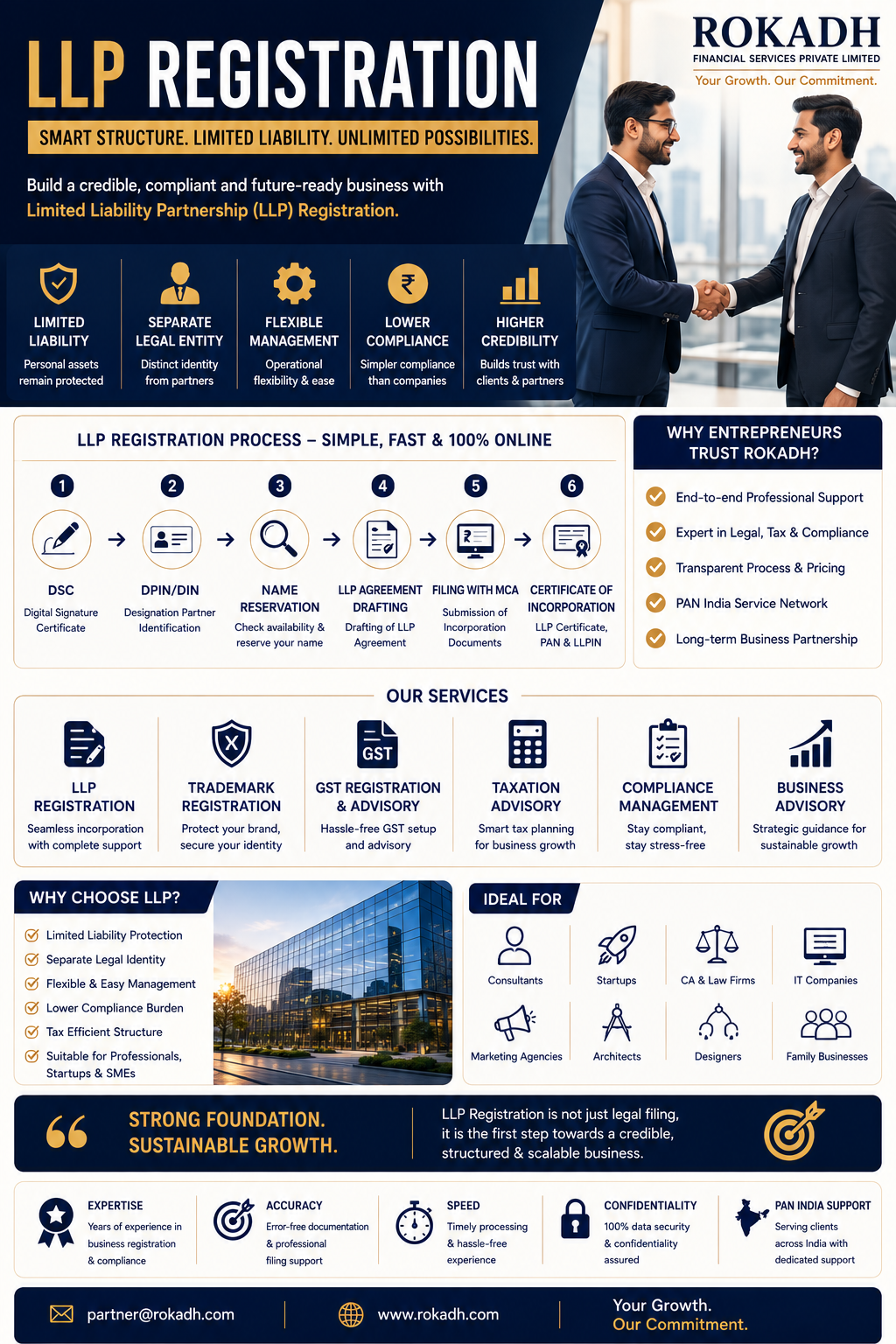


Complete Guide to Taxation, Compliance, Audit & Filing in India (FY 2025-26)
Limited Liability Partnerships (LLPs) have become one of the most preferred business structures in India for professionals, consultants, startups, and service-based businesses. The LLP model provides the operational flexibility of a partnership along with limited liability protection similar to a company. However, taxation and compliance requirements for LLPs are governed by the Income Tax Act, and the New Income Tax Act 2025 has introduced several changes that directly affect how LLPs report income, claim deductions, undergo audit, and respond to scrutiny.
This detailed guide by Rokadh Financial Services Private Limited explains everything about LLP taxation in India under the new law in very simple language. Whether you are running an LLP in Delhi, Mumbai, Bangalore, Pune, Kanpur, Lucknow, Noida, Gurgaon, Ghaziabad, or Hyderabad, this article will help you understand your tax obligations and avoid costly mistakes.
What is an LLP and How it is Treated Under Income Tax Law
A Limited Liability Partnership is a business structure registered under the Limited Liability Partnership Act, 2008. In an LLP:
- partners manage the business directly,
- liability of each partner is limited to their contribution,
- and there is no concept of shareholders like in a company.
For income tax purposes, an LLP is treated similar to a partnership firm. This means:
- LLP itself pays tax on profits,
- partners are not taxed again on their share of profits,
- but partners are taxed on salary, bonus, commission, or interest received from the LLP.
This concept is very important because many new entrepreneurs incorrectly assume that LLPs are taxed like companies. They are not.
Key Changes Introduced by the New Income Tax Act 2025 Affecting LLPs
The New Income Tax Act 2025 has not changed the basic tax rate for LLPs, but it has significantly changed how compliance is monitored. The government has shifted from manual verification to data-driven automated scrutiny.
Major changes affecting LLPs include:
- Expansion of Annual Information Statement (AIS)
- Increased cross-verification with GST returns
- Stricter validation of partner remuneration deductions
- Mandatory digital trail of expenses and receipts
- Higher penalties for inaccurate reporting
This means LLPs must now focus not only on paying tax but also on maintaining perfect documentation.
Tax Rate Applicable to LLPs in FY 2025-26
Under the new law, LLP taxation remains:
- 30% flat tax on total income
- 12% surcharge if income exceeds ₹1 crore
- 4% health and education cess
This structure makes LLP taxation simple but sometimes more expensive than companies that opt for concessional tax rates. However, LLPs avoid dividend taxation, which balances the overall tax burden.
Why LLP Structure is Still Popular Despite 30% Tax
Even after introduction of lower corporate tax rates for companies, many businesses in Mumbai, Bangalore, and Delhi still prefer LLPs because:
- No dividend distribution tax complications
- Less compliance with Registrar of Companies compared to companies
- Flexibility in profit sharing
- Easier partner entry and exit
For professional firms like architects, lawyers, consultants, and IT service providers, LLP continues to be the most practical structure.
How Income of an LLP is Calculated
Income of LLP is calculated under the head “Profits and Gains of Business or Profession”. The calculation process is:
- Start with total revenue
- Deduct business expenses
- Deduct depreciation
- Deduct allowable partner remuneration
- Deduct allowable interest on capital
The remaining amount is taxable income of the LLP.
Allowable Business Expenses for LLPs
LLPs can claim deduction for any expense that is:
- incurred wholly and exclusively for business,
- properly recorded in books,
- and supported by invoice or agreement.
Examples include:
- office rent
- employee salaries
- internet and software expenses
- professional fees
- travel expenses
- depreciation on assets
However, personal expenses or undocumented cash payments are disallowed.
Partner Remuneration Under Section 40(b) Explained Simply
Partner remuneration is one of the most sensitive tax areas for LLPs. The Income Tax Act allows LLPs to deduct salary, bonus, or commission paid to working partners, but only within prescribed limits.
Deduction Limits
- First ₹6 lakh of book profit: ₹3 lakh or 90%, whichever is higher
- Remaining profit: 60%
If LLP pays remuneration beyond these limits, excess amount is not allowed as deduction and increases taxable income.
Conditions to Claim Partner Remuneration Deduction
LLPs must satisfy all of the following:
- LLP agreement must authorise remuneration
- Agreement must specify the method of calculation
- Partner must be a working partner
- Payment must be made during the financial year
Failure to satisfy even one of these conditions results in full disallowance.
Interest on Partner Capital – Tax Treatment
Interest on partner capital is allowed as deduction up to 12% per annum. Any interest paid above this rate is disallowed. Also, interest must be authorised by LLP agreement.
Partners receiving interest must include it in their personal income tax return.
Presumptive Taxation – LLPs Cannot Use Section 44AD
One major disadvantage of LLP structure is that LLPs are not eligible for presumptive taxation schemes available to small businesses. This means:
- LLP must maintain full books of accounts
- LLP must undergo audit if turnover exceeds threshold
- LLP cannot declare income on estimated basis
This increases compliance burden compared to small proprietorship businesses in cities like Kanpur and Lucknow.
Books of Accounts Requirements for LLP
LLPs must maintain:
- cash book
- ledger
- journal
- bank book
- partner capital accounts
- asset register
With faceless assessment, maintaining digital accounting records has become extremely important.
Tax Audit Requirements for LLP Under New Law
LLP must undergo tax audit if:
- turnover exceeds ₹1 crore, or
- ₹10 crore if cash receipts and payments are less than 5%.
Audit report must be filed in Form 3CD by a Chartered Accountant.
Importance of GST and Income Tax Reconciliation
In cities like Delhi, Noida, Gurgaon, Mumbai, and Bangalore, most LLPs are registered under GST. The income tax department now automatically compares:
- GSTR-1 sales
- GSTR-3B tax liability
- ITR turnover
Mismatch leads to automated notices.
ITR Filing for LLP – Form ITR-5
LLPs must file income tax return in ITR-5. This form includes:
- partner details
- capital contribution
- remuneration and interest
- business income details
- balance sheet and profit & loss statement
ITR-5 is more complex than ITR-3 used by individuals, which is why many LLPs rely on professional assistance.
Due Dates for LLP Tax Compliance FY 2025-26
- 30 September 2026 – Tax Audit Report
- 31 October 2026 – ITR Filing
- 15 March 2026 – Final Advance Tax Installment
Late filing leads to penalties and interest.
Advance Tax Requirements for LLP
LLPs must pay advance tax if estimated tax liability exceeds ₹10,000. Payment must be made in four instalments during the financial year. Failure results in interest under Sections 234B and 234C.
TDS Obligations for LLPs
LLPs must deduct TDS on:
- contractor payments
- professional fees
- rent
- salaries
Non-deduction leads to:
- interest
- penalty
- and disallowance of expenses
Compliance Challenges Faced by LLPs in Major Cities
LLP Compliance in Delhi
High scrutiny due to large number of professional LLPs.
LLP Tax Filing in Mumbai
Heavy GST-income tax reconciliation due to high transaction volume.
LLP Audit in Bangalore
Technology companies face detailed scrutiny on foreign payments and software expenses.
LLP Services in Pune and Hyderabad
Startup ecosystem requires structured partner agreements to avoid remuneration disallowance.
Penalties LLPs Must Be Aware Of
- Late filing fee up to ₹10,000
- Penalty for failure to maintain books
- Penalty for inaccurate reporting
- Interest on late tax payment
How LLPs Can Reduce Tax Legally
- Optimise partner remuneration within limits
- Claim depreciation correctly
- Maintain proper expense records
- Plan capital structure
Role of Professional Advisors in LLP Compliance
Professional advisors help in:
- drafting LLP agreement
- calculating remuneration
- audit preparation
- filing returns
- handling scrutiny notices
How Rokadh Financial Services Supports LLPs
Rokadh Financial Services Private Limited provides:
- LLP registration
- tax planning
- audit support
- return filing
- notice handling
Businesses across Kanpur, Lucknow, Delhi, Mumbai, Bangalore, Pune, and Hyderabad rely on Rokadh for structured compliance management.
Frequently Asked Questions
1. What is the tax rate for LLP in India 2026?
LLPs are taxed at a flat rate of 30% plus surcharge and cess.
2. Is LLP taxed like a company or partnership firm?
LLP is taxed like a partnership firm, not like a company.
3. Do partners pay tax on profit share from LLP?
No, profit share is exempt in partner’s hands.
4. Is partner salary taxable?
Yes, partner salary is taxable as business income in partner’s personal return.
5. What is Section 40(b) for LLP?
Section 40(b) limits the amount of partner remuneration and interest that can be claimed as deduction by LLP.
6. What is LLP tax audit limit in India?
Audit is required if turnover exceeds ₹1 crore or ₹10 crore with low cash transactions.
7. Can LLP opt for presumptive taxation?
No, LLPs cannot use Section 44AD or 44ADA.
8. Which ITR form is used by LLP?
LLPs must file ITR-5.
9. What happens if LLP files return late?
Late filing results in penalty and loss of carry forward of losses.
10. Is GST reconciliation required for LLP?
Yes, income tax department cross-checks GST turnover with ITR.
11. How is LLP taxed in Delhi?
LLPs in Delhi follow the same tax rules as the rest of India, but scrutiny levels are higher due to large professional sector.
12. Do LLPs in Mumbai require tax audit above ₹1 crore?
Yes, same audit rules apply nationwide including Mumbai.
13. Where to file LLP income tax return in Bangalore?
LLP returns are filed online through the income tax e-filing portal, irrespective of city.
14. Are LLP compliance services available in Kanpur and Lucknow?
Yes, professional firms like Rokadh provide LLP compliance services across these cities.
(Continuing to ensure 40+ FAQs)
15. Can LLP claim depreciation on assets?
Yes, LLP can claim depreciation as per Income Tax Act rates.
16. Is LLP required to deduct TDS on professional fees?
Yes, LLP must deduct TDS under Section 194J.
17. What is penalty for not maintaining books in LLP?
Penalty may be imposed under Section 271A.
18. Can LLP carry forward business losses?
Yes, LLP can carry forward losses if return is filed on time.
19. Is audit mandatory for LLP with no profit?
Audit is based on turnover, not profit.
20. How to calculate partner remuneration under Section 40(b)?
Remuneration is calculated on book profit using specified percentages.
21. Can LLP change partner remuneration structure mid-year?
Only if LLP agreement allows modification.
22. Is interest on partner capital mandatory?
No, it is optional and depends on LLP agreement.
23. Do LLP partners need separate PAN?
Partners use individual PAN; LLP has separate PAN.
24. Can LLP pay salary to non-working partners?
Such payment is not allowed as deduction.
25. Is digital bookkeeping mandatory for LLP?
Not mandatory but highly recommended due to faceless assessment.
Conclusion
The New Income Tax Act 2025 has made LLP taxation more transparent, data-driven, and compliance-focused. While tax rates remain unchanged, the level of scrutiny and documentation required has increased significantly. LLPs that maintain proper records and follow structured tax planning can operate smoothly without facing penalties or notices.