
An Advisory Insight by Rokadh Financial Services Private Limited
Effective 1 February 2026, the Government of India has introduced a landmark restructuring of the tobacco tax regime through:
- Central Excise Notification No. 04/2025
- CGST Notification No. 19/2025
- CGST Notification No. 20/2025
(all issued on 31 December 2025)
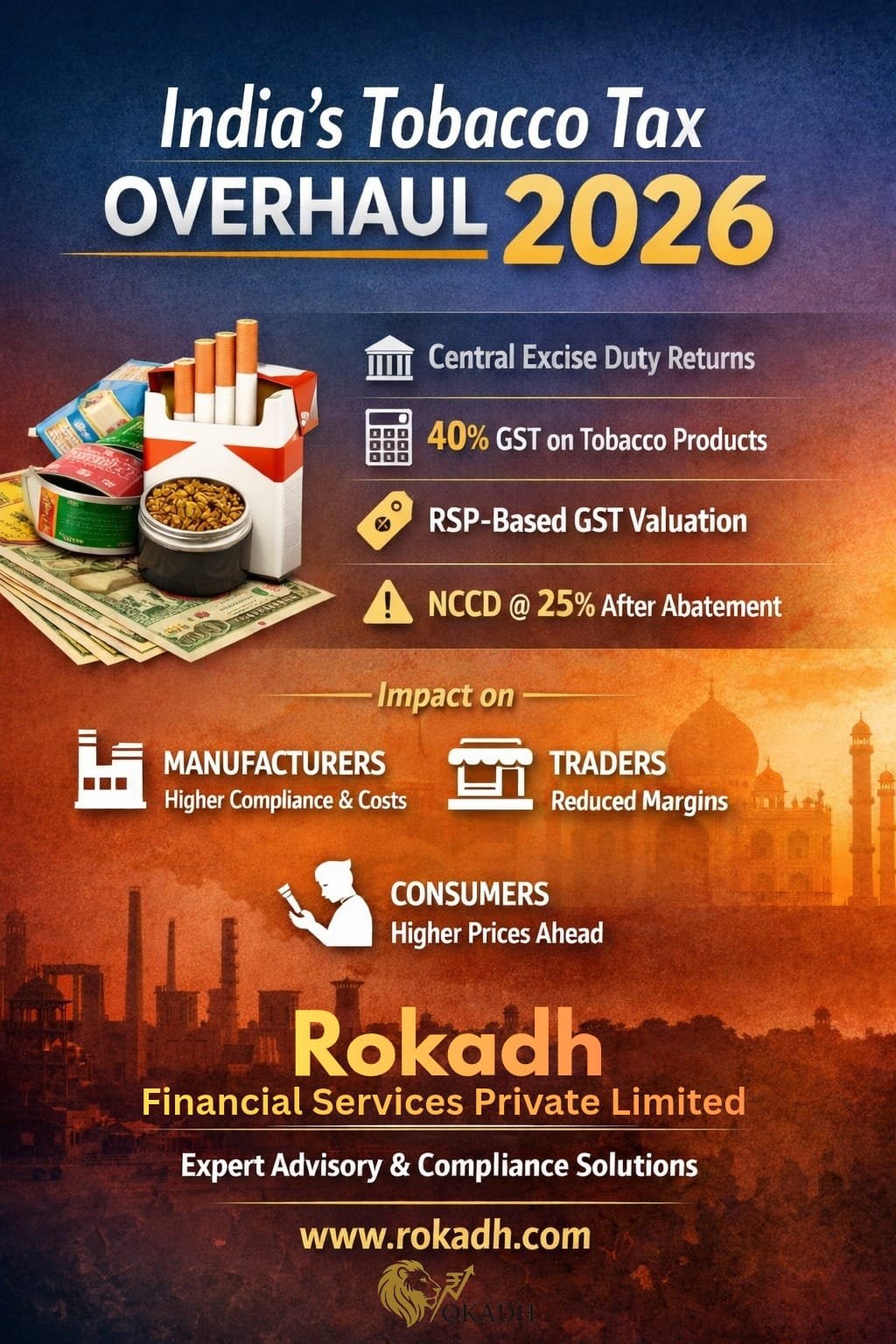
This reform represents one of the most significant regulatory shifts for the tobacco sector in decades. It reintroduces central excise duty, enforces capacity-based taxation, mandates RSP-based GST valuation, revises GST rates, and continues the National Calamity Contingent Duty (NCCD) structure.
At Rokadh Financial Services Private Limited, we have analyzed the practical and financial implications of these changes for manufacturers, traders, and distributors. This article explains what has changed, why it matters, and how your business can prepare.
Why Has the Government Changed the Tobacco Tax System?
The tobacco industry has historically been vulnerable to:
- Under-invoicing
- Price manipulation through trade discounts
- Unaccounted cash sales
- MRP and invoice mismatches
Despite GST and compensation cess, tax leakage remained high. The new framework directly links taxation to actual retail price and production capacity, closing long-standing loopholes and strengthening revenue protection while supporting public health objectives.
Central Excise Notification No. 04/2025 – Return of Excise on Tobacco
What is Introduced?
This notification re-notifies certain tobacco products under Section 3A of the Central Excise Act, 1944, bringing them under a capacity-based excise duty regime.
Products Covered
- Chewing tobacco
- Jarda scented tobacco
- Filter khaini
- Gutkha
- Pan masala with tobacco
These products are typically manufactured using automated packing machines.
How Will Duty Be Calculated?
Instead of being linked to sales value, excise duty will be determined by:
- Number of packing machines
- Speed/capacity of each machine
- Declared Retail Sale Price (RSP) slabs
Duty is payable even if production is low, based on installed capacity.
New Compliance Requirements
Manufacturers must:
- Register all packing machines
- Obtain engineering certification
- Install CCTV monitoring
- File monthly capacity declarations
- Pay fixed monthly excise duty
This marks a return to pre-GST style excise compliance for the tobacco sector.
GST Notification No. 20/2025 – RSP-Based Valuation
A new Rule 31D has been introduced in the CGST Rules.
What This Means
GST will now be calculated on the Retail Sale Price (RSP) printed on the packet — not on the invoice value.
Tax Formula:
Tax = (RSP × GST Rate (40%)) ÷ (100 + GST Rate (40%))
This eliminates undervaluation and ensures taxation reflects what consumers actually pay.
Continuation of NCCD
The existing National Calamity Contingent Duty (NCCD) remains unchanged:
- 25% duty
- After 55% abatement
- Applicable mainly on Jarda Scented Tobacco
Thus, tobacco now carries three layers of tax:
- Central Excise
- NCCD
- GST (RSP based)
Business Impact Analysis
1. Impact on Manufacturers
- Sharp increase in total tax burden
- Mandatory capacity-based excise payments
- Higher compliance and monitoring
- ERP and billing system changes
- Likely MRP revisions to protect margins
2. Impact on Traders & Distributors
- Higher working capital requirements
- Reduced trade margins
- Price volatility
- Compliance alignment with RSP valuation
3. Impact on Consumers
- Significant retail price increases
- Lower affordability
- Possible demand shift to beedis or informal markets
How Rokadh Can Support You
At Rokadh Financial Services Private Limited, we assist tobacco businesses with:
✔ GST & Excise compliance
✔ Capacity declaration advisory
✔ ERP & invoicing system alignment
✔ Pricing & margin impact analysis
✔ Risk management & audit support
Our team ensures your business remains compliant, profitable, and audit-ready under the new regime.
Conclusion
India’s 2026 tobacco tax reform is not merely a rate change — it is a complete structural reset of the industry’s tax framework. Businesses that act early will protect margins, avoid penalties, and gain operational clarity.
For advisory support, compliance solutions, or impact assessment, connect with
Rokadh Financial Services Private Limited at www.rokadh.com.