
Introduction
Every year, lakhs of taxpayers file Income Tax Returns without fully understanding:
- whether they are actually eligible for ITR-1,
- whether their residential status is correct,
- whether their salary structure is properly disclosed,
- whether foreign income must be reported,
- whether exempt income can create scrutiny,
- or whether one small mismatch can trigger notices under Sections 143(1), 143(2), 148 or defective return proceedings.
Most taxpayers realize the seriousness only after:
- refund gets stuck,
- notice gets issued,
- TDS mismatches arise,
- deductions get disallowed,
- reassessment starts,
- or penalty proceedings begin.
At Rokadh Financial Services Private Limited, Team Rokadh has professionally educated, advised, represented and resolved hundreds of such matters for salaried employees, professionals, NRIs, RNORs, professors, startup founders, consultants, merchant navy employees, freelancers, retired individuals and business families across India.
This master guide explains:
- What is ITR-1
- Who can file ITR-1
- Residential Status under Income Tax Act
- RNOR meaning and relaxation
- Exact Sections involved
- Due dates
- Corrections
- Notices
- Refund timelines
- Real professional case studies
- 30+ common mistakes
- 45+ FAQs answered by Team Rokadh
What is ITR-1 (Sahaj)?
ITR-1 is a simplified Income Tax Return form prescribed for resident individuals having comparatively simple income structures.
The return is filed under Section 139(1) of the Income-tax Act, 1961.
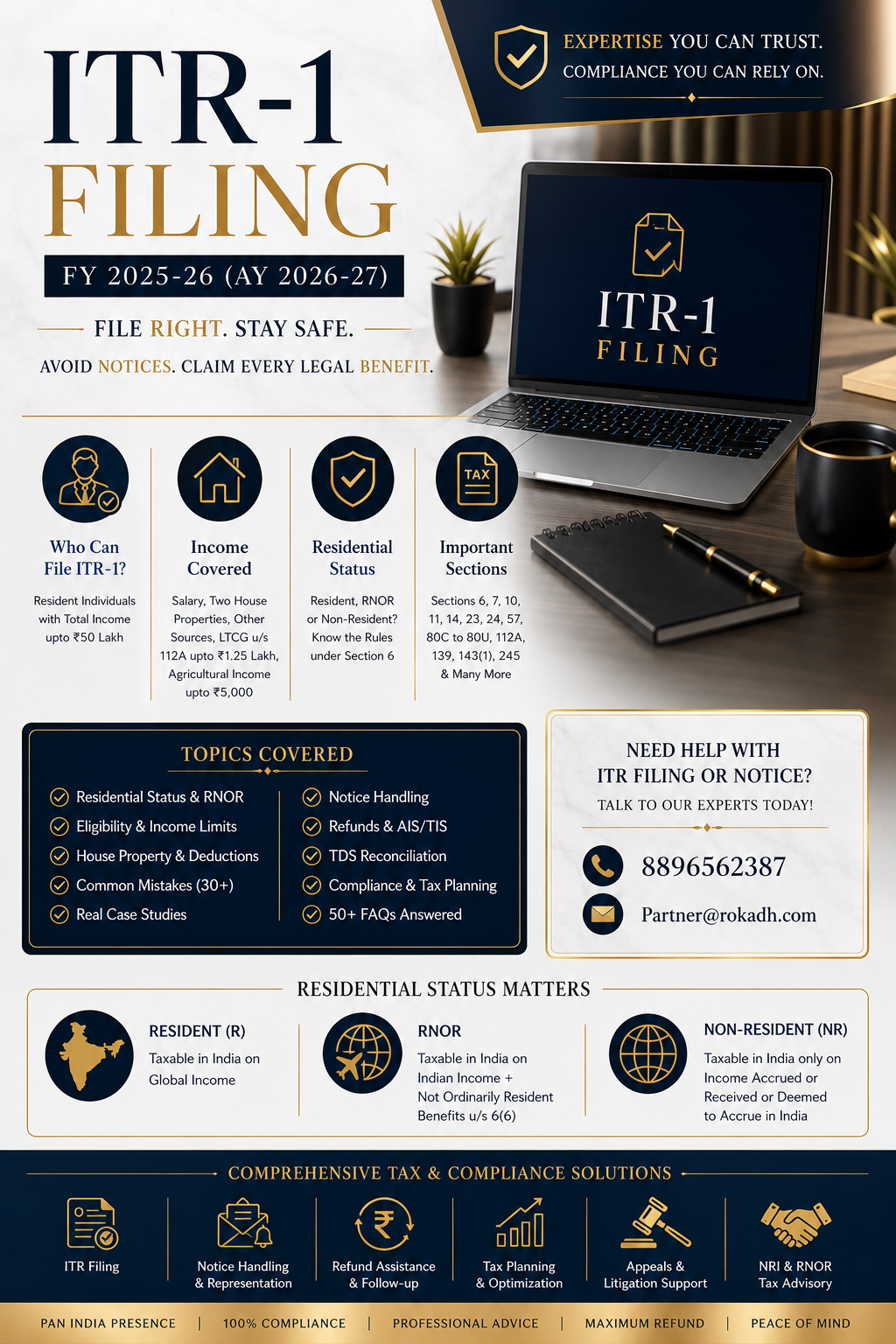
For FY 2025–26, ITR-1 can generally be filed by:
- Resident Individuals
- Total Income up to ₹50 Lakhs
- Income from Salary/Pension
- Income from Maximum Two House Properties
- Income from Other Sources (Interest etc.)
- Agricultural Income up to ₹5,000
- Long-Term Capital Gain under Section 112A up to ₹1.25 Lakhs
Exact Eligibility for ITR-1
A person can file ITR-1 if:
✔ Resident Individual
✔ Total income ≤ ₹50 lakh
✔ Salary/Pension Income
✔ Income from up to 2 House Properties
✔ Interest Income
✔ Agricultural income ≤ ₹5,000
✔ LTCG under Section 112A up to ₹1.25 lakh
Important Sections Governing ITR-1
Section 139(1)
Mandatory filing of return within due date.
Section 139(4)
Belated Return.
Section 139(5)
Revised Return.
Section 139(8A)
Updated Return.
Section 6
Residential Status determination.
Section 10
Exempt income provisions.
Section 80C to 80U
Deductions.
Section 143(1)
Return processing and adjustments.
Section 143(2)
Scrutiny notice.
Section 148
Income escaping assessment.
Section 234A/B/C
Interest for defaults.
Section 270A
Penalty for under-reporting or misreporting.
Residential Status — Most Important Yet Most Ignored Area
One of the biggest mistakes made by taxpayers is wrongly selecting residential status.
This single error can:
- trigger reassessment,
- invalidate exemptions,
- make foreign income taxable,
- deny treaty benefits,
- delay refunds,
- or create prosecution risks.
Section 6 — Residential Status under Income Tax Act
Resident Individual
An individual becomes resident if:
Basic Condition 1:
Stayed in India for 182 days or more during the financial year.
OR
Basic Condition 2:
Stayed in India:
- 60 days or more during the year, and
- 365 days or more during preceding 4 years.
Relaxation for Indian Citizens Leaving India
Under Explanation 1 to Section 6(1):
For Indian citizens leaving India for employment or crew members of Indian ships:
The 60 days condition becomes 182 days.
This relaxation becomes extremely important for:
- Merchant Navy employees
- Engineers abroad
- IT professionals working overseas
- Oil rig workers
- Aviation employees
RNOR — Resident but Not Ordinarily Resident
Exact Meaning
RNOR is a special residential category under Section 6(6).
A person becomes RNOR if:
He is Resident in India but:
- Non-resident in 9 out of 10 preceding years; OR
- Stayed in India for 729 days or less during preceding 7 years.
Why RNOR is Extremely Important
RNOR gets major relaxation.
Foreign income generally remains non-taxable in India unless:
- received in India,
- controlled from India,
- or derived from Indian business/profession.
This creates huge planning opportunities.
Real Case Study — IIT Professor Returning from USA
Case
Professor Arvind (name changed), an IIT Kanpur faculty member, returned to India after serving 11 years in a US university.
He had:
- US salary savings,
- ESOP investments,
- foreign brokerage accounts,
- dividend income abroad.
Local consultant wrongly marked him as “Resident”.
This would have made global income taxable.
Team Rokadh Analysis
Stay Calculation
FY 2025–26 stay in India:
- 158 days
Previous 7 years stay:
- 410 days
Previous 10 years:
- Non-resident for 9 years
Hence:
✔ Resident
✔ RNOR under Section 6(6)
Result
Foreign investment income legally excluded from Indian taxation.
Potential tax exposure avoided:
₹18,47,000
Refund processed:
₹2,31,440
Matter resolved professionally by Team Rokadh.
Internal Support by Team Rokadh
If you are:
- returning from abroad,
- working in foreign universities,
- holding RSUs,
- receiving foreign salary,
- or maintaining overseas accounts,
professional residential status review becomes critical.
Team Rokadh conducts:
- residential analysis,
- FEMA review,
- DTAA review,
- foreign asset reporting,
- RNOR tax planning,
- and reassessment defence.
Real Case Study — Merchant Navy Employee
Case
A marine engineer worked:
- 248 days on international vessel,
- salary received outside India.
Incorrect advice received:
“You are resident because salary credited in Indian account.”
This was legally incorrect.
Team Rokadh Review
Under CBDT circulars and Section 6:
- ship stay counted outside India,
- employment outside India,
- relaxation available.
Status correctly determined:
✔ Non-Resident
Foreign salary excluded.
Wrong tax demand avoided:
₹11,92,000
What Happens if Wrong Residential Status Selected?
Consequences may include:
- Foreign income taxation
- Penalty proceedings
- Black money proceedings
- Notice under Section 148
- Refund withholding
- Scrutiny assessment
- International information matching
What Income Can Be Reported in ITR-1?
Salary Income
Under Sections 15–17.
House Property
Under Sections 22–27.
Interest Income
Savings, FD, RD, family pension etc.
LTCG under Section 112A
Up to ₹1.25 lakh.
Agricultural Income
Up to ₹5,000.
Who Cannot File ITR-1?
Persons having:
- business income,
- foreign assets,
- directorship,
- unlisted shares,
- large capital gains,
- lottery income,
- foreign income,
- agricultural income > ₹5,000,
- complex tax structures.
Due Date for Filing ITR-1
Under Section 139(1):
Usually:
31 July following financial year.
Audit cases:
31 October.
Transfer pricing:
30 November.
Belated Return — Section 139(4)
Can be filed after due date.
But:
- late fee,
- interest,
- loss of deductions,
- refund delays,
- scrutiny risk increases.
Revised Return — Section 139(5)
Mistake discovered?
Return can be revised before:
- assessment completion OR
- statutory deadline.
Updated Return — Section 139(8A)
Introduced for voluntary corrections.
Can be filed within prescribed timelines with additional tax.
But cannot:
- increase refund,
- reduce tax liability,
- or declare fresh losses.
Real Case Study — Salary & FD Interest Mismatch
Case
Software employee filed ITR through mobile app.
Forgot:
₹3.8 lakh FD interest.
AIS reflected mismatch.
Notice under Section 143(1) issued.
Exact Nature of Notice
“Income appearing in Annual Information Statement does not match with return filed.”
Team Rokadh Action
- Reconciled AIS
- Revised computation
- Claimed TDS properly
- Filed corrected response
Original proposed demand:
₹1,14,780
Final liability after professional reconciliation:
₹8,240
Section 143(1) — Processing Notice
Department can:
- correct arithmetic errors,
- disallow incorrect claims,
- reconcile mismatches.
Automated notices now highly common.
Section 143(2) — Scrutiny Notice
Issued where department seeks detailed verification.
Can involve:
- deductions,
- salary mismatch,
- HRA,
- foreign assets,
- house property,
- exempt income,
- bank transactions.
Section 148 — Reassessment
Issued where income escaped assessment.
Common triggers:
- AIS mismatch,
- property transactions,
- stock market activity,
- high cash deposits,
- foreign remittance,
- TDS mismatch.
Refund Timelines
Refund processed after:
- return verification,
- CPC processing,
- reconciliation.
Usually:
20 days to 12 months depending on complexity.
Why Refunds Get Delayed
- Wrong bank account
- Unverified return
- AIS mismatch
- TDS mismatch
- Outstanding demand
- Defective return
- PAN/Aadhaar mismatch
Real Case Study — Refund Blocked
Case
Senior employee refund:
₹4,92,880
Blocked due to:
old demand of AY 2016–17.
Team Rokadh Resolution
- Rectification filed
- Old records produced
- Demand found already paid
Refund released with interest.
Total credited:
₹5,31,420
35+ Common Mistakes in ITR-1 Filing for FY 2025–26
1. Wrong Residential Status Selection
One of the most dangerous and most searched tax mistakes in India is selecting incorrect residential status while filing ITR-1.
Many taxpayers:
- wrongly select Resident instead of RNOR,
- wrongly select Resident instead of Non-Resident,
- or fail to understand Section 6 of Income-tax Act, 1961.
This directly impacts:
- foreign salary taxation,
- overseas investments,
- foreign bank accounts,
- ESOPs,
- DTAA benefits,
- refund eligibility,
- and notice exposure under Sections 143(2) and 148.
Team Rokadh has professionally resolved numerous matters involving:
- merchant navy employees,
- IIT professors,
- software engineers returning from USA,
- Dubai professionals,
- startup founders relocating to India.
Our detailed stay-calculation advisory and RNOR planning services have legally saved substantial taxes for taxpayers across PAN India.
2. Filing ITR-1 Despite Foreign Assets
Many taxpayers wrongly assume:
“Foreign account inactive hai, disclose karne ki zarurat nahi.”
This mistake can trigger:
- scrutiny notices,
- reassessment,
- Black Money Act implications,
- and severe penalties.
Team Rokadh regularly assists taxpayers in:
- Schedule FA disclosures,
- foreign brokerage reporting,
- RSU/ESOP disclosures,
- overseas account reconciliation,
- DTAA documentation.
3. Ignoring AIS/TIS Mismatch
AIS mismatch is now one of the biggest reasons for automated notices.
Taxpayers commonly miss:
- FD interest,
- dividend income,
- stock sales,
- mutual fund redemption,
- foreign remittances,
- crypto transactions.
Team Rokadh performs complete AIS reconciliation before filing to minimize future litigation exposure.
4. Wrong HRA Claim
Fake rent receipts or unsupported HRA claims are now heavily monitored through:
- PAN linkage,
- landlord reporting,
- AIS analytics.
Team Rokadh has resolved several scrutiny matters where:
- HRA was incorrectly claimed,
- employer documentation was defective,
- or rent paid to parents lacked legal support.
5. Incorrect Old vs New Regime Selection
Many salaried employees lose legitimate tax benefits due to improper regime selection.
Taxpayers often:
- choose new regime blindly,
- ignore deduction structures,
- fail to compare tax impact.
Team Rokadh performs regime optimization calculations before filing.
6. Filing Wrong ITR Form
ITR-1 filed despite:
- capital gains,
- foreign assets,
- business income,
- directorship,
- crypto income.
This can invalidate return and trigger notices.
Team Rokadh reviews:
- eligibility,
- income classification,
- reporting requirements,
- before final filing.
7. Not Verifying Return
Thousands of taxpayers assume filing is complete.
But without verification under Section 139:
- return becomes invalid,
- refund gets blocked,
- notices may arise.
Team Rokadh ensures complete compliance including:
- Aadhaar OTP verification,
- EVC,
- DSC compliance.
8. Wrong TDS Credit Claim
Taxpayers often:
- claim excess TDS,
- duplicate TDS,
- or incorrect TAN entries.
This leads to refund blockage and demand notices.
Team Rokadh professionally reconciles:
- Form 26AS,
- AIS,
- Form 16,
- TRACES data.
9. Ignoring Defective Return Notice
Section 139(9) defective return notices are widely ignored.
Consequences:
- return treated invalid,
- refund denied,
- late fee exposure,
- reassessment risk.
Team Rokadh handles complete defective return rectification and response management.
10. Wrong Interest Income Reporting
Interest from:
- savings account,
- FD,
- RD,
- income tax refund interest,
- bonds,
- is often missed.
Department already receives this data.
Team Rokadh conducts complete interest reconciliation.
11. Claiming Unsupported 80C Deductions
Many taxpayers:
- estimate investments,
- claim fake LIC,
- or duplicate tuition fees.
Department now cross-verifies through analytics.
12. Fake Donation Claims under 80G
Improper political donations or fake NGOs create high scrutiny risk.
Team Rokadh verifies:
- approval validity,
- deduction limits,
- documentary compliance.
13. Non-Disclosure of Mutual Fund Redemption
Even exempt/redemption transactions can trigger mismatch.
Team Rokadh reconciles:
- CAMS,
- KFintech,
- AIS,
- broker statements.
14. Wrong House Property Reporting
Common issues:
- self-occupied confusion,
- co-owner mismatch,
- home loan duplication,
- rental omission.
Team Rokadh resolves complex property disclosures professionally.
15. Failure to Disclose Foreign Dividend
Foreign brokerage dividend reporting mistakes are increasingly common.
Especially among:
- startup employees,
- tech professionals,
- RSU holders.
16. Improper Agricultural Income Claim
Fake agricultural income can trigger scrutiny and penalty.
Team Rokadh evaluates:
- land ownership,
- crop records,
- actual agricultural operations.
17. Wrong Carry Forward of Losses
Belated returns may invalidate losses.
Taxpayers frequently miss timelines under Section 139(1).
18. Salary Mismatch between Form 16 & AIS
Incorrect employer reporting causes refund delays and notices.
Team Rokadh performs salary reconciliation professionally.
19. Ignoring Email Notices
Most notices now come electronically.
Ignoring them may lead to:
- ex-parte assessment,
- demand,
- penalty.
20. Wrong Bank Account Reporting
Refund failures commonly happen due to:
- inactive account,
- pre-validation issues,
- IFSC mismatch.
21. Incorrect Family Pension Deduction
Wrong deduction calculation under Section 57 is common.
22. Improper Joint Property Disclosure
Many co-owners wrongly disclose:
- 100% income,
- 100% home loan,
- or ignore ownership ratio.
23. Not Reporting Dividend Income
Dividend is taxable and reported to department.
24. Wrong Claim under Section 80D
Improper medical insurance deduction claims are highly common.
25. Ignoring Capital Gains from Shares
Taxpayers wrongly assume:
“TDS nahi kata toh disclose nahi karna.”
26. Filing Belated Return without Understanding Consequences
Consequences include:
- late fee,
- interest,
- restricted losses,
- scrutiny risk.
27. Wrong PAN-Aadhaar Linkage
This may invalidate return processing.
28. Ignoring Outstanding Demand
Old demand may block current refund under Section 245.
29. Wrong ESOP Taxation
Common among startup employees and MNC executives.
30. Improper RNOR Benefit Claim
Incorrect interpretation can trigger international taxation disputes.
31. Incorrect Reporting of Family Pension Income
Mistake Commonly Made by Taxpayers
Many salaried individuals and senior citizens receiving family pension after the demise of a spouse or parent wrongly report such income under “Salary” instead of “Income from Other Sources.” Because of this incorrect reporting, standard deductions are wrongly claimed or taxable income gets miscalculated.
Several taxpayers also fail to claim the permissible deduction available under Section 57(iia) of the Income Tax Act, 1961, resulting either in excess tax payment or mismatch notices from the Income Tax Department during return processing under Section 143(1).
Real Case Resolved by Team Rokadh
A retired bank officer from Lucknow started receiving family pension of ₹5,40,000 annually after her husband’s demise. While filing ITR-1 through a local agent, the pension was incorrectly shown under “Salary,” and full standard deduction of ₹50,000 was claimed.
Within months, an automated adjustment notice under Section 143(1)(a) was issued stating:
“Incorrect claim apparent from information in return. Income reported under incorrect head leading to excess deduction claim.”
The department proposed additional tax demand of ₹38,720 including interest.
The taxpayer panicked because refund was also withheld simultaneously under Section 245 (now Section 438 under Income Tax Act 2025 framework).
How Team Rokadh Resolved It
Team Rokadh carefully reviewed AIS, Form 26AS, pension entries, and CPC computation. Our experts:
- Reclassified family pension correctly under “Income from Other Sources”
- Claimed proper deduction under Section 57(iia)
- Drafted legal response with judicial references
- Filed rectification request with supporting computation
- Coordinated with CPC processing authorities professionally
Final Result
✅ Demand reduced from ₹38,720 to NIL
✅ Refund of ₹21,440 released with interest
✅ Future filing structure corrected permanently
Awareness by Team Rokadh
Taxpayers must understand:
- Family pension ≠ salary income
- Wrong income head can trigger automated notices
- AIS/TDS mismatch is now fully system-tracked
- Incorrect deductions increase scrutiny risk
📌 Team Rokadh professionally assists taxpayers in:
- Correct ITR-1 filing
- Pension income structuring
- Refund recovery
- Notice handling
- Senior citizen tax advisory
➡️ Read Also:
- Complete Guide on Income Tax Refund FY 2025-26
- ITR-1 Filing Guide FY 2025-26
- How to Respond to Income Tax Notices
32. Claiming Home Loan Interest Without Ownership Proof
Common Error Done by Taxpayers
Many salaried employees claim deduction under Section 24(b) for housing loan interest even when:
- property is not registered in their name,
- loan is in another person’s name,
- possession is incomplete,
- or co-ownership ratio is wrongly claimed.
The Income Tax Department now cross-verifies:
- PAN-linked loan reporting,
- Annual Information Statement (AIS),
- bank interest certificates,
- and property registration databases.
Real Case Resolved by Team Rokadh
An IT employee from Pune claimed ₹2,00,000 housing loan interest deduction in ITR-1 for a flat purchased jointly with his father. However:
- Loan EMI was being paid fully by father,
- Property possession was incomplete,
- Interest certificate mismatch existed.
The taxpayer received an email notice stating:
“Deduction claimed under Section 24 appears inconsistent with available information.”
Proposed tax demand: ₹74,600.
How Team Rokadh Resolved It
Team Rokadh analyzed:
- Builder agreement,
- Home loan sanction letter,
- Possession timeline,
- Payment trail,
- Co-owner contribution ratios.
Our experts legally established:
- proportionate ownership,
- allowable pre-construction interest treatment,
- and corrected deduction eligibility.
Final Result
✅ Demand reduced from ₹74,600 to ₹9,840 only
✅ Interest recomputed correctly
✅ Future tax planning structured properly
Team Rokadh Awareness Initiative
Taxpayers should never:
- blindly claim maximum housing deductions,
- copy previous-year returns,
- or rely on unverified filing portals.
📌 Team Rokadh helps taxpayers with:
- Home loan tax planning
- Joint ownership tax strategy
- Section 24 deduction review
- ITR scrutiny defence
- Refund optimization
➡️ Internal Resources:
- Tax Saving Guide FY 2025-26
- ITR-1 vs ITR-2 Selection Guide
- Income Tax Scrutiny Notice Solutions
33. Wrong Selection of ITR Form
Mistake Frequently Seen
Choosing wrong ITR form is one of the biggest reasons for defective return notices under Section 139(9).
Many taxpayers wrongly file:
- ITR-1 instead of ITR-2,
- ITR-1 despite foreign assets,
- ITR-1 despite capital gains exceeding permitted limits,
- or incorrect residential status disclosures.
This can invalidate the entire return.
Real Case Solved by Team Rokadh
A salaried professor working in Kanpur filed ITR-1 despite having:
- US stock investments,
- dividend income from foreign ETFs,
- LTCG exceeding permissible threshold.
He received defective return notice:
“Return filed in incorrect form. Kindly furnish valid return.”
Risk involved:
- Return becoming invalid,
- Loss of refund,
- Penalty exposure,
- Reassessment risk.
Team Rokadh Resolution Strategy
Our litigation and compliance experts:
- Re-evaluated residential status,
- Examined Schedule FA applicability,
- Revised filing under correct ITR form,
- Reconciled AIS/TIS/foreign disclosures,
- Filed compliant revised return.
Final Result
✅ Defective notice cured successfully
✅ Refund of ₹1,18,400 protected
✅ Foreign disclosure compliance completed
✅ No penalty initiated
Educational Awareness by Team Rokadh
Choosing wrong ITR form may:
- invalidate return,
- block refunds,
- trigger scrutiny,
- create future reassessment exposure.
📌 Team Rokadh professionally assists with:
- Correct ITR selection
- Foreign asset reporting
- Capital gains taxation
- RNOR/NRI tax advisory
- Defective return notice handling
➡️ Read More:
- RNOR Residential Status Explained
- Foreign Asset Disclosure Rules
- ITR-1 Eligibility Detailed Guide
34. Ignoring AIS/TIS Mismatch Before Filing Return
Most Dangerous Modern Filing Mistake
AIS (Annual Information Statement) and TIS (Taxpayer Information Summary) are now major scrutiny tools used by the Income Tax Department.
Many taxpayers:
- ignore stock transactions,
- omit FD interest,
- miss mutual fund redemption,
- fail to disclose high-value transactions,
- leading to automated notices.
Real Case Handled by Team Rokadh
A businessman from Jaipur filed return showing income of ₹11.4 lakh. However AIS reflected:
- mutual fund redemption of ₹42 lakh,
- FD interest from multiple banks,
- credit card spends,
- and securities turnover.
He later received notice for mismatch and possible escaped income assessment.
Potential exposure:
- tax demand,
- penalty,
- reassessment,
- prosecution risk.
How Team Rokadh Resolved It
Our experts:
- downloaded complete AIS/TIS data,
- reconciled capital gains,
- corrected exempt income disclosures,
- prepared revised computation,
- submitted explanation with documentary evidence.
Final Outcome
✅ Reassessment risk neutralized
✅ Additional tax reduced substantially
✅ No penalty initiated
✅ Compliance framework established for future years
Team Rokadh Advisory
Never file return without checking:
- AIS,
- Form 26AS,
- TIS,
- broker statements,
- bank interest certificates.
📌 Team Rokadh provides:
- AIS reconciliation services
- Tax notice defence
- Capital gain computation
- Compliance review
- Advance tax planning
➡️ Explore:
- Complete Income Tax Notice Guide
- Capital Gains Taxation Guide
- Income Tax Refund Delay Solutions
35. Treating Freelance or Consulting Income Incorrectly in ITR-1
Common Taxpayer Error
Many professionals earning:
- freelancing income,
- consultancy receipts,
- online income,
- commission income,
- side-business income,
- wrongly file ITR-1 instead of declaring business/professional income properly.
This often leads to:
- underreporting allegations,
- expense disallowances,
- GST linkage scrutiny,
- and notices under income escaping assessment provisions.
Real Case Resolved by Team Rokadh
A software consultant from Bengaluru earned:
- salary income of ₹18 lakh,
- freelance receipts of ₹9.2 lakh from overseas clients.
Believing freelance income to be “side income,” he filed ITR-1. AIS and foreign remittance records later triggered scrutiny indicators.
Department questioned:
- nature of receipts,
- foreign remittances,
- GST applicability,
- and underreporting.
Potential exposure exceeded ₹3.8 lakh including penalty.
Team Rokadh Professional Resolution
Team Rokadh:
- reviewed bank inward remittances,
- classified freelance receipts correctly,
- evaluated Section 44ADA applicability,
- prepared revised compliant filing,
- reconciled foreign receipts legally.
Final Result
✅ Major penalty exposure avoided
✅ Tax optimized legally under presumptive provisions
✅ GST advisory integrated
✅ Complete compliance framework established
Awareness Created by Team Rokadh
Freelance income is highly monitored through:
- banking channels,
- TDS filings,
- GST systems,
- foreign remittance reporting.
📌 Team Rokadh helps professionals with:
- Freelance taxation
- Presumptive taxation under Section 44ADA
- GST compliance
- Foreign income reporting
- Income tax notices and litigation
➡️ Internal Links:
- GST for Freelancers Guide
- Presumptive Taxation Explained
- Complete ITR Filing Services by Team Rokadh
50+ Most Searched FAQs on ITR-1 Filing
Professionally Answered & Resolved by Team Rokadh
1. Who can file ITR-1 for FY 2025–26?
Resident individuals having:
- income up to ₹50 lakh,
- salary/pension income,
- up to two house properties,
- other source income,
- eligible LTCG under Section 112A,
- may file ITR-1.
Team Rokadh evaluates eligibility before filing.
2. Can RNOR file ITR-1?
Depends upon:
- foreign assets,
- foreign income,
- reporting obligations.
Professional review is strongly recommended.
3. What is RNOR?
Resident but Not Ordinarily Resident under Section 6(6).
Special relaxation available on foreign income taxation.
4. How is residential status calculated?
Based on:
- stay in India,
- preceding years,
- citizenship,
- employment purpose,
- special exemptions.
Team Rokadh performs detailed residential analysis.
5. Can Merchant Navy employees become Non-Resident?
Yes, subject to Section 6 conditions and CBDT guidelines.
6. Can professor returning from abroad claim RNOR?
Yes, if Section 6(6) conditions satisfied.
7. Is foreign salary taxable in India?
Depends on:
- residential status,
- receipt location,
- DTAA,
- control and management.
8. Can ITR-1 include capital gains?
Only specified LTCG under Section 112A within prescribed limits.
9. Can salary employees receive notices?
Absolutely yes.
Modern scrutiny is AI-driven.
10. What is AIS?
Annual Information Statement containing transaction data available with department.
11. Why refund gets delayed?
Common reasons:
- TDS mismatch,
- unverified return,
- AIS mismatch,
- defective return,
- outstanding demand.
12. Can old demand block refund?
Yes, under Section 245 adjustment provisions.
13. Can revised return remove notice risk?
In many cases, yes — if filed timely and properly.
14. Can wrong HRA trigger scrutiny?
Yes.
Fake rent structures are heavily monitored.
15. What if FD interest forgotten?
Department usually already has information.
16. Can mismatch between Form 16 and AIS create notice?
Yes, very commonly.
17. Is dividend income taxable?
Yes.
18. Can taxpayers respond themselves to notices?
Legally yes.
But technical drafting errors often worsen litigation.
19. Can Team Rokadh represent before Income Tax Department?
Yes.
Team Rokadh professionally handles:
- notices,
- scrutiny,
- reassessment,
- appeals,
- refund matters.
20. What happens if return not verified?
Return treated invalid.
21. What if wrong ITR filed?
Revised return may be required.
22. Can refund include interest?
Yes, under Section 244A.
23. What if tax already deducted but demand raised?
Usually reconciliation issue.
24. Can salaried employee face reassessment?
Yes.
25. Can notices come through email only?
Yes, most notices are electronic.
26. Is professional tax planning legal?
Yes, lawful tax planning is completely valid.
27. Can crypto transactions trigger notices?
Yes, heavily monitored.
28. What if PAN not linked with Aadhaar?
Return processing complications may arise.
29. Can agricultural income create scrutiny?
Yes, especially unusually high claims.
30. Can spouse transfers create tax implications?
Yes, clubbing provisions may apply.
31. Can ESOP taxation become complicated?
Very much, especially for startup employees.
32. What if return filed after due date?
Belated return consequences apply.
33. Can updated return reduce litigation?
In many cases, yes.
34. Is e-verification mandatory?
Yes.
35. Can NRIs receive notices in India?
Yes.
36. Can stock market activity trigger scrutiny?
Yes.
37. Can multiple bank accounts create mismatch?
Yes.
38. Is home loan deduction monitored?
Absolutely.
39. Can professional consultation reduce notice risk?
Significantly.
40. Why are salaried employees receiving more notices now?
Because AIS and data analytics have become extremely advanced.
41. Can refund get adjusted automatically?
Yes, against existing demand.
42. Can foreign remittance trigger inquiry?
Yes.
43. Is TDS mismatch common?
Very common.
44. Can family pension be taxed incorrectly?
Yes.
45. Can wrong deductions create penalty?
Yes, under-reporting penalties may apply.
46. Can one wrong entry create scrutiny?
Absolutely.
47. How to avoid future notices?
Through:
- proper reconciliation,
- lawful reporting,
- timely filing,
- professional review.
48. Why taxpayers across India trust Team Rokadh?
Because Team Rokadh focuses on:
- preventive compliance,
- strategic representation,
- legally sustainable tax positions,
- and long-term financial peace of mind.