
Insight & Analysis by Rokadh Financial Services Private Limited
On 1 February 2026, the Government of India presented the Union Budget 2026–27 — a comprehensive fiscal roadmap aimed at sustaining economic momentum, deepening reforms, accelerating infrastructure development, and positioning India as a global hub of technology, manufacturing, trade, and innovation.
In this exhaustive analysis, Rokadh Financial Services decodes all critical announcements, stakeholder impacts, sectoral winners and challenges, and the long-term economic implications of the Budget.
1. Policy Priorities & Context of Budget 2026–27
Union Budget 2026 reflects continuity in economic strategy with a clear emphasis on:
- Growth with fiscal prudence
- Infrastructure-led expansion
- Manufacturing scale-up & export competitiveness
- Digital transformation & strategic technology adoption
- Global integration through trade and investment incentives
The Budget adapts to global economic challenges while tackling structural constraints, such as logistic inefficiencies, digital infrastructure gaps, and manufacturing supply bottlenecks, with targeted reforms and investments.
2. Major Announcements & High-Impact Policy Changes
2.1 Record Capital Expenditure & Connectivity Initiatives
The Budget radically elevates public capital expenditure (capex) to ₹12.2 lakh crore, with a focus on core infrastructure like roads, railways, ports, inland waterways and urban infrastructure.
Key infrastructure highlights include:
- Dankuni–Surat Dedicated Freight Corridor to enhance east-west goods movement
- 20 new National Waterways over the next five years
- Seven High-Speed Rail corridors connecting major economic clusters
- Coastal Cargo Promotion Scheme to increase coastal shipping share
- Infrastructure Risk Guarantee Fund to mitigate private sector execution risk
Impact: This capex expansion will directly benefit sectors such as construction, cement, steel, heavy machinery, logistics, urban infrastructure and real estate by boosting order books, enhancing demand visibility, and expanding capacity utilisation.
2.2 Taxation, Regulatory & Ease of Doing Business Measures
Several structural tax and regulatory changes were announced:
Income Tax Reforms
- Introduction of a New Income Tax Act, 2025, effective from 1 April 2026, simplifying provisions, modernising language and reducing litigation potential without altering fundamental tax rates.
- Rationalisation of various TDS/TCS rules — including unified TCS on overseas tour, education, and medical expenses capped at 2% — aimed at easing compliance and reducing cost burdens on individuals.
Capital Markets & Investment Regulations
- Enhancement of investment limits for NRIs in Indian equity markets — relaxing ownership norms and potentially deepening foreign capital participation.
Customs Rationalisation
- Reduction in tariffs on personal use imports and expanded basic customs duty exemptions for key manufacturing inputs (e.g., lithium-ion battery components).
Impact: Simplified taxation and compliance, paired with better investment treatment, enhances ease of doing business, investor confidence, and cross-border capital flows.
2.3 Strategic Push for Digital & Technology Ecosystem
The Budget reflects a digital infrastructure focus aimed at establishing India as a global cloud, AI, and data hub:
Data Centres & Cloud Services Incentives
- A tax holiday until 2047 for foreign companies providing cloud services globally using Indian data centres, provided they service Indian customers via local resellers.
- A safe harbour provision of 15% for related parties offering these services.
Industry leaders see this as a defining step toward making India a "digital backbone for the world", encouraging hyperscaler investment and advanced computing infrastructure.
AI, Semiconductor & Electronics Push
- Expansion of the Electronics Components Manufacturing Scheme with an outlay raised to ₹40,000 crore, covering hardware critical to data centres, servers, printed circuit boards and AI computing infrastructure.
- India Semiconductor Mission 2.0 to accelerate the domestic semiconductor value chain and strengthen supply chain resilience.
Impact: Technology, cloud services, AI, semiconductor ecosystems, industrial real estate (data centre facilities), power and cooling infrastructure firms are likely to benefit significantly over the medium and long term.
2.4 MSMEs, Exports & E-Commerce Global Integration
To encourage scale and global competitiveness:
- A ₹10,000 crore SME Growth Fund has been established to nurture startups and emerging champions.
- A ₹2,000 crore top-up to the Self-Reliant India Fund for micro enterprise support.
- Enhancements to the TReDS platform and invoice financing mechanisms to improve liquidity and cash cycles for MSMEs.
Exports & E-Commerce Facilitation
- Removal of the ₹10 lakh cap on courier exports — reducing barriers for small exporters and e-commerce merchants to reach global markets.
Impact: MSMEs are likely to see improved access to finance, better working capital, and enhanced ability to integrate into global value chains, especially in exports and digital commerce.
2.5 Tourism, Hospitality & Services Sector Focus
The Budget placed emphasis on tourism as a foreign exchange and employment-intensive sector, with policy signals aimed at infrastructure improvements and promotional frameworks to elevate India’s global tourism footprint.
Impact: Hotels, airlines, travel services, destination infrastructure and allied leisure sectors stand to gain from enhanced policy focus and projected increases in inbound tourism.
2.6 Defence & Strategic Sector Funding
A significant allocation increase was made for the defence sector, aimed at modernisation, indigenisation (Atmanirbhar Bharat), and expanded capabilities, including cyber, maritime and aerospace projects.
Impact: Domestic defence manufacturers, electronics suppliers, avionics firms and service contractors are positioned for growth with elevated procurement budgets and strategic indigenisation policies.
3. Stakeholder-Wise Impact Assessment
3.1 Individual Taxpayers & Households
Neutral to Mildly Positive Outcomes
- With no substantive changes to basic income tax slabs, individual tax burdens remain stable.
- Reduced TCS on overseas education and medical expenses lowers effective tax costs for certain individual outflows.
Inflation & Consumption
- Palpable gains in infrastructure and technology investment may, over time, ameliorate supply constraints, but short-term inflationary pressures may persist.
3.2 Businesses & Corporate Sector
Large Corporates
- Firms in infrastructure, energy, logistics, data centres, semiconductor supply chain and manufacturing stand to benefit from fiscal incentives and market opportunities.
- Customs rationalisation and investor-friendly tax policies enhance competitiveness.
MSMEs
- Greater access to finance and export facilitation measures empower small businesses to scale and link with global markets.
Export-Focused E-Commerce & MSMEs
- The removal of courier export caps and trade facilitation policies reduce barriers for micro and small exporters to compete internationally.
3.3 Investors & Capital Markets
Equities & Growth Sectors
- Long-term structural pushes in technology, infrastructure, logistics, defence and manufacturing offer attractive thematic investment opportunities.
- However, short-term market volatility may arise due to regulatory adjustments (e.g., increased STT on derivatives, fiscal shifts).
Foreign Investment
- Liberalisation of investment norms for NRIs and predictable tax regimes for data/cloud services enhance global investor confidence.
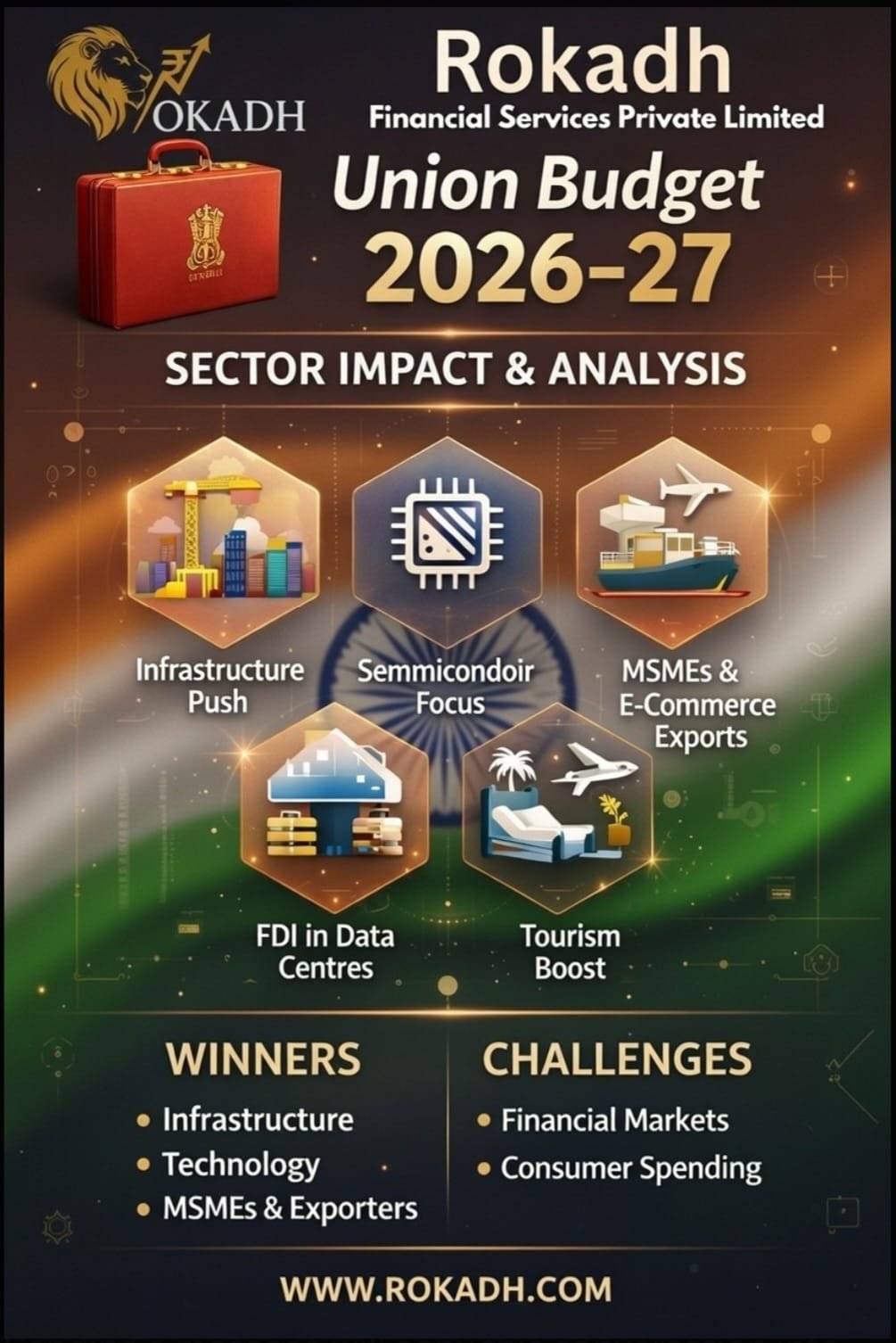
4. Sectoral Winners & Challenges
4.1 Positive Impact Sectors
Digital & Technology
- Cloud services, data centres, AI compute infrastructure, semiconductor & electronics value chains — poised for exponential growth over the decade.
Infrastructure & Construction
- Roads, rail, ports, waterways, urban development — robust project pipelines and funding visibility.
MSMEs & Exports
- Enhanced global access mechanisms and financial support propel MSMEs toward export competitiveness and scale.
Defence Manufacturing
- Elevated budgetary support and indigenisation strategies strengthen domestic defence industrial capacity.
Tourism & Hospitality
- Policy emphasis on tourism bolsters services drive, employment generation and foreign exchange inflows.
4.2 Sectors Facing Headwinds
Consumer Discretionary
- With structural tax changes and persistent fiscal discipline, discretionary spending growth may remain moderate.
Short-Term Financial Markets
- Increased Securities Transaction Tax (STT) on derivatives and fiscal tightening aspects could induce temporary volatility.
5. Strategic & Long-Term Economic Implications
Building a Global Digital Powerhouse
The tax holiday for data centres and cloud services until 2047 signals India’s ambitions to become a global digital services export hub — fostering innovation, capital inflows, and technical capacity building consistent with global data demand projections.
Manufacturing & Self-Reliance
Through initiatives like Biopharma SHAKTI, expanded electronics schemes, and ISM 2.0, the Budget reinforces manufacturing competitiveness and value chain localisation essential for supply chain resilience.
Human Capital & Skills
While not as headline as technological incentives, parallel emphasis on digital skilling, semiconductors workforce development and MSME capacity building point toward future-ready human capital accumulation.
6. Conclusion – Budget 2026 as a Balanced Roadmap for Accelerated Growth
Union Budget 2026–27 articulates a balanced fiscal framework poised for long-term, inclusive growth. Its foundational pillars — infrastructure acceleration, digital ecosystem expansion, strategic manufacturing, trade integration, and tax modernization — create a comprehensive policy mosaic designed to enhance India’s competitiveness globally.
While short-term market responses may vary, medium to long-term structural reforms position India for sustainable high-growth trajectories across pivotal sectors.
For expert consultation on how these Budget changes affect your business, investment portfolio, compliance strategy, or financial planning, reach out to Rokadh Financial Services Private Limited — your partner in navigating India’s evolving economic landscape.