

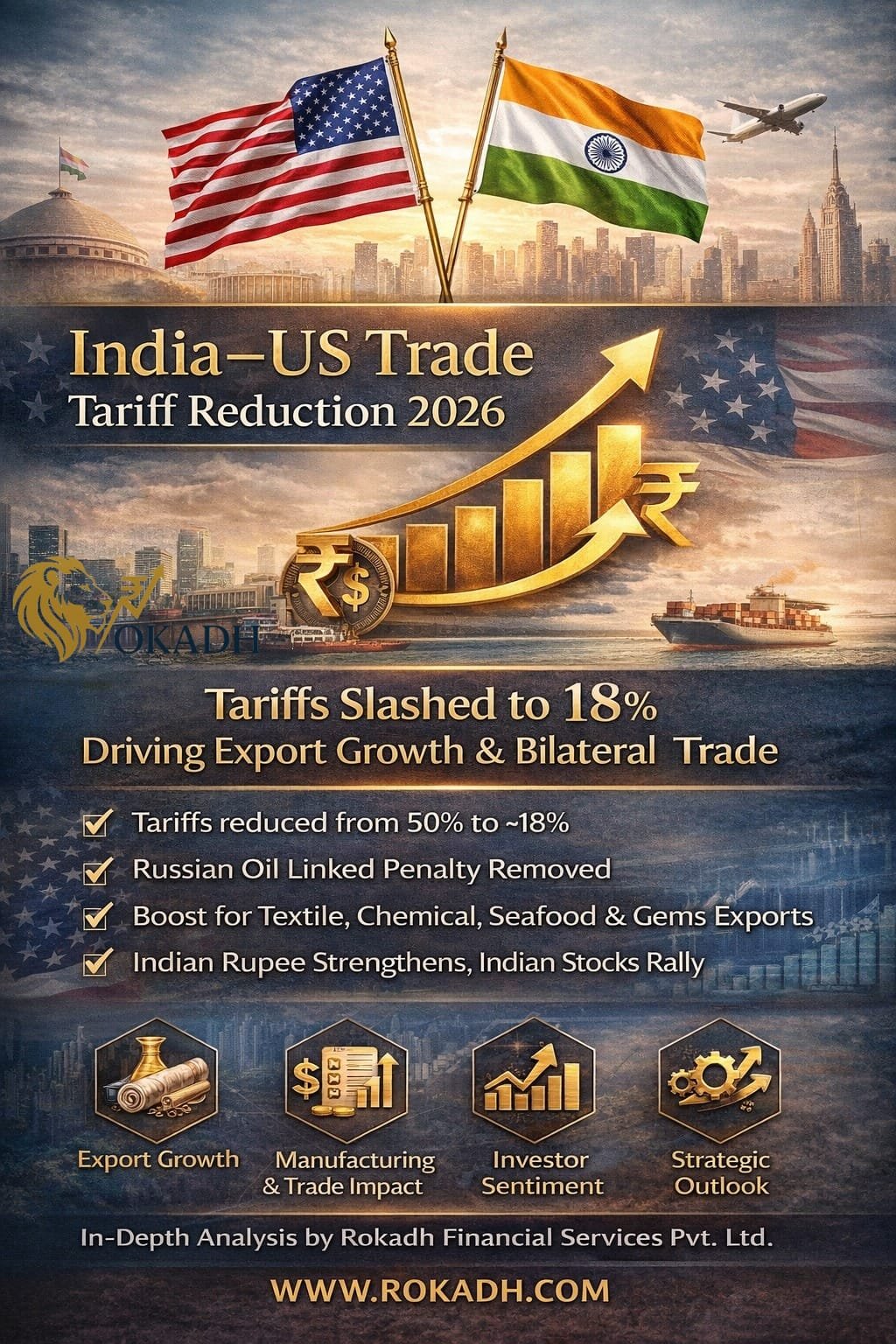
Comprehensive Insight by Rokadh Financial Services Private Limited
In February 2026, India and the United States reached a significant trade understanding that resets tariff rates, eases longstanding trade tensions and reshapes the bilateral economic relationship between two of the world’s largest economies.
Under the agreement:
- U.S. tariffs on Indian imports are now capped at ~18%, down from tariff levels that escalated to 50% at times during 2025.
- The additional punitive tariff imposed over India’s Russian oil purchases has been removed.
- Broad commitments were announced regarding tariff adjustment, energy trade and future cooperation — though several details still await formal ratification and legal text.
This development follows a period of heightened tension that saw multiple tariff adjustments in 2025 — starting with a 26% levy, pauses and surges — reaching approximately 50% punitive tariff on Indian exports before this reset.
1. Historical Context: Trade Tensions & Tariff Escalation
Prior to the February 2026 reset, India–U.S. trade relations experienced sustained friction:
- In April 2025, the U.S. imposed a 26% reciprocal tariff on Indian imports.
- By August 2025, this tariff was further escalated to approximately 50% — composed of a base 25% reciprocal tariff and an additional punitive 25% linked to India’s continued Russian oil purchases.
- These duties affected a large swath of India’s export portfolio and were viewed domestically as severely disruptive to India’s global market access.
The period of heightened tariffs created market uncertainty, disrupted export order books, tested diplomatic mechanisms and prompted India to engage in sustained negotiations with U.S. counterparts.
2. The 2026 Trade Reset: What Changed
The February 2026 understanding brought several tangible shifts:
2.1 Tariff Reduction to ~18%
The U.S. announced that tariffs on Indian goods will be reduced to ~18%, replacing previous punitive rates that had soared to around 50%.
This reduction aims to undo a significant portion of export market strain and make Indian products more competitive again in the U.S. market.
2.2 Removal of Russian Oil-Linked Penalty Tariff
An additional 25% tariff tied to Indian purchases of Russian crude was withdrawn as part of the agreement.
Although U.S. statements linked this to a commitment to reduce Russian oil imports, Indian authorities have not formally confirmed all aspects of this linkage.
2.3 Potential Long-Term Trade Commitments
Public commentary attributed to the U.S. side floated the idea that India could reduce tariffs and non-tariff barriers on U.S. products to zero over time.
However, finalised reciprocal commitments are still subject to detailed negotiation and official treaty text.
2.4 Implementation Timeline
While traders and markets have responded to the announcement as effective immediately, formal implementation often requires bureaucratic processing, notifications and alignment with WTO norms.
3. Immediate Market, Currency & Investor Reaction
The trade reset sent positive shockwaves through Indian markets:
- Nifty 50 rallied nearly 5%, marking one of its best single-day gains in five years.
- The Indian rupee strengthened, reflecting improved risk sentiment and reduction in external demand pressures.
- Bond yields declined modestly as market risk premiums eased.
Analysts interpreted this as a reversal of trade-induced headwinds that had weighed on sentiment throughout 2025.
4. Impact Analysis: Stakeholders Across Spheres
4.1 Indian Government
Strategic & Economic Outcomes
- The reduction in tariffs enables India to restore competitive access for its export industries.
- It signals a maturing bilateral dialogue that combines trade with energy and geopolitical considerations.
- Reducing tariff barriers supports India’s broader export diversification strategy.
Trade Policy Balance
- The government must balance trade diplomacy with domestic policy priorities — including energy security, non-alignment, and diversification of trade partners.
Policy Uncertainties
- Some aspects of the deal — such as zero tariffs on U.S. goods and the precise terms of energy procurement shifts — are yet to be confirmed by Indian authorities.
4.2 U.S. Government & American Stakeholders
U.S. Strategic Goals
- Reducing tariffs on Indian goods reflects a diplomatic effort to stabilise trade relations with a major global partner.
- It also supports U.S. exporters by potentially reducing retaliatory tariffs and expanding market access to India.
Business Community Reaction
- The U.S. Chamber of Commerce welcomed tariff relief as supportive of cross-border commerce.
- Some U.S. small-business coalitions expressed concerns about the persistence of relatively high tariffs compared to zero tariffs in other deals.
4.3 Indian Exporters & Industry Associations
Exporters reacted with cautious optimism:
Textiles & Apparel
- The U.S. is India’s largest single destination market for textiles. Reduced tariffs significantly strengthen Indian competitive positioning vs neighbours like Bangladesh, Indonesia and Vietnam.
- Industry bodies noted that while core tariffs falling to 18% is positive, U.S. Section 232 tariffs on steel, aluminium and some components may remain unchanged, limiting benefits for certain sub-sectors.
Gems & Jewellery
- Reduced duty rates improve cost competitiveness and can rejuvenate U.S. order books that were strained in 2025.
Chemicals & Specialty Products
- Lower tariffs help sustain margin restoration and reinforce pricing flexibility for contract manufacturers exporting to the U.S.
Seafood & Marine Products
- Sectors such as shrimp exports — with significant U.S. demand — stand to benefit from lower entry costs and renewed buyer interest.
5. Sector-Wise Winners & Challenges
5.1 Textiles & Apparel
Winners
- Export houses with U.S. retailers regain partial market access.
- India’s tariff advantage over competitors (18% vs 19–20%) provides a pricing edge.
Challenges
- Cost competitiveness still lags behind countries with free trade agreements (e.g., EU partners).
- Recovery in volumes may be phased, not instantaneous.
5.2 Chemicals & Specialty Products
Winners
- Specialty exporters with robust compliance and certification benefit from reduced trade costs.
Challenges
- Global raw material volatility and compliance costs remain headwinds.
5.3 Engineering Goods & Auto Components
Winners
- Reduced tariffs help restore relevance in U.S. sourcing strategies for certain automotive parts.
Challenges
- Non-tariff barriers and regulatory standards still influence market access timelines.
5.4 Pharmaceuticals & Electronics
Observation
- Many exports in this category were already exempt or less affected by the punitive tariffs.
- While the tariff reset helps maintain stable outlooks, the direct incremental benefit may be limited compared to sectors with heavier exposure.
6. Macroeconomic & Strategic Implications
6.1 Exports & GDP Growth
- With India’s exports to the U.S. constituting a substantial portion of total outbound shipments, lower tariffs restore growth potential.
- Positive export momentum supports job creation, capacity utilisation and GDP stability.
6.2 Currency & Capital Flows
- Stronger rupee and improved bond markets support lower cost of capital and boost foreign portfolio investment.
6.3 India’s Geostrategic Position
- The trade reset comes alongside India’s broader FTA negotiations with the EU and other markets, positioning India as a deeply integrated global economy.
7. Risks, Uncertainties & Areas of Debate
7.1 Pending Confirmation of Commitments
- Not all U.S. claimed elements (e.g., $500 billion U.S. goods purchase commitment or India’s tariff reduction timelines) have been formally confirmed by Indian ministries.
7.2 Non-Tariff Barriers
- Certain barriers, such as Section 232 steel and aluminium tariffs, continue to affect export competitiveness.
7.3 Short-Term Transition Logistics
- Exporters must adapt to new tariff structures while ensuring compliance with U.S. customs, rules of origin, and quality standards.
8. Long-Term Strategic Outlook
8.1 Integrated Global Trade Partnerships
The tariff reset is not merely a trade concession — it represents a shift toward deeper economic integration with the U.S. and a broader global trade engagement strategy.
8.2 Competitive Positioning
India’s ability to secure a tariff rate lower than many neighbouring export economies offers a competitive edge in attracting U.S. buyer preferences — especially for labour-intensive sectors.
9. Conclusion: A Pivotal Moment in India–US Trade Relations
The 2026 India–U.S. trade tariff reduction is a landmark development, reshaping export economics, investor sentiment and strategic global partnerships. While challenges and uncertainties remain, the reset paves the way for renewed trade flows, improved competitiveness and deeper economic cooperation between two global economies poised for long-term growth.
This agreement also underscores the importance of diplomatic engagement, trade policy agility and strategic planning for Indian exporters, investors and policymakers alike.