
Income Tax Slabs in India (FY 2025-26 Explained)
Complete Guide by Rokadh Financial Services Private Limited
Introduction
Understanding income tax slabs is essential for individuals, professionals, and business owners in India. Every financial year, taxpayers need to determine how much income tax they must pay based on the applicable tax rates and deductions allowed by the government.
For the Financial Year 2025-26, taxpayers must carefully choose between the old tax regime and the new tax regime introduced by the Government of India to simplify the taxation system. Selecting the right regime can significantly impact how much tax you pay and how effectively you plan your finances.
Whether you are a salaried employee, freelancer, entrepreneur, or investor working in major business hubs like Kanpur, Lucknow, Prayagraj, Noida, Ghaziabad, Gurgaon, Delhi, Telangana, Hyderabad, Ludhiana, Mumbai, or Bangalore, understanding the income tax structure helps you make smarter financial decisions.
In this detailed guide prepared by Rokadh Financial Services Private Limited, we will explain income tax slabs for FY 2025-26, compare tax regimes, and help taxpayers choose the best option for their financial situation.
What Are Income Tax Slabs?
Income tax slabs are predefined ranges of income on which different tax rates are applied. The Indian government uses a progressive tax system, which means the tax rate increases as income rises.
This structure ensures fairness by taxing individuals according to their earning capacity.
Income tax in India is governed by the Income Tax Act, 1961, which defines the rules for taxation, deductions, exemptions, and compliance.
Income Tax Slabs for FY 2025-26 (AY 2026-27)
Taxpayers in India currently have two options:
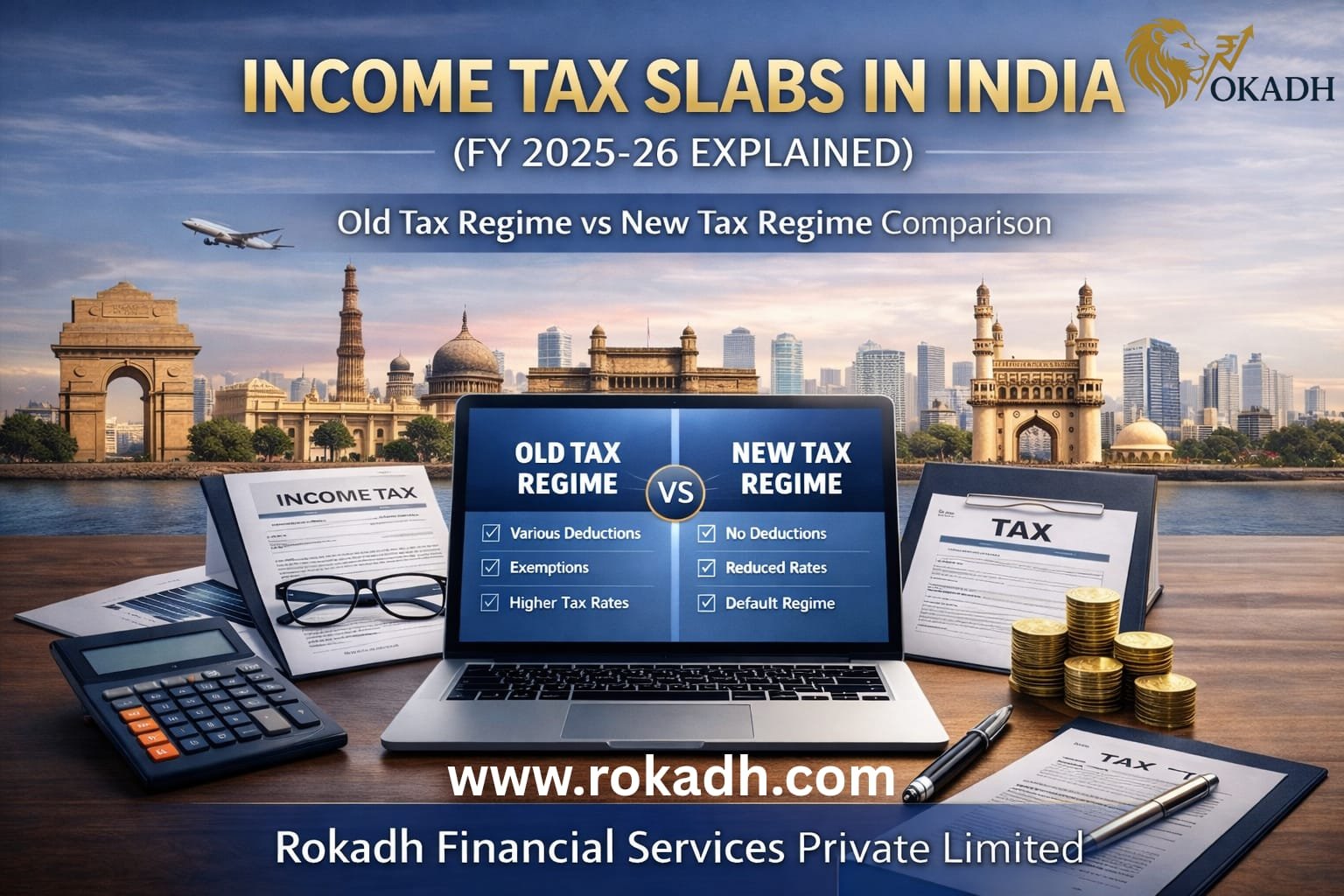
- Old Tax Regime – Includes deductions and exemptions
- New Tax Regime – Lower tax rates but limited deductions
Let us understand both in detail.
New Tax Regime Slabs (FY 2025-26)
The new tax regime was introduced to simplify taxation and reduce compliance complexity.
Income Tax Slabs
Income up to ₹3,00,000 – No Tax
₹3,00,001 to ₹6,00,000 – 5%
₹6,00,001 to ₹9,00,000 – 10%
₹9,00,001 to ₹12,00,000 – 15%
₹12,00,001 to ₹15,00,000 – 20%
Above ₹15,00,000 – 30%
The new regime is now considered the default tax regime for individual taxpayers.
Old Tax Regime Slabs (FY 2025-26)
The old tax regime allows taxpayers to claim various deductions and exemptions.
Income Tax Slabs
Up to ₹2,50,000 – No Tax
₹2,50,001 to ₹5,00,000 – 5%
₹5,00,001 to ₹10,00,000 – 20%
Above ₹10,00,000 – 30%
Senior citizens and super senior citizens have different slab benefits under this regime.
Comparison Between Old and New Tax Regimes
Old Tax Regime
Advantages:
• Allows deductions such as Section 80C, 80D, HRA, LTA
• Useful for taxpayers with large investments and insurance
• Suitable for salaried individuals claiming multiple exemptions
Disadvantages:
• Complex calculations
• Requires documentation of investments
New Tax Regime
Advantages:
• Simpler structure
• Lower tax rates
• Minimal compliance
Disadvantages:
• Most deductions are not allowed
• May increase tax liability for heavily invested taxpayers
Common Deductions Under the Old Tax Regime
Several deductions help reduce taxable income under the old regime.
Section 80C
Investments up to ₹1.5 lakh can be claimed through:
• Provident Fund
• ELSS mutual funds
• Life insurance premiums
• Tax saving fixed deposits
Section 80D
Health insurance premium deduction.
Section 24
Interest deduction on home loan.
Section 80E
Education loan interest deduction.
These deductions significantly reduce taxable income for many individuals.
Standard Deduction for Salaried Employees
The standard deduction for salaried individuals and pensioners continues to play an important role in reducing taxable income.
This deduction is available under both tax regimes.
Income Tax Rebate Under Section 87A
Taxpayers with income up to ₹7 lakh under the new tax regime may receive full tax rebate under Section 87A.
This effectively means many middle-class taxpayers may pay zero tax.
Income Tax Planning for Salaried Individuals
Employees working in major corporate centers such as Noida, Gurgaon, Hyderabad, Mumbai and Bangalore should plan taxes strategically.
Some effective strategies include:
• Investing under Section 80C
• Buying health insurance
• Using home loan deductions
• Utilizing NPS contributions
Proper planning can reduce tax liability significantly.
Tax Planning for Business Owners and Freelancers
Entrepreneurs and freelancers operating in growing business ecosystems like Kanpur, Lucknow and Prayagraj must also optimize tax strategies.
Key methods include:
• Maintaining proper books of accounts
• Claiming business expenses
• Utilizing presumptive taxation schemes
• Claiming depreciation benefits
Professional guidance helps maximize legitimate deductions.
Income Tax Filing Process
Filing income tax returns is mandatory for individuals exceeding the basic exemption limit.
The filing process includes:
- Collecting income documents
- Calculating taxable income
- Choosing tax regime
- Filing return online
- Verifying the return
Timely filing prevents penalties and ensures compliance.
Importance of Professional Tax Consultation
Many taxpayers struggle to decide which tax regime is best for them.
Professional tax consultants provide:
• Accurate tax calculations
• Investment planning advice
• Compliance support
• Handling income tax notices
• Maximizing tax savings
Working with experienced professionals ensures peace of mind and financial efficiency.
Why Choose Rokadh Financial Services Private Limited?
Rokadh Financial Services Private Limited provides expert tax advisory and financial consultancy services to individuals and businesses across India.
Our services include:
• Income tax filing and advisory
• Tax planning for salaried employees
• Business taxation services
• GST registration and compliance
• Startup financial consulting
• Investment planning support
We proudly assist clients across key cities including:
Kanpur
Lucknow
Prayagraj
Noida
Ghaziabad
Gurgaon
Delhi
Telangana
Hyderabad
Ludhiana
Mumbai
Bangalore
Our team ensures accurate compliance and effective tax strategies tailored to individual financial goals.
Conclusion
Understanding Income Tax Slabs for FY 2025-26 is crucial for making informed financial decisions. Choosing between the old and new tax regimes depends on your income structure, investment habits, and financial goals.
While the new tax regime offers simplicity and lower rates, the old regime provides flexibility through deductions and exemptions. Carefully evaluating both options helps taxpayers minimize their tax liability and optimize financial planning.
With expert guidance from Rokadh Financial Services Private Limited, individuals and businesses can navigate India’s tax system confidently and ensure complete compliance with tax regulations.
If you need assistance with income tax filing, tax planning, or financial advisory, our experts are ready to help you achieve better financial outcom