
A Comprehensive Analysis by Rokadh Financial Services Private Limited
India’s indirect tax framework for pan masala and related products is undergoing one of its most significant structural revisions in years. With the impending expiry of the GST compensation cess by March 2026, the Government of India has introduced new mechanisms — including the Health Security se National Security Cess and revised GST valuation rules — through a combination of legislation and CGST notifications.
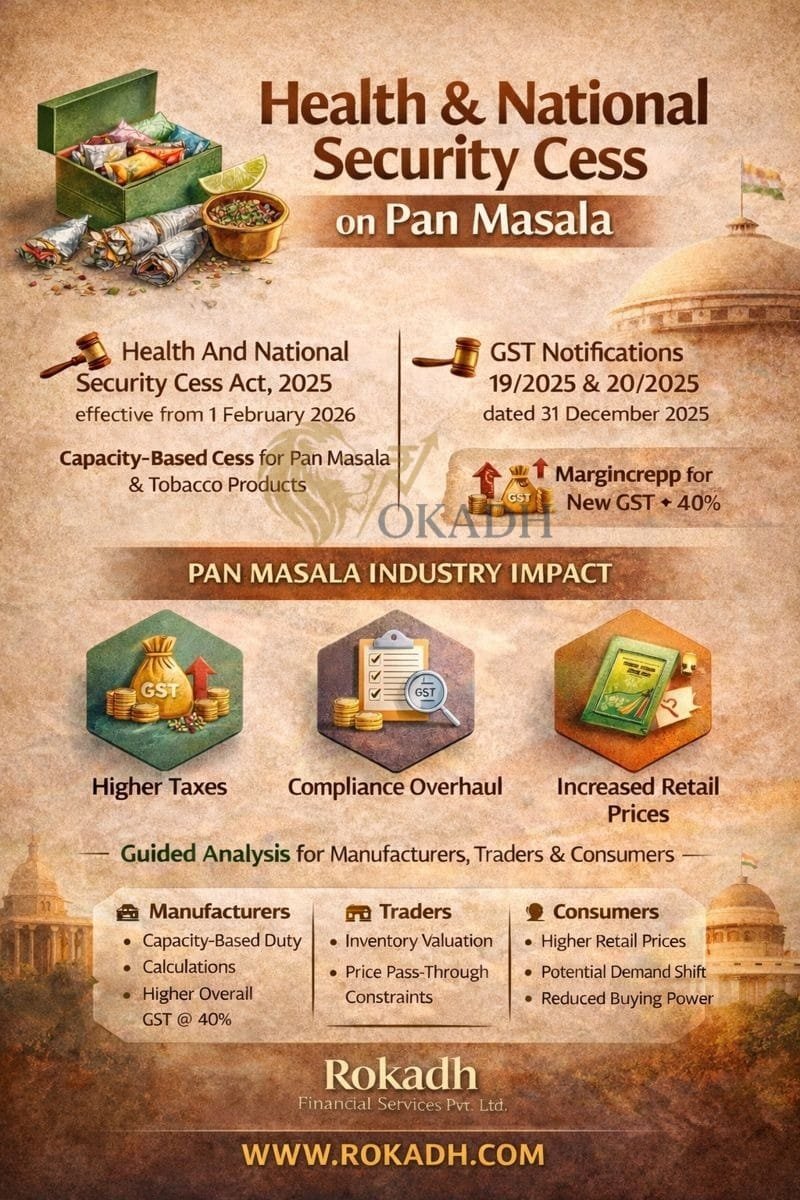
These changes, effective from 1st February 2026, are poised to reshape the tax, pricing, compliance and competitive landscape for the Pan Masala industry and related segments such as gutkha, chewing tobacco and other demerit goods.
In this detailed analysis, Rokadh Financial Services explains the legal background, what the new cess and GST notifications mean, and how manufacturers, traders and consumers are likely to be affected.
1. Background: Why a New Cess & What Changed
1.1 The End of GST Compensation Cess
Since the introduction of GST in 2017, the GST compensation cess has been levied on “sin goods” such as tobacco and pan masala, in addition to high GST rates, to compensate states for revenue loss.
However, this cess was always conceived as a temporary measure tied to financing transitional revenue shortfalls — not a permanent levy. With borrowing and interest on the compensation cess fund expected to be cleared by late 2025, the cess was scheduled to end in March 2026.
To ensure continuity of high taxation on harmful goods and to prevent their prices from plummeting once the compensation cess lapses, Parliament enacted:
👉 The Health Security se National Security Cess Act, 2025 — a new cess law targeting production capacity of demerit goods like pan masala.
1.2 What the Health & National Security Cess Is
Unlike the older GST compensation cess which was levied as a percentage of value at the point of consumption:
- The Health Security & National Security Cess (HSNSC) is designed to be levied on the production capacity of pan masala units (and any other notified goods).
- It expressly excludes essential commodities and is aimed at sin or demerit products that carry public health risks.
- The Government has stated that proceeds from the cess will be shared with states and used for targeted health and security initiatives.
This shift reflects a broader policy objective: to continue high taxation on products with negative societal impacts while creating earmarked revenue for health and security priorities.
1.3 Central Excise & Sin Goods Tax Framework
Alongside the new HSNSC, the Government has also reintroduced central excise duty on tobacco products under the Central Excise (Amendment) Bill, 2025 which ensures the overall duty burden does not decline once compensation cess ends.
This means pan masala and related products will be taxed through:
- GST @ 40%
- Health & National Security Cess (capacity-based)
Together, these taxes form a multi-layered indirect tax system aimed at both revenue protection and public health deterrence.
2. GST Notifications No. 19/2025 & 20/2025 — What Changed
On 31st December 2025, as part of the wider tax reform, the Government issued two major GST notifications affecting pan masala and allied products:
🔹 Notification No. 19/2025 – Central Tax (Rate)
This notification fundamentally restructures the GST rates for tobacco and pan masala products, with the most important changes including:
✔ Withdrawal of the 28% GST slab for tobacco and pan masala products — the earlier rate ceiling under GST.
✔ Placement of pan masala, unmanufactured tobacco, cigarettes, cigars, and other manufactured tobacco products under the 40% GST slab (20% CGST + 20% SGST).
✔ A specific lower GST rate of 18% for biris (Schedule II).
✔ Complete removal of the 14% slab (Schedule VII).
This consolidates a high tax rate for pan masala and associated sin goods while simplifying the overall GST structure.
🔹 Notification No. 20/2025 – Central Tax (Valuation Rules)
Perhaps the most significant change is in GST valuation rules for pan masala and related products:
✔ The introduction of Rule 31D under the CGST Rules, 2017 mandates GST valuation based on the Retail Sale Price (RSP) declared on the package.
✔ Under this rule, the value of supply for specified goods is deemed to be the RSP — minus the applicable tax — regardless of the actual transaction value.
✔ Where multiple RSPs exist on a single package (e.g., for different states/markets), the highest declared RSP applies for valuation and tax computation.
This fundamentally eliminates undervaluation practices that previously allowed manufacturers and traders to reduce their GST liability by declaring transaction values significantly below the printed RSP.
3. Health Security Cess vs National Security Cess Explained
The term “Health Security se National Security Cess” has led to confusion in some quarters, but the intent is clear:
3.1 Cess Purpose & Scope
• It is not a general commodity tax.
• It applies only to manufacturers of notified harmful goods, starting with pan masala.
• The cess base is tied to machine production capacity (machines per minute, output limit) rather than actual output sold — similar to the capacity-based central excise duty on tobacco.
3.2 Policy Rationale
The Government’s stated goals are twofold:
✔ Raise funds for public health programmes (e.g., tobacco-related disease control).
✔ Support national security requirements by earmarking a share of revenue for defence and allied sectors.
This dual focus is why the cess carries a composite name encompassing both health and security objectives.
Note that unlike GST (which is shared with states under the standard 50:50 CGST–SGST split), the cess proceeds will be shared with states under health-related supportive schemes rather than through conventional revenue sharing.
4. Impact on the Pan Masala Industry
The combined effect of the Health & National Security Cess, GST notifications, and valuation changes will be significant. Below, we analyse how manufacturers, traders and consumers will be affected.
4.1 Manufacturers – Strategic & Financial Impact
1) Increased Tax Burden
Under the new regime, pan masala manufacturers will face:
📌 Higher GST @ 40% – consolidated under the top GST slab.
📌 Health and National Security Cess – capacity-based levy over and above GST.
This stacked taxation increases the effective tax burden per unit of capacity compared with the earlier GST + compensation cess system.
2) Revenue Recognition & Pricing Constraints
Because GST will now be based on the Retail Sale Price (RSP) — not the invoice or discounted price — manufacturers can no longer reduce the taxable base by offering trade discounts or dealer incentives that affect invoice value.
This has two effects:
• A higher apparent tax base — GST is computed on gross RSP, increasing tax liability.
• The need for strategic pricing alignment across markets — as the highest printed RSP will be used for taxation purposes.
3) Compliance & Documentation Overhaul
Pan masala manufacturing units will now need to:
• Declare all packing machines and production capacities for cess computation.
• Maintain robust records, including CCTV coverage where required, to support cess and valuation declarations.
• Adjust ERP and invoicing systems to handle RSP-based GST valuation, replacing transaction value calculations.
Smaller and unorganised units that previously relied on variability in invoiced prices or captured cash sales may struggle to meet these compliance expectations.
4) Pricing & Competitive Strategy
With higher aggregated taxes and RSP-based valuation, manufacturers will face pressure to adjust:
• Retail prices (MRPs) upward to maintain margins
• Product mix strategies, possibly promoting lower-tax alternatives or diversification
• Trade terms with distributors to maintain off-take in a higher-priced environment
Industry voices have already noted anticipatory stock accumulation and margin compression ahead of tax changes.
4.2 Traders & Distributors – Operational & Margin Effects
1) Inventory Valuation Shock
Distributors who purchased pan masala stocks at lower pre-Feb 2026 prices may face margin erosion when selling at higher tax-inclusive pricing. Reports suggest early stock hoarding by traders in anticipation of increased acquisition costs.
2) Price Pass-Through Challenges
When taxes increase significantly, retailers often attempt to pass the incremental cost entirely to end consumers. However:
• Elasticity of demand for pan masala is constrained — consumers may reduce purchase frequency or seek cheaper alternatives
• Competition from unbranded or illicit pan masala products may intensify
This squeezes observable trader margins in the medium term.
3) Transition Compliance Costs
Like manufacturers, wholesalers and distributors must update billing systems to handle:
✔ RSP-based taxation
✔ Proper classification under Notification 19/2025
✔ Documentation of tax paid for downstream compliance claims
Failure to do so precisely could trigger downstream disputes with tax authorities.
4.3 Consumers – Price & Demand Implications
1) Higher Retail Prices
With pan masala now fully subject to:
• 40% GST plus
• Health & National Security Cess
The total cost to the end consumer rises — pushing up MRPs and reducing affordability. These changes are clearly aimed at discouraging consumption of demerit goods.
2) Demand Substitution & Behavioural Shift
Costlier pan masala may drive some consumers to:
✔ Lower-cost substitutes (e.g., cheaper regional brands)
✔ Unbranded or grey-market products
✔ Reduced frequency of consumption
However, demand for pan masala has historically been relatively inelastic, so price increases may not proportionally reduce overall demand.
3) Public Health Considerations
The Government’s rationale for imposing the Health & National Security Cess — i.e., deterrence and funding of health programmes — implies a longer-term behavioural objective: reducing consumption of harmful products.
Over time, sustained higher prices may contribute to lower prevalence rates among price-sensitive segments.
5. Strategic & Market Implications
5.1 Impact on Industry Structure
The transition from compensation cess to a combined GST + capacity-based cess regime creates a higher compliance threshold and cost of entry for budding manufacturers:
- Small unregistered units may struggle with capacity documentation and cost passes.
- Larger, compliant manufacturers may benefit from scale efficiencies, potentially consolidating market share.
This could accelerate industry formalisation and reduce grey-market penetration.
5.2 Potential for Illicit Trade Dynamics
Historically, strict taxation on demerit goods has coincided, in some markets, with increases in loose or unlabelled sales (e.g., single stick cigarettes) as reported recently.
If pan masala prices rise sharply, there may be similar incentives for:
• Loose sachet sales
• Unbranded or illicit products
• Undocumented trade channels
Tax authorities will need to strengthen enforcement mechanisms to prevent such leakages.
5.3 Compliance & Technology Adoption
Digital transformation investments — in areas such as:
✔ ERP billing systems
✔ RSP tracking and pricing controls
✔ GST software integrations
✔ Production capacity reporting tools
— will become essential for players across the supply chain to remain compliant.
6. Conclusion: A New Era of Sin Goods Taxation
The introduction of the Health Security se National Security Cess, paired with GST reforms via Notifications No. 19/2025 and 20/2025, marks a major recalibration of India’s indirect tax framework for pan masala and related demerit goods.
What stands out is the Government’s persistence in:
✔ Sustaining high taxation on harmful products
✔ Plugging revenue leakages via RSP-based valuation
✔ Moving away from temporary instruments (GST compensation cess) to structural, capacity-based levies
✔ Ensuring some share of revenue goes toward health and security priorities
For the Pan Masala industry, the era of undervalued invoicing and variable tax bases is ending. In its place is a regime that mandates upfront pricing alignment, comprehensive compliance and strategic cost planning.
Manufacturers, traders and consumers alike will need to adapt quickly — recalibrating pricing, supply chains, demand forecasts and systems compliance to align with this new tax environment.