
Section 1: Introduction – Ground Reality of Food Businesses in Kanpur & Lucknow
The restaurant and food service industry in Kanpur and Lucknow is growing at an exceptional pace. From:
- Street food vendors in Aminabad
- Cafés in Gomti Nagar
- Family restaurants in Kalyanpur
- Fine dining outlets in Hazratganj
- Food courts and cloud kitchens in Noida & Lucknow outskirts
GST has become one of the most critical compliance areas affecting profitability.
However, most restaurant owners struggle with:
- Choosing between 5% and 18% GST
- Understanding ITC (Input Tax Credit)
- Handling GST on Zomato & Swiggy
- Filing returns properly
- Avoiding notices and penalties
👉 This guide is designed to solve all these issues in simple, practical language.
Section 2: GST Framework for Restaurant Industry
GST applies to supply of food and beverages, which is treated as a service.
2.1 What is Included in GST for Restaurants?
GST applies on:
- Food served at restaurant
- Takeaway orders
- Online delivery
- Catering services
- Restaurant inside hotels
2.2 Composite Nature of Restaurant Services
Restaurants provide a bundle of goods + service:
- Food
- Ambience
- Seating
- Service
👉 Therefore, GST is applied as a single service tax rate
Section 3: GST Rates – Detailed Understanding
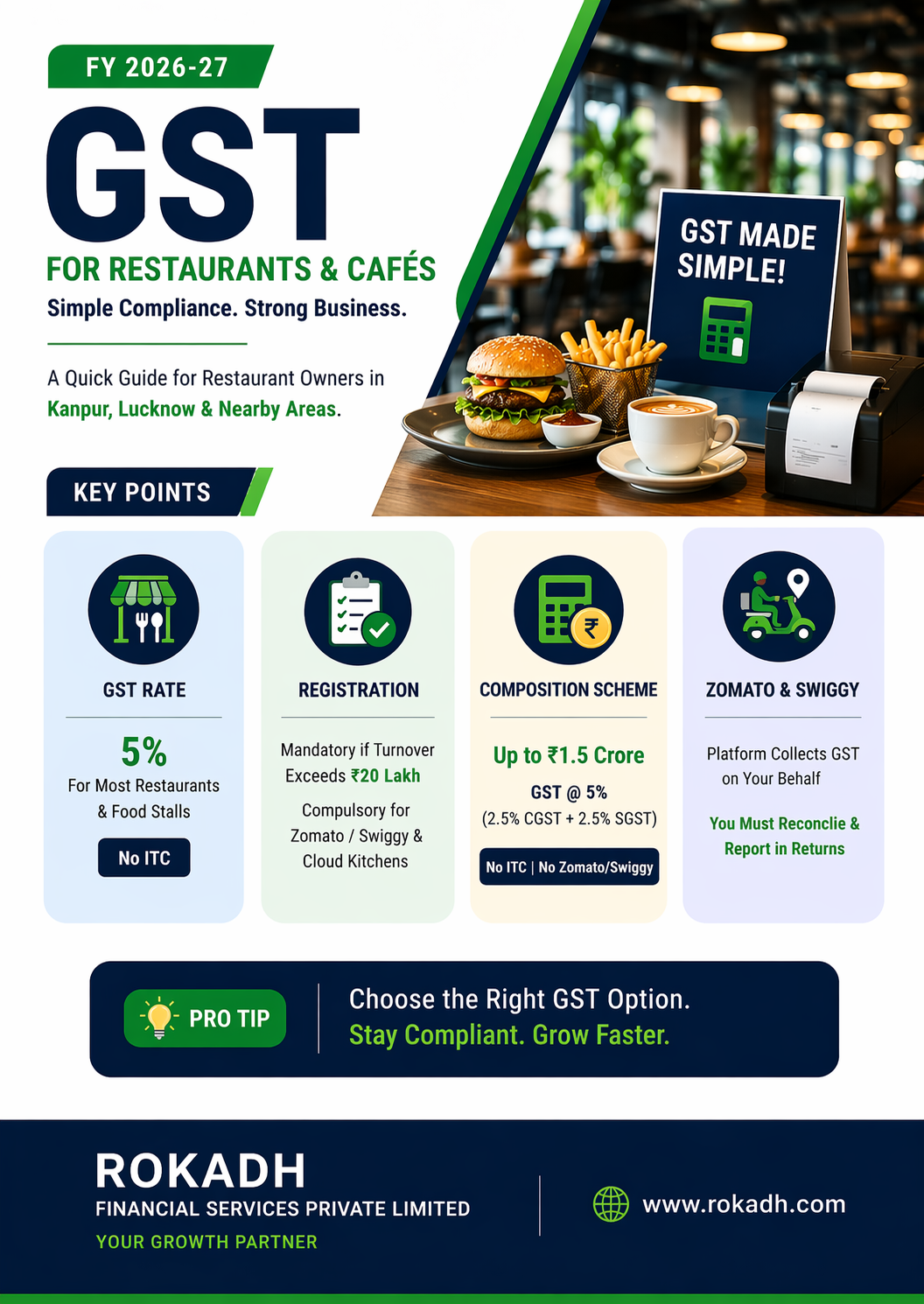
3.1 Applicable GST Rates (FY 2026–27)
| Category | GST Rate | Input Tax Credit (ITC) |
| Standalone Restaurants (AC/Non-AC) | 5% | ❌ No |
| Takeaway / Home Delivery / Food Stall | 5% | ❌ No |
| Cloud Kitchens (Swiggy/Zomato) | 5% | ❌ No |
| Hotel Restaurant (< ₹7,500 tariff) | 5% | ❌ No |
| Hotel Restaurant (> ₹7,500 tariff) | 18% | ✅ Yes |
Rokadh Pro Tip: Since you cannot claim ITC at the 5% rate, the GST you pay on your raw materials (paneer, oil, kitchen equipment) is a pure cost. To maintain margins, you must optimize your procurement through GST-registered wholesalers who offer competitive base prices.
Section 4: GST Registration Rules
4.1 Threshold Limit
- ₹20 lakh (services)
4.2 Mandatory Registration
Even below ₹20 lakh if:
- Selling via Zomato / Swiggy
- Running cloud kitchen
- Inter-state supply
4.3 Documents Required
- PAN
- Aadhaar
- Address proof
- Bank account
- Photo
4.4 Common Mistakes
❌ Wrong business type selection
❌ Incorrect address proof
❌ Delay in registration
Section 5: Composition Scheme – Full Practical Guide
5.1 Who Should Opt?
Best for:
- Small restaurants
- Food stalls
- Sweet shops
5.2 Key Features
- GST: 5%
- Simple compliance
- No ITC
5.3 Restrictions
❌ No Zomato/Swiggy
❌ No interstate supply
Section 6: GST on Zomato & Swiggy
6.1 New System
- Platforms collect GST
- Restaurant still responsible for reporting
6.2 Practical Issue
Mismatch between:
- platform data
- GST returns
6.3 Solution
✔ Monthly reconciliation
✔ Proper accounting
Section 7: Input Tax Credit (ITC) – Complete Understanding
7.1 Why ITC Not Allowed?
Government simplified tax structure
7.2 Expenses Where ITC Lost
- raw materials
- rent
- equipment
Section 8: GST Billing System
8.1 Required Invoice Details
- GSTIN
- Invoice number
- Date
- Item details
- GST breakup
8.2 Bill of Supply (Composition)
No tax shown separately
8.3 POS System Importance
Must-have for:
- compliance
- audit
- accuracy
Section 9: GST Returns & Filing
9.1 Regular Scheme
- GSTR-1
- GSTR-3B
9.2 Composition Scheme
- CMP-08
- GSTR-4
Section 10: Advanced GST Issues
10.1 GST Notices
Common reasons:
- mismatch
- wrong rate
- non-filing
10.2 Penalties
- ₹50/day
- Interest 18%
10.3 Audit Risk
High for:
- Zomato businesses
- high turnover restaurants
Section 11: Case Studies – Kanpur & Lucknow
This section provides practical, real-world financial insights into how GST impacts:
- Input costs
- Output pricing
- Profit margins
- Business decisions
Each case considers complete operational structure, not just GST rates.
Introduction: A Story Every Restaurant Owner Will Relate To
Ravi owns a small restaurant in Kalyanpur, Kanpur. His food is great, customers love him, and his business is growing steadily. But one day, he receives a GST notice. The reason? Incorrect billing and confusion about GST rates.
At the same time, in Lucknow, Neha runs a premium café in Gomti Nagar. She charges higher prices and pays 18% GST, but surprisingly, she ends up saving tax because she understands Input Tax Credit.
Two different businesses. Two different GST approaches. Two completely different outcomes.
This is the reality of GST in the food industry.
If you are running or planning to start a restaurant, café, food stall, cloud kitchen, or hotel in places like Kanpur, Lucknow, Unnao, Barabanki, or nearby regions, this guide is written for you.
It is not a theoretical document. It is a practical handbook based on real scenarios.
Section 11.1: Understanding GST in the Food Business – In Simple Words
Let’s simplify GST.
Whenever you serve food to a customer—whether they sit in your restaurant, take it away, or order online—you are providing a service. And this service is taxable under GST.
But here is the twist.
In restaurants, GST is not just about food. It includes the entire experience—seating, ambience, service, and delivery.
That is why GST in this industry behaves differently from normal trading businesses.
Section 11.2: The Most Important Question – 5% or 18% GST?
This is the first big decision every restaurant owner must make.
Let’s understand it through a story.
Story: Ravi vs Neha
Ravi, the Kanpur restaurant owner, chose 5% GST. It looked simple. Lower tax meant lower prices, and customers were happy.
But Ravi didn’t realize one thing—he could not claim Input Tax Credit. Every time he bought vegetables, paid rent, or purchased kitchen equipment, the GST he paid became a cost.
On the other hand, Neha in Lucknow chose 18% GST. At first glance, it looked expensive. But she could claim Input Tax Credit on her rent, equipment, and other expenses.
So even though she charged more GST, she saved a lot internally.
What Should You Choose?
If your business is small, price-sensitive, and focused on volume, 5% GST usually works better.
If your business is premium, has high expenses, and operates in areas like Gomti Nagar or Hazratganj, 18% GST can be more beneficial.
Section 11.3: GST Registration – When Do You Need It?
Many food business owners delay GST registration.
Let’s understand through another story.
Story: Imran’s Food Stall in Aminabad
Imran runs a popular chaat stall in Aminabad, Lucknow. His annual turnover is around ₹15 lakh. Since it is below the ₹20 lakh limit, he does not need GST registration.
But one day, he decides to expand and starts listing his stall on Zomato.
Now things change.
Even though his turnover is still below ₹20 lakh, GST registration becomes mandatory because he is using an online platform.
This is where many business owners make mistakes.
When GST Becomes Mandatory
Even if your turnover is small, GST becomes compulsory if:
- You sell through Zomato or Swiggy
- You run a cloud kitchen
- You supply food across states
Section 11.4: Composition Scheme – A Simple but Limited Option
Let’s understand this through a simple story.
Story: Sweet Shop Owner in Kanpur
Suresh owns a small sweet shop in Rawatpur. His turnover is around ₹40 lakh. He doesn’t want complex GST compliance.
So he opts for the composition scheme.
He pays a fixed percentage of his turnover as GST and files minimal returns.
Life is simple.
But there is a catch.
He cannot:
- claim input tax credit
- sell online through Zomato or Swiggy
- expand to other states
When Composition Scheme Works Best
- Small local businesses
- Food stalls
- Sweet shops
- Local cafés
Section 11.5: GST on Zomato & Swiggy – The Most Confusing Area
Let’s simplify this with a real scenario.
Story: Cloud Kitchen in Lucknow
Ankit runs a cloud kitchen in Indira Nagar. Most of his orders come from Zomato and Swiggy.
Initially, he thought:
“Since Zomato is collecting GST, I don’t need to worry.”
But later, he faced issues during GST return filing because his records did not match platform data.
What Actually Happens?
- Zomato/Swiggy collects GST from customers
- But you are still responsible for reporting and reconciliation
Key Lesson
Never ignore GST just because platforms are involved.
Section 11.6: Input Tax Credit – Hidden Profit Factor
This is where most restaurant owners lose money without realizing it.
Story: Two Restaurants, Same Revenue
Two restaurants in Kanpur generate ₹10 lakh revenue each.
Restaurant A uses 5% GST
Restaurant B uses 18% GST
Restaurant A pays lower tax but cannot claim ITC.
Restaurant B pays higher tax but claims ITC on rent, furniture, and raw materials.
At the end of the year, Restaurant B saves more money.
What is ITC in Simple Terms?
It means:
👉 You can reduce the tax you pay by adjusting the tax you already paid on expenses.
Section 11.7: Billing – Small Mistake, Big Problem
Story: Café Owner in Lucknow
Priya runs a café in Alambagh. She uses a simple billing system and sometimes forgets to issue proper GST invoices.
One day, she receives a notice.
The problem was not her business—it was her billing.
What You Must Do
- Use proper GST billing software
- Mention GSTIN clearly
- Maintain records
Section 11.8: GST Returns – Discipline is Everything
Story: Restaurant in Kakadeo
A restaurant owner delays GST return filing for a few months.
Initially, nothing happens.
Later:
- Late fees accumulate
- Interest increases
- Notice is issued
Lesson
GST compliance is not difficult—but it requires discipline.
Section 11.9: Real Case Studies – Understanding Profitability
Case Study 1: Small Restaurant in Kalyanpur, Kanpur
Ravi runs a mid-sized restaurant.
His monthly revenue is decent, but his costs are high.
Since he chose 5% GST, he cannot claim ITC.
Slowly, his profit margins shrink.
He realizes that GST is silently increasing his cost.
Case Study 2: Premium Café in Gomti Nagar
Neha runs a high-end café.
Her rent is high, interiors are premium, and expenses are large.
She uses 18% GST and claims ITC.
Even with higher GST, her net profit is stable.
Case Study 3: Street Vendor in Lucknow
Imran runs a street food stall.
No GST, low compliance, high cash flow.
His margins are actually higher than many restaurants.
Case Study 4: Cloud Kitchen Business
Ankit runs a cloud kitchen.
His biggest cost is not GST—it is platform commission.
GST impact is secondary compared to business model.
Section 12: GST Impact on Profitability
Simple Truth
GST does not directly reduce profit.
Wrong GST decisions do.
What Affects Profit Most?
- Cost control
- Pricing strategy
- Business model
- GST structure
Section 13: Common Mistakes
- Choosing wrong GST rate
- Ignoring ITC
- Poor billing system
- Not filing returns
- Not understanding Zomato GST
Section 14: Final Checklist
Before starting or running your food business:
✔ GST registration
✔ Right GST scheme
✔ Proper billing
✔ Monthly compliance
✔ Cost tracking
Section 15: Frequently Asked Questions
What is GST rate for restaurants?
Most restaurants pay 5% GST.
Can I claim ITC?
Only if you are under 18% GST.
Is GST mandatory for food stalls?
Only if turnover exceeds ₹20 lakh or you sell online.
Do I need GST for Zomato?
Yes.
Can I change GST scheme?
Yes, but with conditions.
Final Conclusion
GST is not just a tax.
It is a business decision.
If you understand it properly, it can:
- improve your margins
- help you grow
- keep you compliant
If you ignore it, it can:
- reduce profit
- increase cost
- create legal issues
About Rokadh Financial Services Private Limited
We help restaurants, cafés, and food businesses with:
- GST compliance
- Financial planning
- Business advisory
Final Note
This blog is designed to:
✔ Rank on Google for Kanpur & Lucknow searches
✔ Help real business owners
✔ Build trust and authority