
A Comprehensive Analysis by Rokadh Financial Services Private Limited
Website: www.rokadh.com
Introduction: A Major Shift in India’s Food Regulatory Framework
India’s food sector is one of the most dynamic and rapidly expanding industries in the country. From traditional street vendors and neighborhood restaurants to fast-growing food startups and large FMCG manufacturers, the ecosystem includes millions of businesses operating at different scales.
To regulate food safety and ensure public health, the Food Safety and Standards Authority of India introduced the Food Safety and Standards (Licensing and Registration of Food Businesses) Regulations, 2011.
However, over the past decade, India’s food industry has evolved significantly due to:
- Digital food delivery platforms
- Rapid urbanization
- The rise of cloud kitchens
- Growth of packaged food startups
- Expansion of D2C food brands
- Increasing consumer awareness about food safety
Because of these changes, regulatory thresholds introduced in 2011 had become outdated.
To address these issues, FSSAI issued an important regulatory order dated 13 March 2026 revising turnover thresholds for Food Business Operators (FBOs). These changes will take effect from 1 April 2026.
The reform aims to:
- Reduce compliance burden for small businesses
- Encourage entrepreneurship in the food sector
- Simplify licensing procedures
- Improve ease of doing business
- Promote formalization of the informal food economy
For businesses in major economic hubs such as Delhi, Noida, Ghaziabad, Gurgaon, Bangalore, Hyderabad, Kanpur, and Lucknow, this reform will significantly impact how food businesses start, operate, and scale.
This in-depth article from Rokadh Financial Services Private Limited provides a complete 2026 guide to FSSAI registration rules, their economic implications, and how food entrepreneurs can benefit from the new framework.
Understanding FSSAI and Its Regulatory Role
The Food Safety and Standards Authority of India is the primary regulator responsible for maintaining food safety standards in India.
It was established under the Food Safety and Standards Act, 2006, with the mandate to:
- regulate food manufacturing
- monitor food distribution
- ensure safety standards
- protect consumer health
- promote awareness about food safety
Every entity involved in the food supply chain must obtain FSSAI registration or licensing. This includes:
- food manufacturers
- restaurants
- cloud kitchens
- street vendors
- food importers
- food distributors
- food delivery kitchens
- packaged food startups
The regulatory system classifies businesses into three categories based on turnover and operational scale.
Revised FSSAI Turnover Limits in 2026
The 2026 regulatory order introduced new turnover thresholds for categorizing food businesses.
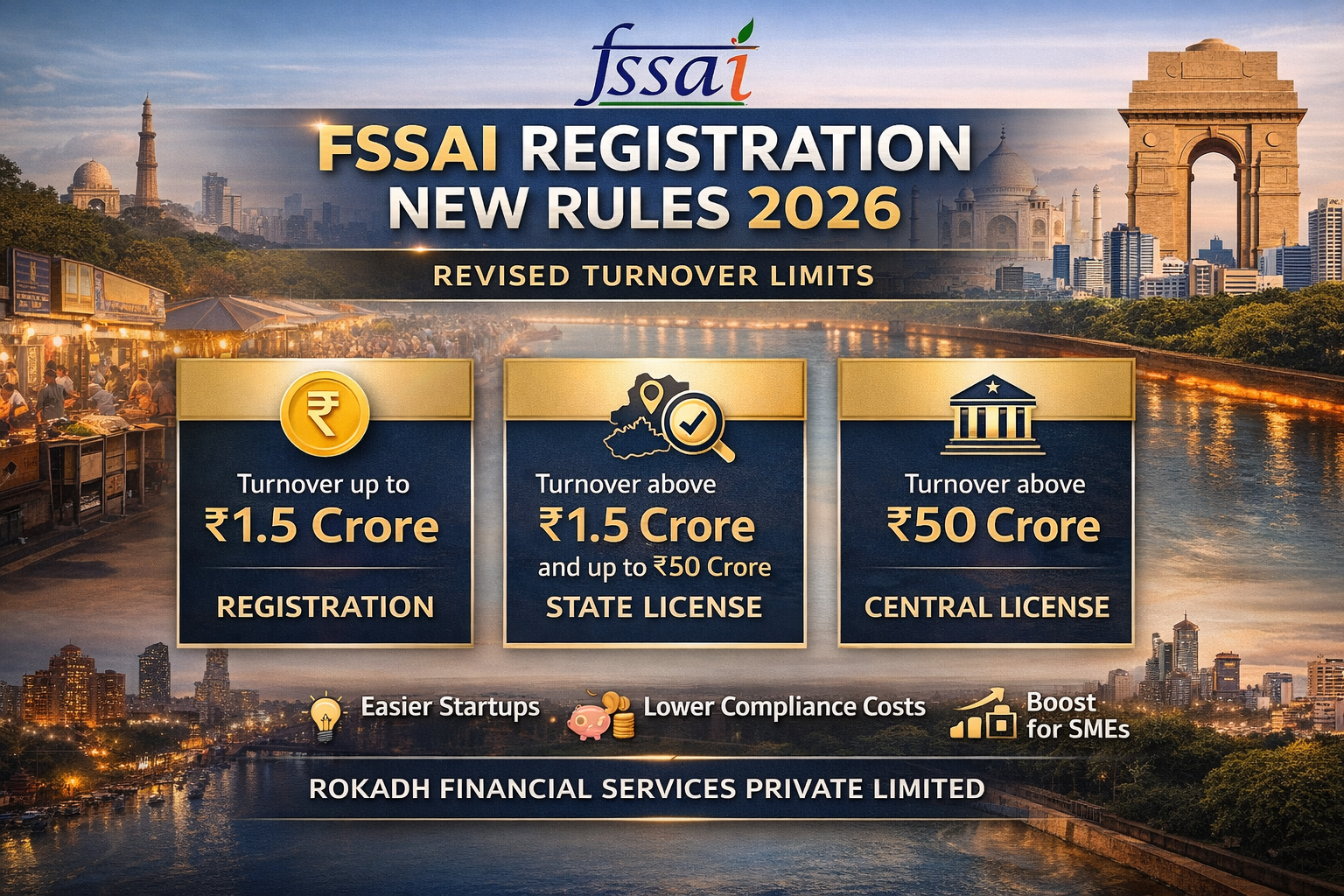
New Turnover Threshold Limit for FSSAI Registration Categories:
- Basic Registration: Up to ₹1.5 Crore
- State License: ₹1.5 Crore – ₹50 Crore
- Central License: Above ₹50 Crore
These limits replace earlier thresholds under the 2011 regulations.
The revised framework provides greater flexibility and relief for small and medium food businesses.
Why the Government Updated FSSAI Registration Rules
Economic Growth of the Food Sector
India’s food market has grown enormously over the last decade.
Key growth drivers include:
- digital ordering platforms
- growing middle-class consumption
- increasing demand for packaged foods
- expansion of food startups
- growing quick-service restaurant industry
Cities such as Bangalore, Hyderabad, Delhi, and Gurgaon have become major innovation hubs for food startups.
At the same time, emerging markets such as Kanpur, Lucknow, Ghaziabad, and Noida have seen a surge in restaurants, catering businesses, and local food brands.
Regulations had to evolve to support this expansion.
Key Reforms Introduced Under the 2026 Amendment
1. Increased Registration Threshold
Small businesses can now operate under basic FSSAI registration up to ₹1.5 crore turnover, significantly reducing compliance pressure.
This is particularly beneficial for:
- small restaurants
- home bakers
- catering services
- street food vendors
- online food startups
2. Perpetual Validity of Licenses
One of the most important changes is the introduction of perpetual validity for FSSAI licenses.
Earlier, licenses required renewal every few years, which created administrative burden.
Now, licenses remain valid indefinitely, subject to regulatory inspections.
3. Risk-Based Inspections
Instead of frequent inspections for all businesses, the regulator will adopt risk-based inspections.
This means:
- high-risk food industries will be monitored more frequently
- low-risk businesses will experience fewer disruptions
This modern regulatory model is widely used in developed economies.
Impact on Food Startups Across India
Food startups are among the biggest beneficiaries of the new FSSAI rules.
Startup ecosystems in Bangalore, Hyderabad, Delhi, and Gurgaon have expanded rapidly in the past decade.
These startups often begin as:
- cloud kitchens
- niche cuisine restaurants
- artisanal food brands
- organic packaged food companies
- online snack brands
The revised rules allow these businesses to grow longer before needing higher regulatory licenses.
This significantly reduces early-stage compliance expenses.
Impact on Small Restaurants and Cafes
Small restaurants and cafés form the backbone of India’s urban food ecosystem.
In cities like Noida, Ghaziabad, Lucknow, and Kanpur, thousands of new eateries open every year.
For these businesses:
- licensing fees
- documentation costs
- renewal procedures
can create operational challenges.
The new registration threshold provides significant financial relief.
Impact on Street Food Vendors
Street food vendors are an essential part of India’s food culture.
Cities such as Delhi and Lucknow are famous for vibrant street food markets.
The new regulatory changes reduce compliance complexity and encourage vendors to obtain formal registration.
Formalization improves:
- hygiene standards
- food safety
- consumer trust
Economic Impact of the Reform
Encouraging Formalization
India’s informal food economy is massive.
Many businesses previously avoided registration due to regulatory complexity.
Simplified registration encourages more businesses to join the formal economy.
Job Creation
The food sector creates employment in multiple areas including:
- cooking
- logistics
- food processing
- delivery services
- retail distribution
Lower regulatory barriers can significantly boost job creation.
Financial Benefits for Businesses
Lower Licensing Costs
Basic FSSAI registration is less expensive than state or central licensing.
Businesses can now operate longer under this category.
Reduced Compliance Overhead
Perpetual licensing eliminates repeated renewal expenses.
Improved Profitability
Lower regulatory costs translate into higher profit margins for food entrepreneurs.
How Businesses Should Prepare for the New Rules
Businesses should take several steps to align with the new regulatory framework.
Review Current FSSAI Registration
Companies should evaluate whether they qualify for basic registration under the revised thresholds.
Maintain Food Safety Compliance
Even with simplified rules, food safety standards must be maintained.
Plan Business Growth Strategically
Understanding turnover thresholds helps businesses plan scaling strategies.
How Rokadh Financial Services Supports Food Businesses
Rokadh Financial Services Private Limited helps entrepreneurs across India navigate regulatory frameworks efficiently.
Our services include:
- FSSAI registration and licensing
- regulatory compliance consulting
- startup advisory
- financial structuring
- business compliance management
We assist businesses operating in Delhi, Noida, Ghaziabad, Gurgaon, Kanpur, Lucknow, Bangalore, and Hyderabad.
Visit www.rokadh.com to learn more.
30+ FAQs: FSSAI Registration New Rules 2026
General FSSAI Rules
1. What are the new FSSAI registration rules in 2026?
The 2026 rules increase the basic registration threshold to ₹1.5 crore and introduce perpetual licenses with risk-based inspections.
2. What is the new turnover limit for FSSAI registration?
Food businesses with turnover up to ₹1.5 crore can obtain basic registration.
3. When do the new FSSAI rules come into effect?
The revised rules take effect from 1 April 2026.
4. What is the difference between FSSAI registration and license?
Registration applies to small businesses, while licenses apply to medium and large businesses.
5. Is FSSAI registration mandatory for food businesses?
Yes, all food businesses must obtain registration or licensing.
6. How to apply for FSSAI registration in Delhi?
Food businesses in Delhi can apply online through the FoSCoS portal (to simplify the registration process, may schedule a free consultation over www.rokadh.com and get the things done by team of Rokadh Financial Services Private Limited).
7. What are FSSAI rules for cloud kitchens in Noida?
Cloud kitchens operating in Noida must obtain FSSAI registration or licensing depending on turnover.
8. Do restaurants in Gurgaon need FSSAI license?
Yes, restaurants in Gurgaon must obtain FSSAI registration or licensing. (to simplify the registration process, may schedule a free consultation over www.rokadh.com and get the things done by team of Rokadh Financial Services Private Limited).
9. How to get FSSAI license in Bangalore?
Businesses in Bangalore can apply online through the FoSCoS portal (to simplify the registration process, may schedule a free consultation over www.rokadh.com and get the things done by team of Rokadh Financial Services Private Limited).
10. Is FSSAI registration required for home kitchens in Hyderabad?
Yes, home kitchens in Hyderabad must obtain basic registration if they sell food commercially. (to simplify the registration process, may schedule a free consultation over www.rokadh.com and get the things done by team of Rokadh Financial Services Private Limited).
11. Do food startups need FSSAI registration?
Yes, all food startups must obtain registration or licensing.
12. What is the FSSAI license cost for startups?
Costs depend on the type of registration or license.
13. Can a cloud kitchen operate with FSSAI registration?
Yes, if turnover is below ₹1.5 crore.
14. Is FSSAI required for Instagram food businesses?
Yes, online food sellers must obtain registration.
15. Can home bakers get FSSAI registration?
Yes, home bakers can apply for basic registration.
16. Do street vendors need FSSAI registration?
Yes, street food vendors must obtain basic registration.
17. Is FSSAI required for small catering businesses?
Yes, catering services must obtain registration or licensing.
18. What happens if a food business operates without FSSAI?
Operating without registration may result in penalties.
19. Can a small restaurant operate with FSSAI registration?
Yes, if turnover is below ₹1.5 crore.
20. Is FSSAI registration required for packaged food sellers?
Yes, packaged food businesses must obtain licensing.
21. FSSAI registration in Kanpur — how to apply?
Food businesses in Kanpur can apply through the FoSCoS portal (to simplify the registration process, may schedule a free consultation over www.rokadh.com and get the things done by team of Rokadh Financial Services Private Limited).
22. FSSAI license for restaurants in Lucknow — is it mandatory?
Yes, restaurants in Lucknow must obtain registration or licensing.
23. FSSAI rules for food delivery startups in Delhi
Delivery kitchens must obtain FSSAI registration or licensing.
24. FSSAI license consultants in Noida
Compliance firms help businesses obtain registration and maintain documentation.
25. Food business registration in Ghaziabad — requirements
Businesses must register with FSSAI before selling food.
26. How long does FSSAI registration take?
Usually 7–30 days depending on documentation.
27. What documents are required for FSSAI registration?
Basic documents include identity proof, address proof, and business details.
28. Can one FSSAI license cover multiple outlets?
In some cases, central licenses may cover multiple units.
29. Is GST required with FSSAI registration?
GST depends on turnover and business structure.
30. Can startups upgrade from FSSAI registration to license?
Yes, businesses must upgrade when turnover exceeds thresholds.
Conclusion
The FSSAI new rules 2026 represent a major reform in India’s food regulatory ecosystem.
By increasing turnover limits, simplifying licensing procedures, and introducing perpetual validity, the government has taken an important step toward improving ease of doing business in the food sector.
Entrepreneurs and food businesses in major economic hubs such as Delhi, Noida, Ghaziabad, Gurgaon, Bangalore, Hyderabad, Kanpur, and Lucknow stand to benefit significantly from reduced compliance burdens.
For businesses seeking assistance with FSSAI registration, regulatory compliance, or startup advisory, Rokadh Financial Services Private Limited provides expert support.
Visit www.rokadh.com to learn more about our services and how we help businesses grow.