
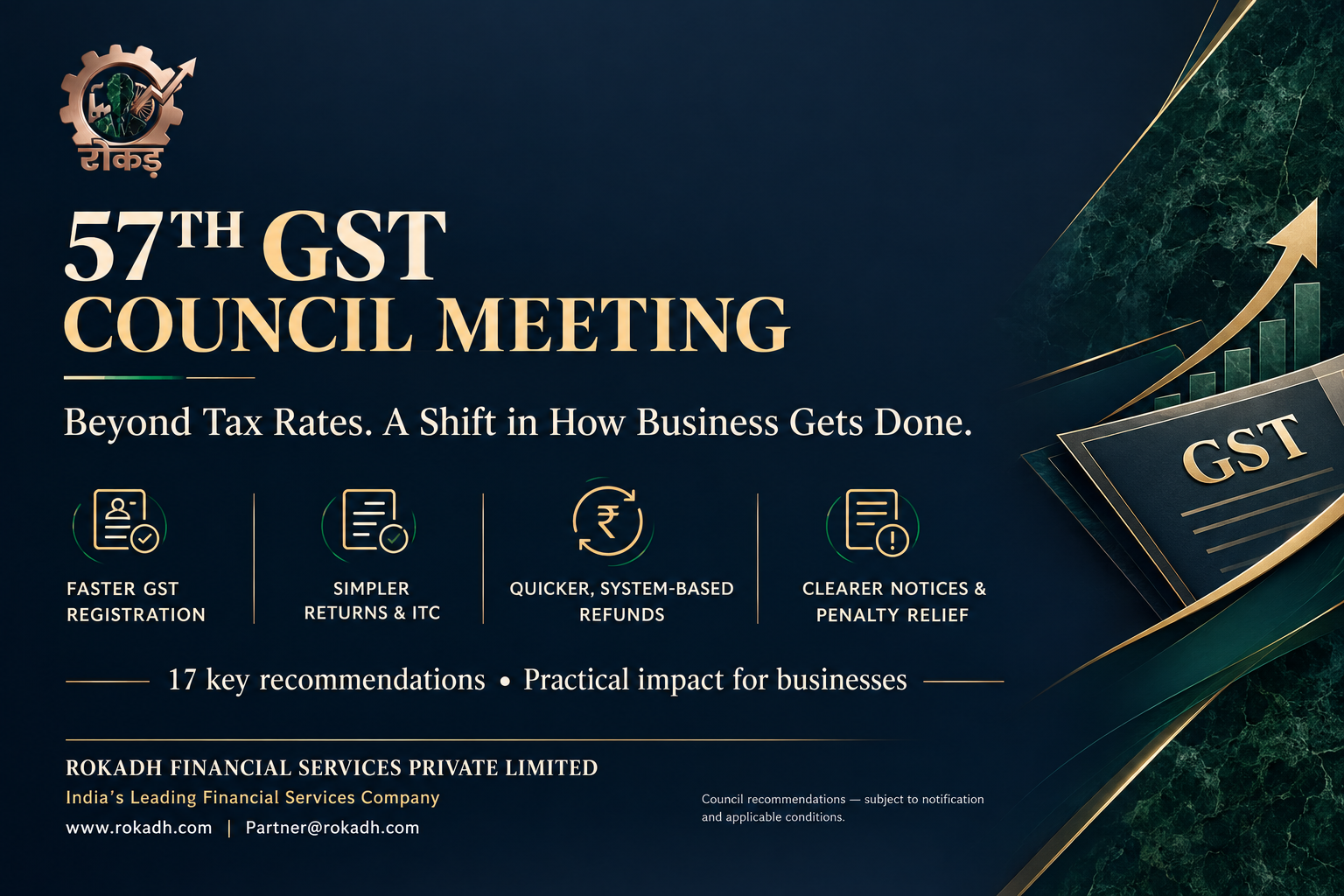
On 8 October 2026, the 57th GST Council meeting was held in New Delhi under Union Finance Minister Smt. Nirmala Sitharaman. Last year’s 56th meeting was about rates. This one is about process: registration, returns, refunds, notices, penalties and road checking.
PART A: PROCESS REFORMS
A1. Registration Reforms
Provision 1: Streamlined Registration Process
What the Council recommended:
- Since the 56th meeting, the portal grants registration automatically (rule 14A) where the applicant does not intend to pass on ITC of more than ₹2.5 lakh per month. For the remaining cases, the 57th meeting recommended:
- A comprehensive circular and FAQs on documents and information required.
- Drop-down boxes in FORM GST REG-01 so taxpayer and officer know exactly what to furnish.
- A user-friendly portal with navigation paths, drop-down lists, tool-tips and guidance.
- The aim is fewer rejections and queries, and faster processing.
Case Study: Ritu Srivastava, online tuition and design services, Kakadeo, Kanpur
Ritu applied for registration twice. Both applications came back with queries because she uploaded the wrong proof of address. Three weeks passed and a client project waited.
How this helps: With a clear document list and drop-down selection in REG-01, Ritu would know what to upload before she clicks “submit”. Fewer queries means a faster GSTIN.
How we help: We prepare the document set before filing. See our GST registration service.
Q&A
Q. Does this mean I no longer need a CA for registration?
You can file on your own, but the circular and drop-down boxes only help if you pick the right options. A wrong business-activity or address-proof choice still brings queries, so a quick review before filing is cheap insurance.
Q. Who gets automatic registration?
Applicants who do not intend to pass on ITC of more than ₹2.5 lakh per month, under rule 14A. The 57th meeting works on the cases outside that route.
Provision 2: Easier Amendment in Registration
What the Council recommended:
- Amend rule 19 so amendments to all registration particulars are accepted automatically on the portal, except those relating to the Principal Place of Business (PPoB).
- For taxpayers on the rule 14A automatic route, amendments including PPoB are also accepted automatically.
- This allows near real-time updates without officer interface.
Case Study: Faizan Ahmad, garment trader, Lucknow (Chowk)
Faizan changed his authorised signatory and mobile number. The approval took weeks, and the OTPs kept going to the old number, so his return filing got stuck.
How this helps: Such changes would be accepted automatically on the portal, so his login and OTP problem would be solved in near real time.
How we help: We update registration details and keep your records matching. See our GST miscellaneous services.
Q&A
Q. Can I change my business address automatically?
Only if you are on the rule 14A automatic route. For others, changes relating to the Principal Place of Business are excluded from automatic acceptance.
Q. Why does this matter for return filing?
Outdated mobile, email or authorised-signatory details often block filing. Quick updating removes that risk.
Provision 3: Simpler Cancellation of Registration
What the Council recommended:
- Taxpayer’s own application, Phase 1: FORM GST REG-16 is accepted automatically once all pending returns are filed and dues paid, where (i) ITC passed on has not exceeded ₹2.5 lakh in any month since registration, or (ii) it has, but the final return in GSTR-10 was filed within the specified time.
- Phase 2: All applications are accepted automatically on the same condition. REG-16 will be amended to carry GSTR-10 details.
- Officer-initiated: certain grounds in rule 21 omitted. Rules 21A and 22 amended and a new rule 23A inserted for system-based cancellation and revocation linked to non-filing of returns or non-furnishing of bank account details.
Case Study (Illustrative): Dinesh Pal, fabrication workshop, Panki, Kanpur
Dinesh closed his workshop but the cancellation request kept getting queries. Meanwhile, returns continued to fall due.
How this helps: Once pending returns are filed and dues are paid, his application would be accepted automatically under Phase 1 if his ITC passed on stayed within ₹2.5 lakh in each month, or if he filed GSTR-10 on time.
How we help: We clear old returns, file GSTR-10 and apply for cancellation. See GST regular compliance.
Q&A
Q. If I stop business and ignore GST, what happens?
Returns keep falling due and late fees and notices build up. Cancellation needs pending returns to be filed first.
Q. My registration got cancelled for not filing returns. Is revival possible?
The Council recommended a system-based revocation mechanism on subsequent compliance within the specified time. Wait for the notified rule and timelines.
Provision 4: Simplified Registration for Small E-Commerce Sellers (Rule 14B)
What the Council recommended:
- A new rule 14B for small suppliers of goods through ECOs. They can register in a State/UT where they have no physical presence, by declaring the ECO’s warehouse in that State/UT as their Principal Place of Business.
- Condition: intend to pass on ITC of not more than ₹2.5 lakh per month (excluding stock transfers between distinct persons).
- Registration is granted automatically, subject to conditions.
Case Study (Illustrative): Pooja Mishra, handmade home products, Barabanki
Pooja’s products sell well in Delhi and Mumbai through online marketplaces, but a registration in each state would mean renting a place she cannot afford.
How this helps: Under rule 14B, she could register in those states by declaring the ECO’s warehouse there as her PPoB, if she meets the conditions.
How we help: We check eligibility, apply and handle returns for each state registration.
Q&A
Q. Does this apply to service providers?
No. The recommendation is for small suppliers making supplies of goods through ECOs.
Q. What if I transfer stock between my own registrations?
Stock transfers between distinct persons are excluded when calculating the ₹2.5 lakh ITC limit.
A2. Return Reforms
Provision 5: Alternate Mechanism to Correct Liability and ITC in Returns
What the Council recommended:
- Enhancements in GSTR-1/1A/IFF for better reconciliation with GSTR-3B.
- Rule 86D: Electronic Statement of tax paid on reverse charge and ITC claimed.
- Rule 86C: Electronic Credit Reversal and Reclaim Statement.
- Rule 61 (sub-rules 1A and 1B): correct and rectify liability and ITC in GSTR-3B so they align with GSTR-1/1A/IFF and GSTR-2B.
- DRC-03 to declare underlying invoice details.
- Rule 60 (sub-rule 6A): IMS allows recipients to accept, reject or keep pending inward documents, with conditions including how long a credit note can be kept pending.
- A circular on correct reporting of ITC and reversals.
- Proposed to come into force from the return of April 2027, after public consultation.
Case Study (Illustrative): Sunita Verma, chikankari boutique and online seller, Aminabad, Lucknow
Sunita’s GSTR-3B had slightly lower liability than GSTR-1 because of a data-entry slip. She received a system intimation and spent days responding.
How this helps: The new correction mechanism is designed so liability in 3B aligns with 1, and ITC aligns with 2B. That should reduce such intimations and notices.
How we help: Monthly reconciliation. See GST monthly/quarterly compliance.
Q&A
Q. Is this live now?
No. The proposed date is from the April 2027 return, and the mechanism will first go to public consultation.
Q. What should I do with IMS until then?
Check your IMS inbox regularly, avoid leaving credit notes pending and reconcile 2B with your books monthly.
Q. Does this reduce the need for professional help?
It reduces mismatches only if your underlying data is accurate. Clean books remain the base.
A3. Refund Reforms
Provision 6: Faster, System-Based Automated Refunds
What the Council recommended:
- Phase 1:Full refund of excess balance in electronic cash ledger sanctioned automatically.
- Acknowledgement or deficiency memo time cut from 15 to 10 days, with deemed acknowledgement.
- For zero-rated supplies and inverted duty, 90% of the claimed amount sanctioned provisionally and automatically, based on risk evaluation.
- Phase 2: automated acknowledgement, and automated sanction of the full refund for zero-rated supplies after adjusting pending dues.
- RFD-01 to capture details in a system-readable format, with no scanned uploads for zero-rated and inverted duty claims.
- Rule 89(4)(C): the cap of 1.5 times the value of like goods domestically supplied is removed.
- Section 54(14): the ₹1,000 threshold applies to the total refund (CGST + SGST/UTGST + IGST).
- Section 115: a standalone provision on interest on refund of pre-deposit, plus a circular.
Case Study (Illustrative): Meenakshi Agarwal, leather goods exporter, Unnao
Meenakshi’s zero-rated refund was stuck for months with repeated document requests. She paid overdraft interest while the government held her money.
How this helps: Phase 1 could release 90% of the claim provisionally through the system, and the system-readable RFD-01 reduces document requests. Phase 2 aims at full automated sanction after risk evaluation.
How we help: Clean invoice-shipping bill matching and a correct RFD-01. See our GST refund service.
Q&A
Q. Is 90% a final amount?
It is a provisional sanction based on system risk evaluation. The remaining claim follows the later stages.
Q. Do small refunds qualify?
The ₹1,000 threshold is now calculated on the total of CGST, SGST/UTGST and IGST taken together.
Q. What if my refund is for pre-deposit?
The Council recommended a clear standalone rule on interest under section 115 and a circular to remove confusion.
A4. Dispute Resolution Reforms
Provision 7: Better Quality Notices and Orders (Circular)
What the Council recommended:
- A circular with comprehensive guidelines for officers on quality of notices and orders, timely issuance, invoking fraud, wilful misstatement or suppression only on merits, and following natural justice including personal hearings.
Case Study (Illustrative): Sandeep Tripathi, attar distiller, Kannauj
Sandeep received a notice that alleged suppression of facts without explaining the basis. He felt it was a copy-paste notice and had no clear idea how to respond.
How this helps: Guidelines on quality and the proper invocation of fraud or suppression grounds should lead to clearer notices, with a hearing opportunity.
How we help: Notice analysis and reply drafting. See GST litigation support.
Q&A
Q. Does the circular bind officers?
Circulars are issued to guide field officers, so wait for the actual text and its effect.
Q. Should I still reply to a notice within the time limit?
Yes. Never ignore a notice because reforms are coming.
Provision 8: Minimum ₹10,000 Threshold for Show Cause Notices
What the Council recommended:
- Amend sections 73, 74 and 74A to provide a minimum threshold of ₹10,000 (CGST + SGST + IGST + Cess) for issuing show cause notices. No notice for tax below ₹10,000.
- A statutory provision so that pending notices and appeals below ₹10,000 are decided as if the threshold had been in force when the notice was issued.
Case Study (Illustrative): Geeta Rawat, boutique owner, Lajpat Nagar, Delhi
Geeta got a notice for a ₹7,800 difference. Replying cost her more in time and fees than the amount.
How this helps: Under the threshold, such a notice would not be issued, and a pending one would be treated as if the threshold applied.
How we help: We check each pending notice against the final provision once it is notified.
Q&A
Q. Is the ₹10,000 per notice or per year?
The release speaks of the tax amount involved in the notice. Wait for the exact statutory wording.
Q. If my notice is under ₹10,000, can I ignore it?
Don’t. The relief becomes effective only after the law is amended.
Provision 9: Penalty Relief in Non-Fraud Cases
What the Council recommended:
- Deeming the penalty amount as “charge” where full tax, interest and penalty are voluntarily paid within the specified time.
- A reduced penalty of 5% in non-fraud cases, if tax and interest are paid within 30 days (section 73) or 60 days (section 74A) of the adjudication order.
- Removal of the ₹10,000 minimum penalty in non-fraud cases.
Case Study (Illustrative): Ashok Yadav, footwear manufacturer, Unnao
Ashok got an adjudication order in a non-fraud matter. He had the money to pay the tax and interest, but the penalty made settlement painful.
How this helps: If he pays tax with interest within 30 days (under section 73), only a 5% penalty would apply as per the recommendation.
How we help: We calculate the settlement route against the appeal route, so you pick the better option.
Q&A
Q. Does the 5% penalty apply to fraud cases?
No. It is for non-fraud cases.
Q. Is it better to pay or appeal?
That depends on facts, merits and the amount. Take advice before deciding.
Provision 10: General Penalty Reduced (Section 125)
What the Council recommended:
- Reduce the maximum general penalty under section 125 from ₹25,000 to ₹10,000.
Case Study (Illustrative): Arvind Maurya, stationery shop, Barabanki
Arvind made a procedural lapse that attracted the general penalty. For a small shop, ₹25,000 was a heavy blow.
How this helps: The maximum general penalty would be capped at ₹10,000.
How we help: Regular compliance reviews to avoid procedural lapses. See GST audit.
Q&A
Q. Does this reduce every penalty?
No. It is about the general penalty under section 125, not all penalties under GST.
Provision 11: Cap on Pre-Deposit for Penalty-Only Orders
What the Council recommended:
- Amend the provisos to section 107(6) and 112(8) to cap the pre-deposit at ₹40 crore (₹20 crore CGST + ₹20 crore SGST/UTGST) where the order involves only penalty and no tax demand, for appeals before the Appellate Authority or Tribunal.
Case Study (Illustrative): Vikram Khanna, mid-size manufacturer, Okhla, Delhi
Vikram’s company faced a very large penalty-only order. The pre-deposit would have blocked the working capital needed to run the plant.
How this helps: The pre-deposit would be limited to the cap, easing access to appeal.
How we help: Appeal strategy and documentation. See GST litigation.
Q&A
Q. Does the cap apply when tax demand is also involved?
The release speaks of cases where the order involves only penalty and no demand of tax.
PART B: OTHER MAJOR REFORMS
B1. Seamless Flow of Input Tax Credit
Provision 12: Refund of Accumulated ITC on Capital Goods and Input Services
What the Council recommended:
- Amend section 54(3) proviso clause (ii): refund of accumulated ITC on capital goods for zero-rated supplies, and on input services and capital goods for inverted duty structure.
- Input services (inverted duty): ITC availed on or after 1 November 2026.
- Capital goods: refund spread over 60 months, for ITC availed on or after 1 April 2027.
Case Study (Illustrative): Sheetal Awasthi, textile processing unit, Kanpur
Sheetal invested in new machinery. The ITC on it piled up with no way to refund, and her cash flow was tight.
How this helps: For ITC on capital goods availed on or after 1 April 2027, refund could be claimed spread over 60 months, in the cases covered.
How we help: We plan the timing of purchases and refund claims. See GST refund.
Q&A
Q. Does it apply to ITC I already availed?
Not for ITC availed before the dates above.
Q. Why 60 months?
The Council recommended the refund of ITC on capital goods be spread over 60 months.
Provision 13: Rationalisation of Blocked ITC (Section 17(5))
What the Council recommended:
- Amend section 17(5) to remove restrictions on ITC, among others, on outdoor catering, health and life insurance, telecommunication towers, pipelines outside factory premises, free samples, and goods destroyed or written off on expiry of shelf life as required by law.
Case Study (Illustrative): Neeraj Bajpai, packaging unit owner, Lucknow
Neeraj pays group health insurance for his staff. The GST on the premium was a pure cost because ITC was blocked.
How this helps: If the amendment is notified as recommended, the restriction on ITC for health insurance would be removed.
How we help: We update your ITC policy once the final law is out.
Q&A
Q. Can I start claiming ITC today?
No. Wait for the amendment and conditions.
Q. Is the list final?
The release says “inter-alia”, so the final law may cover more items.
B2. Exports and Zero Rating
Provision 14: Facilitating Exports of Goods and Services
What the Council recommended:
- Omit section 2(6)(v) of the IGST Act, removing the “distinct person” condition for export of services.
- A circular on receipt of payment in foreign exchange or Indian rupees.
- Omit section 13(3)(a) of the IGST Act so the place of supply follows the recipient’s location by default.
- An explanation to section 16(1): goods supplied to an overseas buyer but delivered in an SEZ/FTWZ, with payment in convertible foreign exchange or INR where RBI permits, are deemed supply to an SEZ/FTWZ.
Case Study (Illustrative): Karan Malhotra, IT services firm, Nehru Place, Delhi
Karan supplies services to his company’s own Dubai branch. His export treatment and refund were questioned because of the distinct person condition.
How this helps: With section 2(6)(v) omitted, that condition goes and his refunds would be easier.
How we help: We review payment realisation, place of supply and documents. See our Virtual CFO services.
Q&A
Q. Does this help manufacturers too?
Yes, the SEZ/FTWZ delivery explanation gives certainty to Indian manufacturers supplying goods to overseas buyers through SEZ/FTWZ delivery.
B3. Ease of Living and Doing Business
Provision 15: Arrest and Prosecution
What the Council recommended:
- Omit section 69 (arrest powers) of the CGST Act.
- Raise the prosecution monetary threshold from ₹1 crore to ₹5 crore.
- Omit clause (i) of section 132(1); delete “evades tax” in clause (e) and “or in any other manner deals with” in clause (h).
- Amend clause (c) to cover only fraudulent ITC availment without receipt of goods/services or without invoice.
- Rationalise the punishment under section 132.
Case Study (Illustrative): Rajesh Gupta, hardware trader, Naya Ganj, Kanpur
One of Rajesh’s suppliers turned out to be non-genuine. He worried about arrest even though he had paid through banking channels and received goods.
How this helps: With arrest powers removed and prosecution narrowed to fake-invoice type offences above ₹5 crore, a genuine buyer with documents stands on firmer ground.
How we help: Supplier verification and documentation reviews. See GST litigation.
Q&A
Q. Is fraud now safe?
No. The Council wants “effective deterrence against fraud and evasion”. Tax, interest, penalty and prosecution for serious offences remain.
Q. Do I still need to verify suppliers?
Yes. Clause (c) targets ITC without receipt of goods or services, or without invoice.
Provision 16: E-Way Bill and Interception of Goods
What the Council recommended:
- Amend sections 68, 129 and 130:
- Interception only on specific intelligence, authorised by an officer not below Joint Commissioner.
- Action only if supplier or recipient is located or registered in that State, so no interception in transit States.
- If no e-way bill or no document showing origin or destination, goods may be inspected, detained or seized irrespective of jurisdiction.
- Section 130 confiscation not applicable to goods and conveyances in transit.
Case Study (Illustrative): Harpreet Singh, transporter, Kannauj
Harpreet’s truck carrying perfume consignments with valid documents was held in a state it was only passing through, and the delicate goods suffered.
How this helps: No interception in transit States, and confiscation would not apply to goods in transit.
How we help: Driver document checklists and e-way bill discipline.
Q&A
Q. If I have no e-way bill, am I protected?
No. The relief is for documented movement. Without e-way bill or origin and destination documents, goods can be inspected, detained or seized irrespective of jurisdiction.
Provision 17: Transfer of Title in IPR
What the Council recommended:
- Amend Schedule II so that transfer of title in IPRs, temporary or permanent, is uniformly treated as supply of services.
Case Study (Illustrative): Aisha Khan, design studio, Hauz Khas, Delhi
Aisha licenses designs to clients abroad and sells rights outright to some. She was never sure whether a transfer was a service or a supply of goods.
How this helps: Uniform treatment as services removes that confusion and eases cross-border dealings.
How we help: Agreement and invoice structuring. See our Intellectual Property services.
Q&A
Q. Does this apply to permanent transfers?
Yes. Both temporary and permanent transfers of title are treated as services.
Provision 18: Opportunity of Hearing under Rule 86A
What the Council recommended:
- Amend rule 86A so a taxpayer can file an objection against blocking of an amount in the electronic credit ledger and get a personal hearing before the officer decides.
Case Study (Illustrative): Prakash Dixit, footwear unit, Unnao
Prakash’s credit ledger was blocked without a chance to explain, and he could not pay tax from credit that month.
How this helps: He could file an objection and be heard before the decision.
How we help: Objection drafting with ledger and invoice evidence.
Q&A
Q. Does this unblock credit automatically?
No. It gives a right to object and a hearing before the officer decides.
Provision 19: Late Fee Waiver for Small Taxpayers
What the Council recommended:
- Waive late fee on delayed return under section 39(1) for taxpayers with annual turnover up to ₹5 crore in the preceding financial year, if the return is filed by the end of the month in which it was due.
Case Study (Illustrative): Anil Saxena, grocery wholesaler, Kanpur
Anil filed his return a few days late and paid the late fee, even though he filed within the same month.
How this helps: His late fee would be waived, as turnover is below ₹5 crore and he filed within the month.
How we help: Due-date reminders. See monthly/quarterly compliance.
Q&A
Q. Is interest also waived?
The recommendation covers the late fee, not interest on late payment of tax.
Provision 20: Clarifying Circulars
What the Council recommended:
Circulars on: ISD mechanism; ITC for banks and NBFCs opting for section 17(4); pre-deposit issues; ITC on demonstration vehicles in certain situations; and omission of rule 96(10) effective from 23.10.2017 following the Supreme Court decision.
Case Study (Illustrative): Manoj Yadav, car dealership, Lucknow
Manoj’s team was never sure whether ITC on demonstration vehicles is available, and different officers took different views.
How this helps: A circular on admissibility in certain situations should reduce varied interpretations.
How we help: Position papers and replies aligned with the circular.
Q&A
Q. Do circulars have the force of law?
They guide officers, but the PIB note stresses that circulars, notifications and amendments carry legal effect.
Provision 21: ARQP Scheme for Small B2C Businesses
What the Council recommended:
- In-principle approval of a concept note for an optional Annual Return Quarterly Payment (ARQP) scheme for taxpayers with aggregate turnover up to ₹5 crore in the preceding financial year engaged exclusively in B2C supplies.
Case Study (Illustrative): Rekha Pandey, general store, Barabanki
Rekha sells only to walk-in customers, but she files monthly returns like bigger businesses.
How this helps: ARQP could reduce her filing burden, once designed and notified.
How we help: We will check eligibility when the scheme is notified.
Q&A
Q. Can I opt in now?
No. It is approved in principle, and details are yet to come.
Provision 22: Other Compliance Measures
What the Council recommended:
- Align sections 16, 37 and 39 with the section 16(4) time limit for ITC.
- Amend section 9(5) to clarify ECO’s liability for notified services irrespective of business model.
- A validation clause for notices held invalid by courts for covering multiple financial years.
- Extend e-invoicing to domestic supplies received from an unregistered person under reverse charge and to import of services, for aggregate turnover of ₹5 crore and above.
Case Study (Illustrative): Sanjay Jain, manufacturer with ₹18 crore turnover, Kanpur
Sanjay buys from unregistered suppliers and imports some services. He never had to raise e-invoices for these before.
How this helps / affects: If notified as recommended, his reverse-charge purchases and import of services would be covered by e-invoicing, so his systems must be ready.
How we help: ERP and process review. See GST annual compliance.
Q&A
Q. Is e-invoicing extension good news or bad news?
It adds compliance for taxpayers at ₹5 crore and above, though it also improves record accuracy.
Provision 23: GSTAT Alignment
What the Council recommended:
- Amendments to the CGST Act and GSTAT (Appointment and Conditions of Service of President and Members) Rules, 2023 to align with the Tribunals Reforms Act, 2026 and the related Rules, 2026.
Case Study (Illustrative): Smita Arora, trading company, Delhi
Smita’s company plans to appeal to the GST Appellate Tribunal and wants to know whether Tribunal rules will change.
How this helps: The alignment is about the Tribunal’s structure and service conditions, so her focus should stay on a well-prepared appeal.
How we help: Appeal preparation. See GST litigation.
Q&A
Q. Does this change how I file an appeal?
The release speaks of alignment in provisions about the Tribunal. Watch for notified changes.
PART C: RATE CHANGES AND CLARIFICATIONS
Provision 24: Goods
What the Council recommended:
- Sublimation paper: heading 4809; past cases regularised “as is where is”.
- Toys: entries cover all toys under heading 9503, not only tricycles, scooters and pedal cars.
- Sea-weed extract based bio-stimulants registered under the Fertiliser (Control) Order: heading 3101 as fertilisers; past cases regularised.
- Second-hand vehicle margin scheme: ITC allowed on inputs and input services other than the second-hand vehicles.
- Waste and scrap (plastics, e-waste, tyres, used cooking oil): reverse charge from unregistered to registered persons; 2% TDS on B2B supplies.
- Psyllium seeds (Isabgol): nil rate.
- Re-treaded tractor tyres: rate aligned with new tractor tyres.
- Exemption of certain compensation cess for canteen periods.
Case Study (Illustrative): Ankur Goel, toy wholesaler, Sadar Bazaar, Delhi
Ankur’s dolls and puzzles were charged differently by different suppliers because some thought the toy entry covered only tricycles, scooters and pedal cars.
How this helps: The clarification says the entries cover all toys under heading 9503.
How we help: Rate mapping and invoice review.
Q&A
Q. I deal in scrap. What changes?
For the specified scrap, reverse charge applies when an unregistered person supplies to a registered person, and 2% TDS applies on B2B supplies.
Q. Is the recipient liable even if the supplier is below threshold?
The release says the recipient liable under reverse charge shall pay tax even if the supplier is under the threshold.
Provision 25: Services
What the Council recommended:
- EV passenger transport and rental: option to pay 5% with restricted ITC, where battery charging cost is included.
- Delivery services through ECOs: covered under section 9(5), 5% without ITC; GTA exemption (entry 21A) excluded for goods supplied or ordered through an ECO.
- Motor vehicle leasing: clarification on statutory and ancillary recoveries.
- Limited ITC in same line of business: restaurants/outdoor catering, hotel accommodation up to ₹7,500 per unit per day, gym/fitness services.
- Exemptions: helicopter seat-sharing (north-eastern states, Sikkim, Bagdogra), storage of seeds for sowing, coffee curing, SPFO services, foreign shipping line import of services (without consideration), highway TOT upfront amounts.
- R&D: self-certification by head of institution.
- TOT O&M services: special valuation and payment procedure.
- Banks: funds transfer pricing “interest” clarification.
Case Study (Illustrative): Ravi Kumar, EV cab operator, Lucknow
Ravi runs electric cabs and includes charging in his fare. He was never sure of the GST route.
How this helps: He could opt for 5% GST with restricted ITC where the cost of charging is included in the consideration.
How we help: Cost and ITC modelling to compare options.
Q&A
Q. Will every restaurant get ITC now?
Only limited ITC in the same line of business, so check the final notification.
Q. Is delivery through e-commerce platforms costlier?
The recommendation is 5% without ITC for the delivery services described in the release.
Quick Timeline
- 1 November 2026: ITC on input services for inverted duty refunds.
- 1 April 2027: ITC on capital goods for refunds, spread over 60 months.
- April 2027 return: proposed alternate mechanism to correct liability and ITC.
- Everything else: wait for notifications and circulars.
Local Questions We Hear (Kanpur, Lucknow, Unnao, Kannauj, Barabanki, Delhi)
Q. Which changes matter most to a Kanpur trader?
The ₹10,000 notice threshold, late fee waiver (turnover up to ₹5 crore), refund automation and IMS reconciliation.
Q. Lucknow online sellers?
Look at rule 14B, return corrections and the late fee waiver.
Q. Unnao and Kannauj manufacturers and transporters?
Check refunds, blocked ITC changes and e-way bill interception rules.
Q. Barabanki small businesses?
Check your turnover bracket against ₹5 crore and ₹2.5 lakh ITC, then registration and cancellation rules.
Q. Delhi service firms?
Check export of services, e-invoicing extension and IPR treatment.
How Rokadh Can Help
ROKADH Financial Services Pvt. Ltd., founded in 2017, offers compliance, taxation, advisory and registration services across India, with remote consultation and a free first consultation.
- GST Registration
- GST Monthly / Quarterly Compliance
- GST Annual Compliance
- GST Refund
- GST Litigation
- GST Audit
- Books of Accounts
- Virtual CFO for MSMEs
Not sure what applies to you?
Book your free consultation with Rokadh with your turnover, state and business type.
Further reading: PIB release | GST Portal | CBIC GST | Rokadh Blog
Disclaimer: General information only, not legal or tax advice. Recommendations take effect only through Act amendments, rules, circulars and notifications. Case studies are fictional.